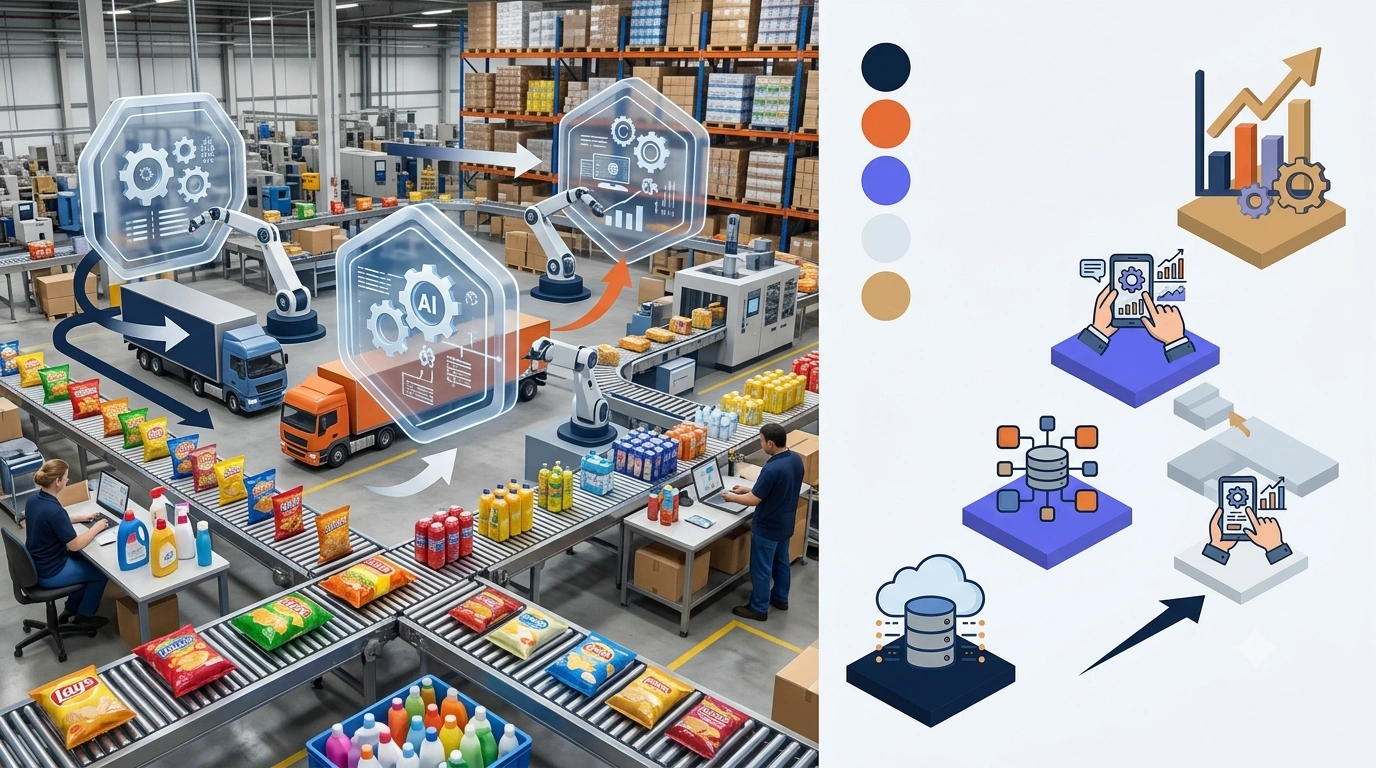
The FMCG sector is moving. Not in the direction of more pilots. In the direction of production.
Specialist AI agents built for inventory management, sales execution, and market planning are being deployed in live supply chain environments right now. That shift has specific implications for every FMCG technology leader who is still waiting for their first working AI system to clear internal approvals.
AI Navi provides fractional AI leadership for CP/FMCG and logistics companies. We have led AI inside $3B+ revenue businesses not as consultants, as operators. What we are seeing in the market in 2026 mirrors exactly what we built the Execute pillar of our methodology to address.
What Is Actually Happening in FMCG AI Deployment Right Now?
The market has crossed a threshold. FMCG companies are no longer evaluating AI. They are deploying it into operations that affect margin, inventory, and revenue.
According to StockTitan, RedCloud has announced plans to deploy three specialist AI agents for FMCG supply chains in H2 2026, with agents trained specifically for inventory management, sales, and market planning.
According to Retail Tech Innovation Hub, Retail Express is launching its Vanguard AI platform in 2026, projecting a 40% efficiency gain and a 5% promotional sales lift.
These are not pilot metrics. These are production targets from companies that have committed capital and delivery accountability to specific operational outcomes.
The use cases inventory, sales, planning — are not coincidental. They are the highest-friction, highest-cost areas of FMCG operations. That is exactly where AI creates measurable value quickly. And exactly where most internal AI projects stall.
Why Specialist Agents Outperform General AI Tools in Supply Chain
A general-purpose AI tool can summarise a demand forecast. A specialist agent can act on it.
The distinction matters for supply chain. FMCG operations run on interdependent data: sales velocity, promotional uplift, supplier lead times, shelf availability, route-to-market. A specialist agent trained on that data context — and connected to the systems that hold it — can flag a stockout risk before it becomes a lost sale. A generic tool cannot.
This is why the specialist agent model is gaining traction. It is not about the technology. It is about the specificity of training data and the tightness of system integration.
We have seen this directly. Inside a $3B+ CPG business, the commercial analytics work that moved the needle was never the broadest AI initiative. It was the most precisely scoped one — the agent that understood route-to-market data well enough to surface margin-affecting decisions before the weekly review.
Breadth does not produce production value. Specificity does.
What Stops FMCG Leaders From Deploying at This Level?
Most FMCG technology leaders are not short of AI ambition. They are short of one thing: a data engineering foundation that can actually support a specialist agent in production.
Here is the pattern we see repeatedly:
- The pilot worked in a sandboxed environment
- The data in production is fragmented, inconsistent, or siloed across legacy systems
- The vendor delivered a model. Nobody built the pipeline
- The agent cannot run without clean, connected, real-time data
- The project stalls. The board meeting happens. Nothing to show
This is not a technology failure. It is a sequencing failure.
Specialist AI agents for supply chain require three things before they deliver value:
- A defined operational use case — inventory, sales, or planning, not all three simultaneously
- A data engineering foundation — connected, cleaned, and accessible by the agent
- A production deployment path — not a demo environment, a live system with governance
Skip step two and the agent is a prototype. Permanently.
The Framework: How to Sequence Specialist Agent Deployment in FMCG
Deploying a specialist AI agent for supply chain is a sequencing problem, not a technology problem. The framework below reflects what we use inside our Execute pillar to move from concept to production in 30 days.
| Stage | What It Involves | Common Failure Point |
|---|---|---|
| Use Case Definition | Identify one operational pain point with measurable P&L impact | Scoping too broadly across multiple functions simultaneously |
| Data Audit | Map available data sources, identify gaps, assess pipeline readiness | Assuming clean data exists when it does not |
| Foundation Build | Connect data sources, build pipelines, establish agent training context | Treating this as a technology task rather than a business data task |
| Production Deployment | Deploy into live operational environment with governance layer | Launching in staging and never moving to production |
| Adoption & Measurement | Define success metrics, train users, establish feedback loop | Deploying without change management — agent goes unused |
The 40% efficiency gain projected by Retail Express and the specialist agent architecture from RedCloud both follow this logic. Defined scope. Connected data. Production deployment. Measurable outcome.
The companies that are still in pilot purgatory skipped the middle rows.
What Should FMCG Tech Leaders Do Before Deploying Specialist Agents?
Start with the use case that has the clearest P&L line.
Inventory management, promotional planning, and sales execution each have measurable cost or revenue implications. The right starting point is whichever one your board is already asking about in quarterly reviews. That alignment matters — not because it is politically convenient, but because it ensures the agent's output connects to a decision someone is already trying to make.
Before selecting a vendor or a platform, answer three questions:
- What data does this agent need to function — and do we have it in a usable state?
- Who owns the operational decision this agent will inform — and are they involved in the build?
- What does success look like in 90 days, in language the board can verify?
If you cannot answer all three clearly, the agent will not make it to production. The platform is not the problem. The preparation is.
We ran this diagnostic inside a logistics business earlier this year. The team had selected a vendor, agreed a budget, and were six weeks from deployment. The data audit revealed three critical pipeline gaps that would have surfaced in production and stalled the entire initiative. We rebuilt the sequence. The agent launched on schedule. The gaps became a feature of the delivery story, not a crisis.
Is the FMCG Sector Ready for Specialist AI Agents at Scale?
The deployments from RedCloud and Retail Express suggest the market has already answered this question.
The sector is ready. The question is whether your specific organisation is.
Readiness is not about AI maturity in the abstract. It is about whether your data infrastructure can support a specialist agent in a live operational environment. Most $500M–$2B FMCG businesses have the data. It is fragmented, not absent. The work is integration and sequencing, not collection.
The companies deploying successfully in 2026 are not the ones with the most sophisticated AI strategies. They are the ones that started with one specific use case, built the data foundation first, and held a vendor accountable to production — not prototype.
That is a delivery discipline. It is learnable. And it is exactly what separates the businesses showing board results from the ones still explaining why the pilot never scaled.
Where to Start
If you are a FMCG technology leader with AI investment and no production results, the next step is not another strategy session.
It is a data and use case audit — a clear view of what you have, what is missing, and what can realistically reach production in 30 days.
Our AI FlightCheck™ diagnostic does exactly that. $4,500. Two weeks. A clear delivery roadmap — not a slide deck.
Book a conversation with our team to find out whether your organisation is deployment-ready.