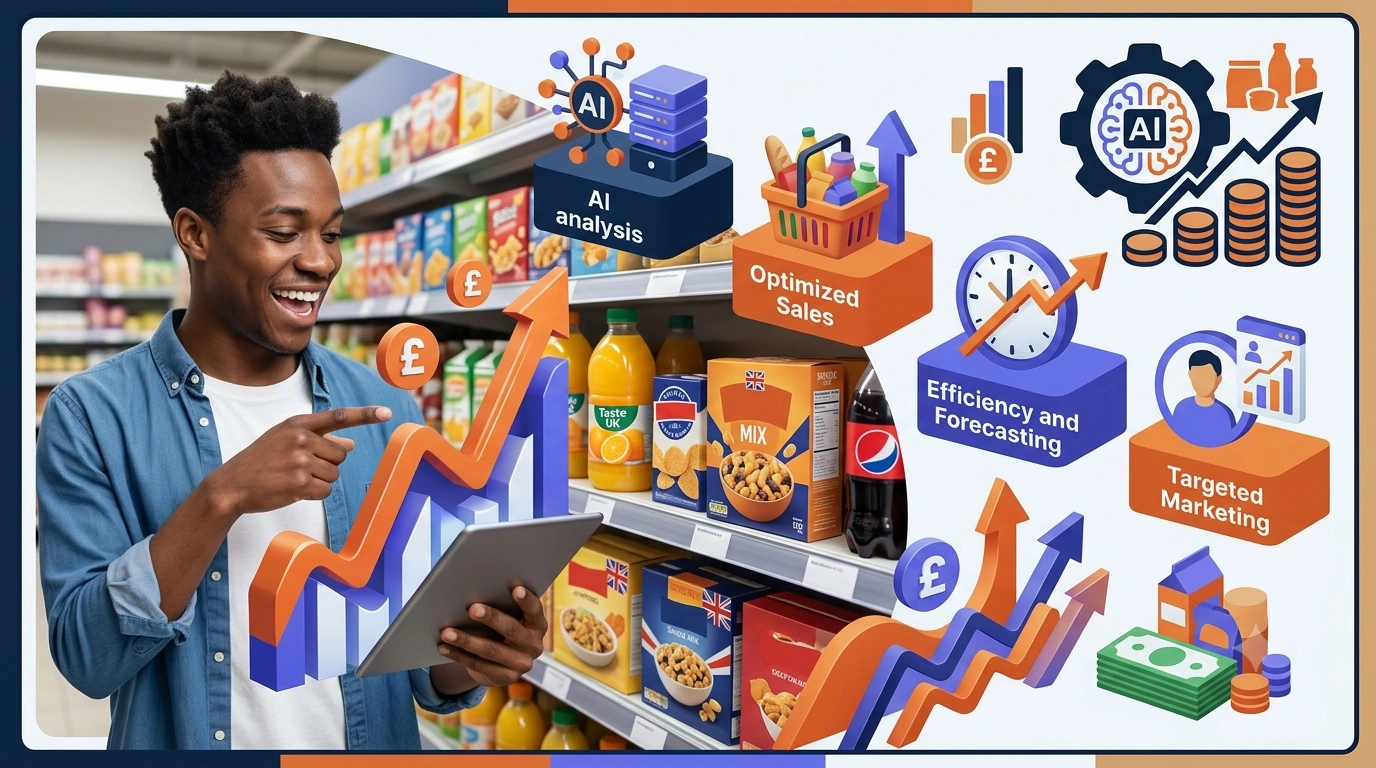
The M&S result has changed one thing inside UK CPG boardrooms: there is now a named UK retailer attached to a specific sterling figure. That matters because most AI ROI claims circulate as percentages with no absolute number. A specific sterling figure is different. It is something a CFO can hold.
This article sets out what M&S actually did, why the logic scales to mid-market food and drink businesses, and what the AI Navi team consistently sees as the obstacle between ambition and production results.
What did M&S actually do with AI, and why does it matter for UK food brands?
The M&S result was not a single AI product. It was data segmentation paired with AI-generated language personalisation applied to commercial communications. Real-time audience signals were matched to segments and delivered through copy that adapted to the reader. According to a LinkedIn analysis of the M&S case by brand strategist Chloe Edwards, the 20 to 34 per cent lift in conversion rates came from removing one-size-fits-all messaging.
The core logic is not new. What has changed is cost and speed. AI has made this approach executable at a price and pace that mid-market businesses can reach, provided there is someone accountable for connecting the commercial problem to the right approach.
A £50 million food brand with 60,000 active trade and direct-to-consumer customers is sitting on the same structural opportunity: segmented data, differentiated messaging, measurable conversion lift. The constraint is not the technology. It is ownership.
Why is your board asking about AI revenue results right now?
Board pressure for AI results has been building throughout 2026, but concrete UK revenue benchmarks have been rare. Most AI ROI claims in CPG circulate as percentages with no absolute figure attached. A named UK retailer attaching a specific sterling figure to an AI programme changes that conversation permanently.
When PE-backed boards or non-executive directors see a result like this, the question that follows is not whether it is possible. It is why it is not happening inside their business.
The honest answer is almost never that the technology is out of reach. It is that nobody owns the problem end-to-end. A Commercial Director does not have the data engineering resource. The IT team does not have the commercial context. The AI vendor under evaluation has never sat inside a CPG business at month-end when case fill rate is the only thing anyone cares about.
That is the ownership gap. And it is the gap that stalls most mid-market AI programmes before they produce a single usable result.
UK FMCG data is unambiguous on this point: 84 per cent of UK FMCG leaders say they need to move faster on AI. Only 3 per cent have reached full deployment. The bottleneck is not technology. It is ownership.
What does AI personalisation actually require at mid-market scale?
Before reaching revenue, four questions need honest answers.
Do you have usable data?
Not clean, not perfect -- usable. Most mid-market CPG businesses have more usable data than they realise, spread across their ERP, their CRM, and their retailer portals. The challenge is connecting it, not collecting more of it.
Is your commercial problem specific enough?
Personalisation is not a strategy. "Increase conversion on our DTC email programme" is a strategy. "Reduce trade deduction disputes by surfacing account-level risk signals before month-end" is a strategy. The more bounded the problem, the faster AI produces a result worth measuring.
Who is accountable for the output?
AI tools do not own outcomes. People do. If no senior operator has P&L accountability for the AI programme, not just oversight but actual accountability, the programme will drift toward outputs that look good on slides and away from results that move EBITDA.
Can you run a 30-day test?
You do not need a platform, a data lake, or a restructured team. You need clean enough data on one commercial problem, someone who knows how to build the right thing quickly, and a metric agreed on before you start.
How does the M&S benchmark compare with mid-market CPG reality?
The M&S number is a useful anchor. It is not a blueprint. The customer base, channel mix, and data infrastructure are different in scale. The underlying logic, however, scales down cleanly.
| Element | M&S Context | Mid-Market CPG Reality |
| Data foundation | Retail loyalty plus real-time signals | ERP, CRM, retailer portals -- connected but not unified |
| AI application | Language personalisation at segment level | Account-level messaging, trade spend targeting, demand signal scoring |
| Commercial problem | Consumer conversion rate | Trade deduction recovery, DTC reactivation, promotional ROI |
| Ownership model | Internal AI team | Fractional AI leadership with embedded delivery |
| Time to first result | Not disclosed | 30 days to working prototype, 90 days to production |
| Investment threshold | Enterprise budget | Fixed pricing comparable to AI audits at $5,000 to $10,000 in the market |
AI Navi Insight: what the Flight Risk Index reveals about UK food and drink businesses
AI NAVI INSIGHT The M&S case confirms the revenue opportunity is real. What the Flight Risk Index reveals is that the distance from where most UK mid-market businesses are today to a board-ready result is shorter than they think. The primary obstacle is not technology. |
For an initial view of where your business sits on the SCALE AI dimensions, the AI Readiness Scorecard takes ten minutes and produces a structured starting point.
Is your business ready to move on AI personalisation?
Most mid-market CPG businesses are closer to ready than they think, and further from execution than they want to admit.
A direct self-assessment:
- You have at least one commercial problem where better use of existing data would move a metric you care about.
- Your ERP and CRM data is accessible, even if it is not unified.
- You have a Commercial Director or COO who would own the outcome, not just the initiative.
- You are willing to agree on a metric before you start, not after.
- You can approve an initial diagnostic below your committee sign-off threshold.
- Your board is already asking questions that the M&S number has put into circulation.
If four or more of those are true, you are not waiting on readiness. You are waiting on ownership.
The AI Navi team works with UK food and drink businesses in the £40 million to £500 million revenue range to identify the commercial problem most likely to produce a measurable result within 30 to 90 days. The right starting point is an AI FlightCheck: a fixed-price diagnostic that takes two to four weeks, produces a 15-page assessment, and delivers a Flight Risk Index score and a 90-day action plan. It is priced comparably to AI audits at $5,000 to $10,000 in the market, and below the threshold that triggers a procurement committee.
Frequently asked questions
What did M&S use AI for to generate £6.5 million in extra revenue?
Marks and Spencer used real-time data segmentation and AI-generated language personalisation applied to commercial communications. According to a LinkedIn analysis of the case, the result was a 20 to 34 per cent lift in conversion rates, producing £6.5 million in incremental annual revenue.
Can mid-market UK food brands replicate AI personalisation results?
The underlying logic scales. A mid-market UK food or drink business with accessible ERP and CRM data, a specific commercial problem, and clear senior ownership can run a bounded AI test within 30 days. Enterprise infrastructure and an enterprise budget are not prerequisites.
What is the biggest barrier to AI revenue results in UK mid-market CPG?
According to AI Navi FlightCheck diagnostics, the most consistent barrier is the ownership gap: no senior operator with P&L accountability for the AI programme. Leadership scores an average of 18 per cent readiness on the SCALE AI framework across mid-market CPG businesses, lower than any technology dimension. This is the primary reason most mid-market AI programmes stall before they produce a result.
How long does it take to see AI revenue results in a food and drink business?
Working results in production typically take 30 to 90 days for a bounded commercial problem with accessible data. The AI FlightCheck diagnostic takes two to four weeks and produces a Flight Risk Index score and a prioritised 90-day action plan as the starting point.
What is an AI FlightCheck and what does it include?
The AI FlightCheck is a fixed-price diagnostic from AI Navi that takes two to four weeks. It produces a 15-page assessment of your specific situation, a Flight Risk Index score across the five SCALE AI dimensions, and a 90-day action plan you can take into your next board review. It is priced comparably to AI audits at $5,000 to $10,000 in the market.
What if our board is already asking about AI ROI?
A board already asking about AI ROI is ahead of most mid-market peers. The AI FlightCheck converts that question into a specific, evidenced answer: where your business sits on the SCALE AI framework, what your Flight Risk Index score is, and which commercial problem is most likely to move first. Separately, the AI Readiness Scorecard provides a ten-minute initial diagnostic that can be run before committing to a full FlightCheck.