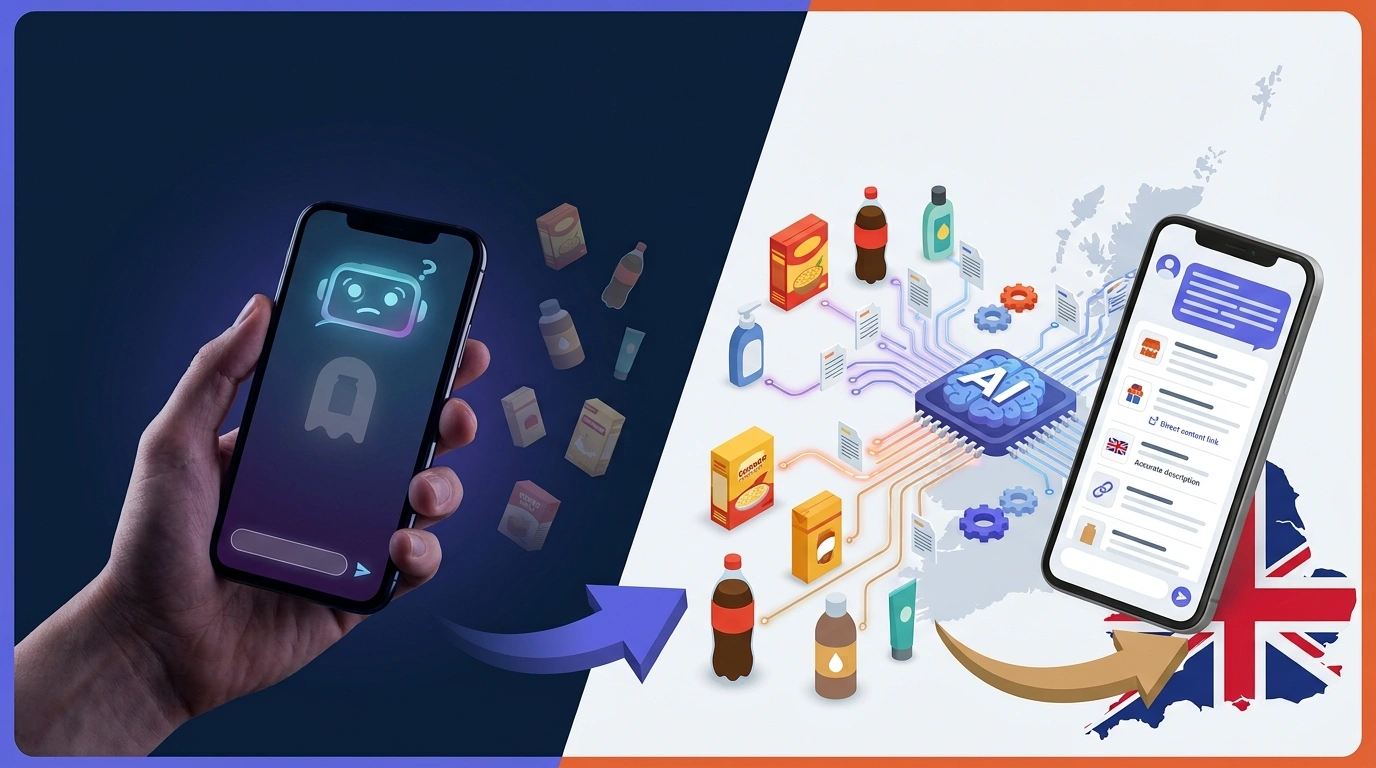
A shopper asks ChatGPT to recommend a hand cream, a protein bar, or a laundry detergent. Your brand has been on supermarket shelves for twenty years. It doesn't get mentioned.
This is happening today, at scale, to some of the biggest names in CPG and almost no one in UK mid-market FMCG is watching for it yet.
The CPG citation gap is already here
A 2026 audit of how large consumer brands appear across AI answer engines found some uncomfortable numbers for household names. Unilever's heritage portfolio, in particular, barely registers: Vaseline appeared in just 8% of relevant AI answers, Hellmann's 8%, Lipton 12%, TRESemmé 18% (Everything PR's CPG Citation Index).
Compare that to Dove at 68%, Neutrogena at 85%, and P&G's Tide and Gillette both above 80%. The difference isn't shelf space or ad spend it's whether the brand has built the kind of structured, third-party-verified, clinically or functionally specific content that answer engines trust enough to cite. As the report puts it, "AI search doesn't weight shelf space." Retail dominance built over decades of trade marketing counts for very little in a ChatGPT answer.
If that's true for global giants with entire content and PR functions behind them, it's a far bigger risk for UK mid-market CPG and FMCG brands with a fraction of the resource and it's a risk almost no one is measuring yet.
What AEO actually means (and how it's different from SEO)
Answer Engine Optimization (AEO) sometimes called Generative Engine Optimization (GEO) is the practice of structuring your brand's content and third-party presence so that large language models and AI answer engines (ChatGPT, Perplexity, Google AI Overviews, Gemini) select, trust and cite it when generating an answer.
It overlaps with SEO but the mechanics are different. Traditional SEO optimizes for a ranked list of blue links a human scans. AEO optimizes for being one of a handful of sources an LLM synthesizes into a single conversational answer where there's no page two, and where the model is weighing signals like source authority, consistency across the web, structured data, and third-party corroboration (reviews, forums, retailer listings) far more heavily than backlinks alone (HubSpot: Answer Engine Optimization trends in 2026; Jasper: GEO vs AEO vs SEO).
Worth being precise about scope here: this is a different problem from agentic commerce readiness, which we covered in Is Your CPG Brand "Agent-Ready"?. That piece is about whether AI shopping agents can read your product data well enough to complete a transaction pricing feeds, GS1-standard product data, real-time inventory APIs. AEO is about something upstream of that: whether your brand gets mentioned at all when a consumer asks an AI tool an informational or comparison question. You can have perfect transactional data and still be invisible in the conversation that leads a shopper to consider you in the first place.
How answer engines decide who to cite
Based on current research into what drives AI citation rates, five factors consistently separate visible brands from invisible ones (Everything PR CPG Citation Index; Sapt: AI Search Optimization Guide):
- Specific, verifiable positioning. Brands with a clear, defensible claim (Dove's dermatology credentials, Neutrogena's clinical positioning) get cited 15–40 percentage points more often than brands leaning on generic lifestyle or heritage messaging.
- Third-party review density. Deep, verified review infrastructure (Amazon reviews in the tens of thousands, for example) gives models a corroborating signal they can point to.
- Community and earned-media presence. Mentions on Reddit, YouTube and independent publications carry more weight with LLMs than owned brand content alone.
- Portfolio and category breadth. Brands present across multiple price tiers and use cases show up more consistently across different query types.
- Structured, consistent data. The same product facts, claims and specifications need to be consistent everywhere they appear online your own site, retailer listings, review platforms because inconsistency reads as unreliability to a model.
Self-diagnostic: 5 signs your CPG brand is already invisible in AI search
- You've never actually asked ChatGPT, Perplexity or Copilot to recommend a product in your category and checked whether you appear.
- Your product pages lead with brand heritage or lifestyle imagery rather than a specific, verifiable claim (ingredient, clinical result, certification, comparison).
- Your review volume and depth on major retailers and Amazon lags category leaders.
- Nobody owns "AI visibility" internally it sits in the gap between brand marketing, digital, and IT.
- Your EU AI Act and governance work (see Does the EU AI Act Apply to Your UK Business?) is further along than your AI visibility work most mid-market CPG teams are further ahead on AI compliance than on AI discoverability.
If two or more of those are true, there's a reasonable chance your brand is quietly losing consideration in a channel that didn't exist for marketers eighteen months ago.
A practical AEO action plan
1. Audit before you act. Run your top 15–20 category and comparison queries through ChatGPT, Perplexity and Google AI Overviews and log whether, and how, your brand appears. This is the AI-search equivalent of the diagnostic step in our AI FlightCheck framework you can't fix visibility you haven't measured.
2. Rebuild content around specific, citable claims. Replace generic brand copy with content structured around the question a model is trying to answer: ingredient function, clinical or performance data, direct comparisons, certifications. Answer engines favor content that reads like a confident, sourced answer not an ad.
3. Fix structured data and cross-platform consistency. Product specs, claims and positioning need to match, word-for-word where possible, across your own site, retailer pages and marketplaces. This is the same data-quality discipline behind agentic commerce readiness see our guide to making product data agent-ready and the two workstreams should be planned together rather than run as separate projects.
4. Invest deliberately in third-party corroboration. Prioritise review generation, category forum presence (Reddit, specialist communities) and earned media over paid placements these are the signals current research shows LLMs weight most heavily.
5. Monitor on a cadence, not a one-off. AI answer engines update their retrieval and ranking behaviour constantly. Treat AI visibility like a board-level metric with a monthly check, not a project with an end date.
Why this belongs on the board agenda, not just the marketing plan
We've written before about how to present AI ROI to your board the same discipline applies here. AI visibility isn't a nice-to-have marketing metric; if a growing share of category research and product discovery happens inside an AI conversation, invisibility there is a direct, quantifiable revenue risk, in the same way stockout or delisting risk would be. Frame it that way and it earns the budget and cross-functional ownership it needs.
For most UK mid-market CPG and FMCG teams, the starting point isn't a full AEO programme it's a two-week audit to find out where you actually stand. If you want help running that audit, get in touch to book a call or start with our AI Readiness Scorecard.
Related reading: Is Your CPG Brand "Agent-Ready"? · How to Present AI ROI to Your Board · Does the EU AI Act Apply to Your UK Business?