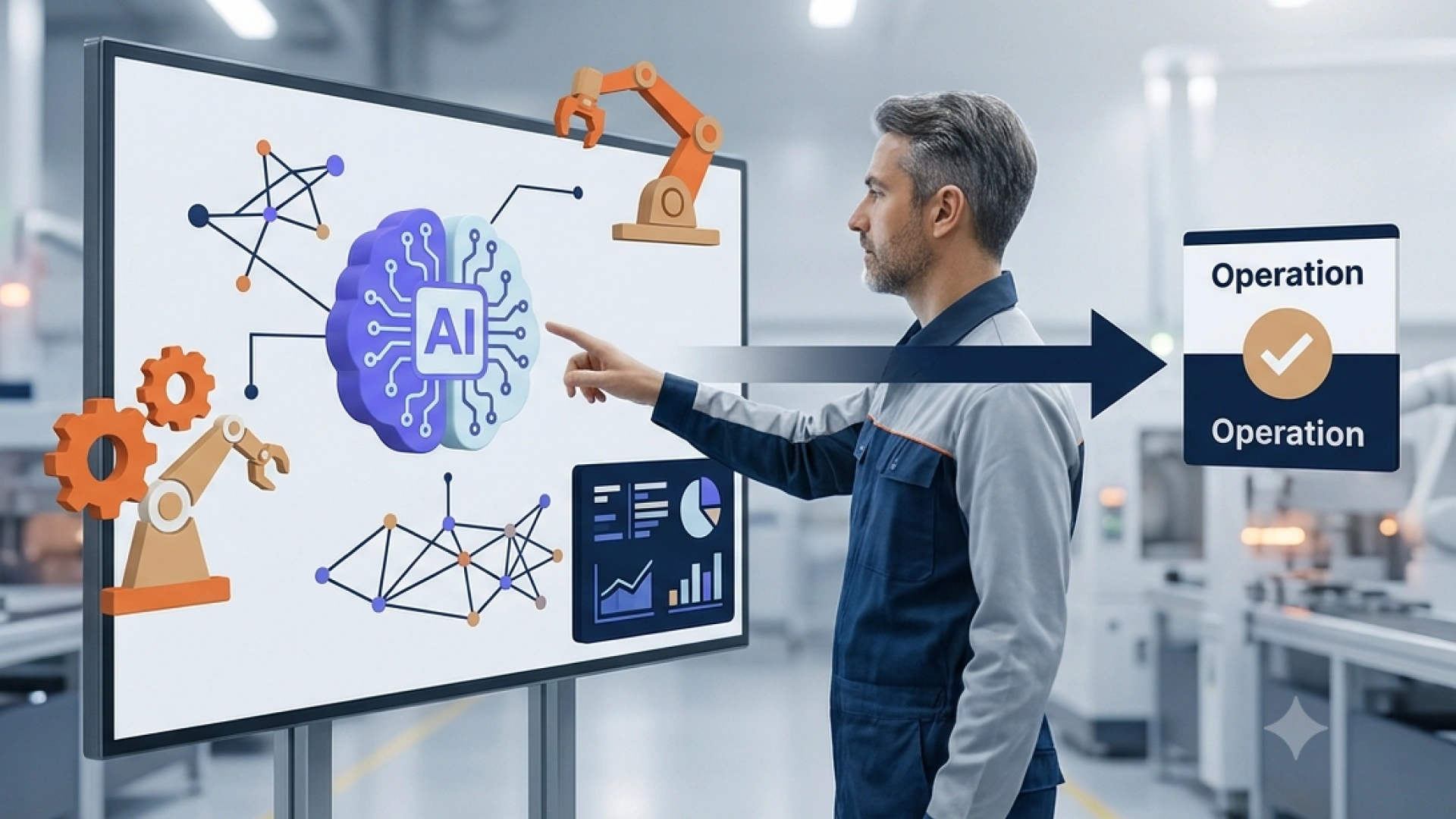
| Operationalising AI means embedding it in daily workflows so it produces measurable output without a consultant in the room. It is not the same as installing a tool. In 2026, the line separating UK mid-market CPG businesses that gain margin from AI and those still searching for a use case is operationalisation, not technology. |
The shelf life of a promising AI pilot is shorter than most operations directors expect. A vendor is approved, the demos are watched, the data team is given three months, and a proof of concept reaches a board review. Then it is quietly shelved when no one can explain how it runs inside Monday's S&OP cycle.
AI Navi sees this pattern across UK mid-market consumer goods and logistics businesses, typically £40M to £500M in revenue, and it is the pattern that now separates the firms gaining margin from AI from those still hunting for a use case worth funding. AI Navi embeds inside these businesses as a fractional Chief AI Officer and ships working AI into production. Not strategy decks. Not frameworks. Production.
What does operationalising AI actually mean in a manufacturing context?
Operationalising AI means the system is embedded in daily workflows, producing measurable output, and running without a consultant in the room. It is not the same as having AI available.
Most mid-market manufacturers have AI available in some form: a demand forecasting tool someone evaluated, an analytics dashboard checked occasionally, a pilot that ran for 90 days and produced a report. None of that is operationalised AI. Operationalised AI changes what the commercial team does on Tuesday morning.
This distinction is the central manufacturing question of 2026. Deloitte's 2026 Manufacturing Industry Outlook frames the move from agentic AI pilots to full-scale implementation as a trend likely to accelerate through the year. The challenge is no longer installation. It is operationalisation.
Why do so many AI programmes stall between pilot and production?
The stall happens at the handover point, and there is almost always a handover point that nobody owns.
The pattern is consistent across UK food and drink businesses. A vendor wins the pilot and builds something that works under controlled conditions. The pilot produces credible results. Then the vendor exits. The internal team inherits a system it did not build, connected to data pipelines it does not fully understand, designed to answer questions that may already have shifted.
No one is accountable for making it run. No one has the authority to prioritise the data engineering work it needs. No one bridges the gap between what the tool can do and what the commercial team will actually use. That is the ownership gap, and it is why so many programmes stop short of production. AI Navi sets out the mechanics of this failure mode in its analysis of why AI pilots never reach production.
Big consultancies install frameworks and leave. Permanent hires spend six months learning the business before they can make a decision. Neither reliably ships AI into production inside a commercial timeline. McKinsey's State of AI reports that while most organisations now use AI in at least one function, roughly two-thirds have not begun to scale it across the enterprise. The gap between use and scale is an ownership and workflow gap, not a technology one.
What does the difference look like in practice?
Most businesses think they are further along the operationalisation curve than they are. The four stages below show where the work actually stops.
| Stage | What it looks like | Who owns it | Output |
|---|---|---|---|
| Evaluation | Vendor demos, RFP process, internal debate about tools | IT / Procurement | Shortlist |
| Pilot | Proof of concept, controlled data set, board presentation | Vendor and data team | Report |
| Installation | Tool is live, accessible, technically deployed | IT | Access |
| Operationalisation | AI runs inside daily workflows, outputs drive decisions, the team uses it without prompting | Operational owner with P&L accountability | Measurable business outcome |
The gap between installation and operationalisation is where most mid-market CPG programmes stop. The tool is live. No one uses it consistently. No one is accountable for the output. Three months later it is described as not quite right for us. Operationalisation requires someone who sits at the intersection of the technical build and the commercial workflow, with the authority to make both sides move.
AI Navi Insight: what does operationalised AI actually produce?
FROM THE FLIGHTCHECK FILES AI Navi has shipped a working AI prototype in five days for a talent matching application, because the team solves a bounded problem rather than boiling the ocean. And across mid-market CPG businesses AI Navi has assessed, manual S&OP corrections cost an average of 12% in forecasting accuracy, a direct and recoverable margin leak that operationalised demand AI is built to close. The pattern is consistent. The output arrives when someone owns the workflow change, not just the tool. |
How do you move AI from pilot to production?
The answer is not a better vendor or a larger data team. It is a defined method for moving AI from evaluation to embedded workflow, and a named individual who carries that accountability. AI Navi runs its SCALE AI implementation approach in three phases.
Navigate: set the priority before the tool. Most pilots fail because the problem was chosen by the vendor, not the business. AI Navi starts by identifying the specific bounded commercial problem where AI will move a number someone reviews each week: a deductions process, a demand signal, a trade spend decision. Narrow, high value, and tied to a metric the board already watches.
Execute: build on existing data and systems. No new platforms. No data lakes. No team restructures. AI Navi works with the data the business already has and the systems already running. A working prototype in the right environment in under 30 days is realistic, because the team is solving a bounded problem.
Land: change the workflow, not just the tool. This is the step that gets skipped. Landing means the commercial team uses the AI output in its daily process without being asked. The S&OP meeting references the demand signal. The finance team acts on the deduction flag. AI Navi runs this phase inside the business until the behaviour change is durable.
How do you know if your AI programme is at risk of stalling?
The AI FlightCheck diagnostic was built to answer exactly this. In two to four weeks it produces a 15-page assessment and a Flight Risk Index score: a single number showing how close a programme is to operational stall. Comparable AI audits in the market are typically priced at $5,000 to $10,000.
The questions it answers are operational, not technical:
- Who owns this programme when the vendor leaves?
- Is the problem being solved tied to a commercial metric reviewed at board level?
- Does the data feeding the system reflect how the business actually operates today?
- Can the team that will use the output describe how it changes their daily process?
- What is the 90-day production plan?
A business that cannot answer at least four of these clearly is at risk of stalling, regardless of how strong the pilot results looked. Leaders can get an early read with the free AI Readiness Scorecard.
Where does this leave mid-market CPG leaders in 2026?
If the board is asking for AI results and the answer involves the word pilot, the clock is running. The 2026 line between businesses with AI embedded in production and those still in evaluation is a commercial line. It shows up in demand forecasting accuracy, in deduction recovery rates, in trade spend decisions made with better information. It shows up in margin.
Against a backdrop where 84% of UK FMCG leaders say they need to move faster on AI while only 3% have reached full deployment, and where average AI confidence in UK mid-market CPG sits at 4.1 out of 10, the businesses that move are not the ones with the most sophisticated AI. They are the ones where someone owns the gap between tool and workflow, holds a production timeline, and has the authority to clear the obstacles in between.
The fractional CAIO model exists because mid-market businesses do not need a full-time executive to operationalise one or two high-value AI applications. They need a senior operator who has done this inside businesses like theirs, can ship in 30 days, and holds P&L accountability for the outcome. That is the role AI Navi fills as a fractional Chief AI Officer.
Frequently asked questions
What is the difference between installing AI and operationalising AI?
Installing AI means the tool is live and technically deployed. Operationalising AI means it runs inside daily workflows, produces measurable output, and is used by the team without prompting. Most mid-market CPG programmes stall in the gap between the two.
How long does it take to move an AI pilot into production?
With a bounded problem and the data the business already holds, a working prototype can be in the right environment in under 30 days. AI Navi has delivered one in five days for a talent matching application. The longer task is landing the workflow change so the output is used by default.
Why do most AI pilots in FMCG fail to scale?
They fail at the handover point. The vendor builds the pilot and exits, leaving an internal team to run a system it did not build, with no clear owner, no authority over the data work, and no bridge to the commercial workflow. This ownership gap, not the technology, is the usual cause.
What is a Flight Risk Index?
It is AI Navi's proprietary score of how close an AI programme is to operational stall. For one £400M CPG client it dropped from 7.2 to 4.1 within 60 days after a single data pipeline project.
Does operationalising AI require a new platform or a data lake?
No. AI Navi builds on the data and systems a business already runs. The constraint is rarely missing technology. It is missing ownership of the workflow change.
What does an AI FlightCheck include?
A two to four week diagnostic producing a 15-page assessment, a Flight Risk Index score, and a 90-day action plan. It is comparable to market AI audits priced at $5,000 to $10,000.
| The AI FlightCheck is the starting point for any leader who wants to know where a programme sits on the operationalisation curve. Fixed scope. Two to four weeks. A clear answer. Start with the AI FlightCheck at ainavi.co.uk, or take the free AI Readiness Scorecard first. |