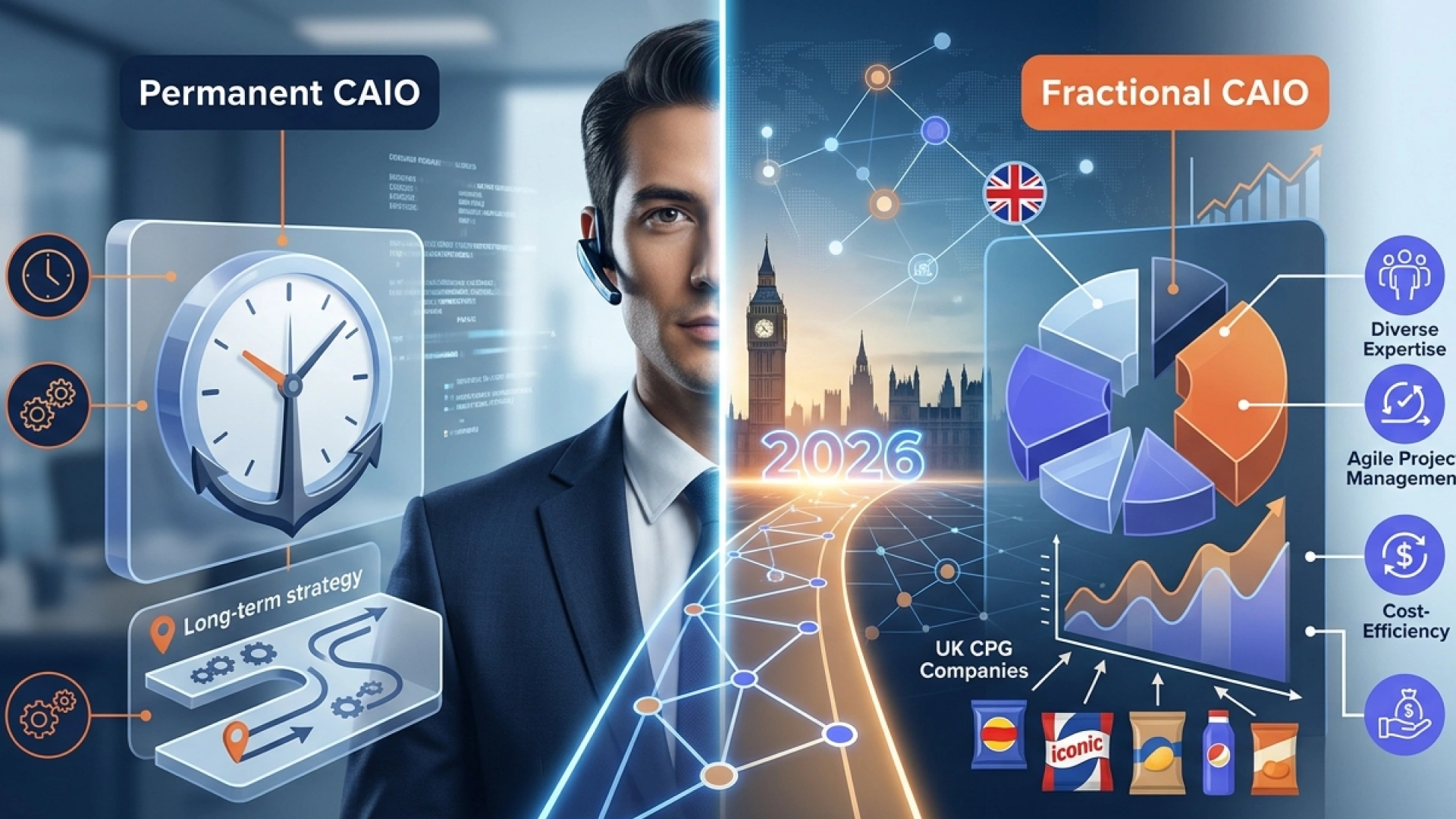
The average mid-market CPG business spends months recruiting a permanent Chief AI Officer. By the time that person has learned the ERP, met the commercial team and written a first strategy document, faster competitors have already shipped working AI.
That is the problem with the permanent CAIO model in 2026. The ownership the role represents is critical. The way most mid-market businesses have tried to fill it is costing them margin, momentum and board credibility at the same time.
AI Navi works with UK mid-market consumer goods and logistics businesses, led by Haja J Deen, a fractional CAIO with 25 years in digital and operational change at businesses including pladis Global ($3B+ CPG), Holland & Barrett and Toyota, alongside data and AI delivery lead Abhishek C, formerly of Deloitte and trusted by Cargill, DPD and Swinkels Family Brewers. The pattern they see is consistent: hiring senior AI leadership on a permanent basis rarely fits how a £50M to £500M consumer goods business actually works.
Does a mid-market CPG business need a permanent CAIO?
Usually not. The commercial problems AI solves in mid-market CPG are bounded. These businesses are not running hyperscalers. They need AI that sharpens demand forecasting, recovers margin from deductions and reduces manual process cost. That is a deployment problem, not an empire to build.
The case for a permanent hire usually rests on three assumptions: that the business needs full-time strategic ownership, that the leader must be embedded in the culture, and that continuity drives better outcomes. All three are reasonable on paper. Few hold up against the operational reality of a £40M to £100M food or drink business, where the AI agenda is a defined set of P&L problems rather than a standing department.
Consider the wider market. 84% of UK FMCG leaders say they need to move faster on AI, yet only 3% have reached full deployment. The gap is rarely technology or even skills. McKinsey’s State of AI research finds workflow redesign, not model choice, is the strongest predictor of whether AI delivers value. The missing element is ownership: a senior operator with the authority and accountability to take one problem and ship a working answer.
What does a fractional CAIO actually do?
A fractional CAIO gives a business senior operator time allocated to its specific AI problems, without the overhead of a full-time executive who needs a team, a budget cycle and months of internal political capital before acting.
In practice that means arriving with a structured diagnostic (AI Navi runs the AI FlightCheck™), a clear read on where the data is actually usable, and a prioritised set of problems AI can solve inside existing systems. No platform migrations. No data lake projects. No restructures.
The first valuable AI application is almost always in plain sight. The commercial team already knows which deductions go unchallenged. The supply chain team already knows where forecasting breaks every promotional period; manual S&OP corrections cost an average of 12% forecasting accuracy across the mid-market CPG businesses AI Navi has assessed. The data exists. What is missing is someone with both the authority and the technical capability to close the loop.
Permanent CAIO vs fractional CAIO: how do they compare?
The honest comparison is not about price. It is about how quickly a business reaches a working result, and who carries accountability for it.
| Model | Time to first working AI | Sector depth | Accountable for |
|---|---|---|---|
| Permanent CAIO | Commonly 9 to 15 months to full P&L accountability | Variable, often technology-first | Building and running a function |
| Large consultancy | 6 to 12 months, then the senior team leaves | Framework-level, not operational | The deliverable, not the outcome |
| Fractional CAIO | First working system in production, commonly 6 to 8 weeks | Embedded CPG operator experience | The outcome, against your P&L |
For a full cost breakdown by model, see AI Navi’s guide to what a fractional Chief AI Officer costs in the UK
A permanent, credible CAIO with genuine CPG operator experience commonly takes several months to hire and several more to onboard before making decisions with real P&L accountability. UK executive recruitment listings in 2026 place CAIO base salaries in roughly the £150,000 to £250,000 range plus benefits, before counting the months spent waiting for output. Meanwhile, the board has been asking about AI results for two years.
The fractional model is not a budget version of the permanent role. It is a different model, built around deployment speed, bounded scope and accountability for outcomes rather than activity.
Why can't a traditional consultancy fill this gap?
The consultancy model is built to produce artefacts: assessments, roadmaps, frameworks, recommendations. Those have value. They also have a structural problem. The people who write them are usually not the people who stay to implement them, and almost never the people who live with the consequences if implementation fails. The expertise and the execution are separated by design.
A fractional CAIO carries both. Strategy and implementation live in the same person, accountable to the same P&L outcome. It also closes a gap consultancies rarely own: ILX Group research found 46% of organisations treat change management as a “nice to have”, which is one of the most common reasons AI programmes stall after the slide deck is delivered. AI Navi covers the decision-making difference in more depth in its comparison of fractional leadership and traditional AI consultancies,
How do you know if the fractional model is right for your business?
A quick self-assessment. If more than three of these are true, the permanent hire is probably the wrong structure for where the business is now:
- The board is asking for AI results, but the programme is still in planning or pilot
- Data teams are one analyst deep and already stretched
- At least one AI initiative has stalled on unclear ownership
- The commercial or supply chain problems are specific and bounded: deductions, forecasting, trade spend, carrier costs
- The business is under PE ownership or board pressure with quarterly accountability
- Something needs to be in production before the next board review
- What is needed is a senior operator to ship one thing that works, not a full-time executive to manage a team of ten
If that reads like the last leadership meeting, the fractional model is not a compromise. It is the right structure.
What should a CPG business expect in the first 90 days?
This is where the fractional model earns or loses credibility. A good fractional CAIO should be able to show three things inside 90 days:
- A clear Flight Risk score. An honest read on where the AI programme stands and what is likely to stall it. AI Navi uses the Flight Risk Index™. One £400M CPG client saw its score move from 7.2 to 4.1 in 60 days after a single data pipeline project. That number matters because it tells the board something specific rather than aspirational.
- One working AI application in production. Not a prototype, not a demo, not a proof of concept needing six months of productionisation. Something the team uses to make decisions. Across AI Navi builds, first working systems reach production in roughly six to eight weeks.
- A clear priority for what comes next. Based on where commercial pressure is highest and where the data is ready, not where AI looks most impressive in a presentation.
Not a programme of work. A working thing, a clear read on risk and a prioritised next step.
AI NAVI INSIGHT: FROM THE FLIGHTCHECK™ FILES Across UK mid-market CPG diagnostics, AI Navi’s SCALE AI™ benchmark shows Leadership scoring lowest of the five dimensions, at an average of 18% (against Strategy 32%, Capability 28%, Data Architecture 24% and Applied AI 21%). The average executive AI confidence score sits at 4.1 out of 10. The constraint is not ambition or tooling. It is senior ownership. The single £400M CPG data pipeline project that moved a Flight Risk Index™ from 7.2 to 4.1 in 60 days is what closing that ownership gap looks like in practice. |
The model is shifting, with or without you
The fractional CAIO model is not emerging because it is cheaper, though the economics are clear. It is emerging because AI deployment in mid-market businesses does not require, and cannot support, the organisational structure a permanent hire assumes.
A £60M food business does not need a full-time executive to own AI. It needs a senior operator with sector credibility, delivery capability and a structured method for turning specific commercial problems into working AI. Someone who has sat in that seat, knows what a buyer meeting looks like, knows what S&OP failure costs, and does not need six months to understand the business before making a decision.
If an AI programme has stalled, or has not started, or is producing decks instead of results, that is the gap. It is solvable.
AI Navi offers an AI FlightCheck™: a fixed-price, two to four week diagnostic giving a 15-page read on AI readiness, a Flight Risk Index™ score and a 90-day action plan. It costs £9,000 and fits inside most approval thresholds without a committee. For a business that wants to know where it stands before committing to anything larger, that is the place to start. Get in touch at ainavi.co.uk.
Frequently asked questions
What is a fractional Chief AI Officer?
A fractional Chief AI Officer is a senior AI leader who takes ownership of a company’s AI agenda on a part-time, ongoing basis. They provide the strategy and accountability of an executive hire while staying focused on a bounded set of commercial problems, typically delivering a first working system in weeks rather than months.
Do mid-market CPG companies need a full-time CAIO?
Most do not. AI problems in mid-market consumer goods are usually bounded (deductions, forecasting, trade spend, manual process cost) rather than open-ended. A fractional CAIO can own and deliver those without the cost and lead time of a permanent executive and the team that role assumes.
How long does it take to hire a permanent CAIO?
A credible permanent CAIO with genuine CPG operator experience commonly takes several months to recruit and several more to onboard before making decisions with full P&L accountability. In practice many businesses wait close to a year for meaningful output.
How much does a permanent CAIO cost in the UK?
UK executive recruitment listings in 2026 place Chief AI Officer base salaries in roughly the £150,000 to £250,000 range plus benefits and, in some cases, equity. That excludes the cost of the months spent before the role produces results. For a full model-by-model cost comparison, see AI Navi’s dedicated guide [internal link: cost page].
What is the difference between a fractional CAIO and a consultancy?
A consultancy typically delivers artefacts (assessments, roadmaps, recommendations) produced by people who do not stay to implement them. A fractional CAIO carries both strategy and execution in the same person, accountable to the same P&L outcome.
What does an AI FlightCheck™ involve?
The AI FlightCheck™ is a fixed-price, two to four week diagnostic for £9,000. It produces a 15-page read on AI readiness, a Flight Risk Index™ score and a 90-day action plan, sized to fit inside most procurement approval thresholds.
How quickly can a fractional CAIO deliver a working AI system?
Across AI Navi engagements, first working systems typically reach production in six to eight weeks, not as prototypes but as tools teams use to make decisions. One £400M CPG client’s Flight Risk Index™ improved from 7.2 to 4.1 within 60 days following a single data pipeline project.