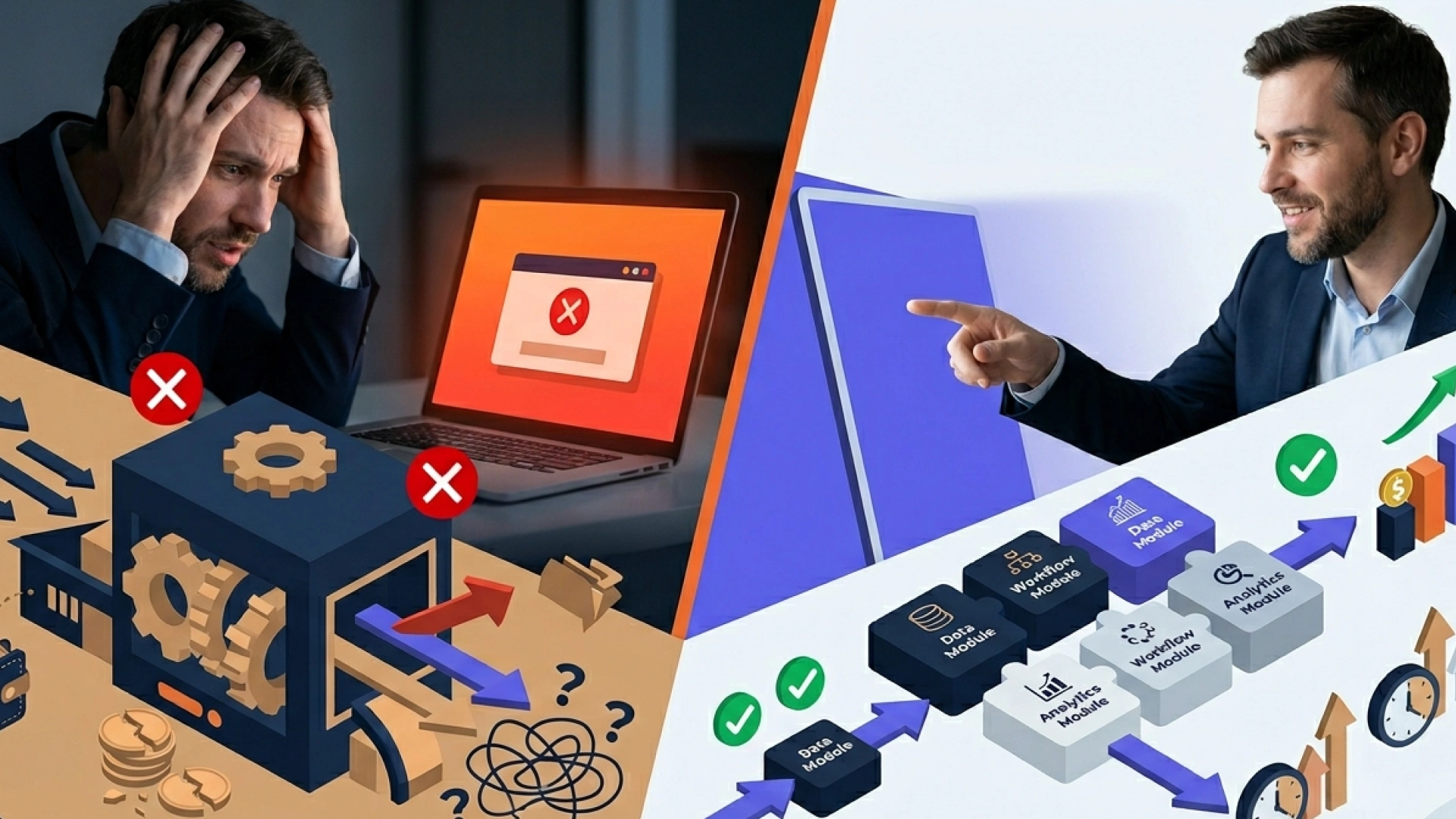
At AI Navi, we've watched countless teams get burned by the same promise: buy the platform, transform your business.
The pattern is predictable. Big tech vendors announce sweeping AI capabilities Microsoft's seven in-house AI models for 'long term self-sufficiency,' Amazon's Alexa+ expanding to web-based 'agentic, workflow-oriented AI.' The sales pitches follow. The procurement committees approve. Six months later, nothing meaningful has changed.
Meanwhile, your competitors are quietly applying AI to solve specific problems using their existing data. No platforms required.
Why Are Platform-Heavy AI Solutions Struggling to Deliver?
Platform-first AI initiatives fail because they solve vendor problems, not business problems.
The evidence is mounting. According to TechNewsWorld, AI PC adoption is slower than vendors hoped due to 'underpowered hardware, unclear messaging, and weak use-cases.' Organizations are being warned to 'avoid AI browsers for now' due to security risks.
This isn't surprising. I've seen it play out across five different food businesses where I've led digital transformation. The pattern is always the same:
- Vendor demos focus on what the platform can do, not what your business needs
- Implementation requires months of data migration and team training
- ROI calculations assume perfect adoption across departments
- Success depends on changing how people work, not solving how work gets done
The Real Cost of Platform Dependencies
When GeekWire reports that Microsoft is developing seven in-house AI models for 'long term self-sufficiency,' they're describing a vendor strategy, not a customer benefit.
Consider what 'self-sufficiency' means for your business:
| Platform Promise | Business Reality |
|---|---|
| "Unified AI ecosystem" | Vendor lock-in with switching costs |
| "Seamless integration" | Months of system restructuring |
| "Future-proof technology" | Dependency on vendor roadmap priorities |
| "Enterprise-grade security" | New attack vectors and compliance gaps |
A £400M food brand I worked with spent eight months implementing a major vendor's AI platform. Their Flight Risk Index™ our measure of AI implementation success actually increased from 5.8 to 7.2 during deployment. They were further from working AI, not closer.
What Happens When You Start With Data Instead of Platforms?
The alternative approach is deceptively simple: identify a specific business problem, apply AI to your existing data, measure the result.
Last year, we helped a £40M UK food brand recover unchallenged deductions. No platform purchase. No data migration. We used their existing ERP data and built a focused AI system that flagged suspicious deductions for manual review.
Result: 60% of unchallenged deductions recovered in eight weeks. Total technology investment: under £15K.
The difference wasn't the sophistication of the AI. It was the specificity of the problem and the immediacy of the data.
The 90-Day Transformation Model
Here's how problem-first AI deployment actually works:
Week 1-2: Problem Definition
- Map the specific operational pain point
- Quantify current cost in time or margin
- Identify existing data sources
- Set measurable success criteria
Week 3-8: Focused Development
- Build AI system using existing data infrastructure
- Test with small subset of real scenarios
- Refine based on operational feedback
- Train internal team on system management
Week 9-12: Production Deployment
- Roll out to full operational scope
- Measure impact against baseline
- Document process for internal capability
- Identify next bounded problem to solve
From the FlightCheck™ Files: what we see in UK mid-market CPG
AI Navi Insight Across the UK mid-market CPG businesses assessed through AI FlightCheck™ this year:
The pattern is consistent: the businesses that move fastest do not have the most ambitious platform roadmap. They have the most specific problem definition. |
How Do You Choose Between Platform Promises and Practical AI?
The decision framework is straightforward, but most businesses ask the wrong questions.
Wrong Questions That Lead to Platform Purchases:
- "What AI capabilities do we need?"
- "Which vendor has the most comprehensive solution?"
- "How do we future-proof our AI strategy?"
- "What platform integrates with our existing systems?"
Right Questions That Lead to Working AI:
- "Which specific business process costs us the most time or margin?"
- "What data do we already collect about this problem?"
- "How would we measure success in 90 days?"
- "Who internally would champion this solution?"
We use our SCALE AI™ methodology to help leadership teams focus on the right questions. The acronym stands for: Specific problem, Current data assessment, Adoption pathway, Learning objectives, Execution timeline.
Most platform evaluations skip the 'Specific problem' step entirely. They start with 'Current platform gaps' instead.
When Platforms Actually Make Sense
Platforms aren't always wrong. They make sense when:
- You've already solved 3-5 specific AI problems and need centralized management
- Your data infrastructure genuinely requires replacement regardless of AI
- You have dedicated technical teams with bandwidth for 6-month implementations
- Your competitive advantage comes from AI capabilities, not AI outcomes
But for most mid-market businesses, these conditions don't exist. You need AI that works with your current reality, not AI that requires a new reality.
What Does Success Look Like Without Platform Dependencies?
Real AI success in mid-market businesses looks different than vendor case studies suggest.
At a £400M FMCG client, we improved their Flight Risk Index™ from 7.2 to 4.1 in 60 days. Not through platform deployment, but through a single data pipeline project that solved their demand forecasting accuracy problem.
The project used existing sales data, existing planning processes, and existing team members. The AI component was specifically designed to enhance human judgment, not replace human processes.
Measurable Outcomes from Focused AI
Across the businesses I've worked with, problem-first AI consistently delivers:
- 80% reduction in manual research time (achieved through our SalesGenius.ai implementation)
- Working prototypes in 5 days (versus 5 months for platform rollouts)
- ROI measurement within first month (not first year)
- Internal capability building alongside external results
These outcomes happen because the AI solves real operational problems using real operational data. The technology serves the business process, not the other way around.
FAQ
What is the difference between platform-first and problem-first AI?
Platform-first AI starts with a vendor capability and looks for use cases to apply it. Problem-first AI starts with a quantified operational problem and applies the minimum technology required to solve it. For UK mid-market FMCG and logistics, problem-first deployment typically delivers measurable margin impact faster.
How long does problem-first AI take to deliver results in FMCG?
A focused problem-first AI system runs from definition to production in approximately 90 days using existing ERP and planning data. This is the standard FlightPath™ Sprint timeline.
What is the average AI confidence score for UK mid-market CPG businesses?
Across AI FlightCheck™ engagements assessed this year, the average AI confidence score for UK mid-market CPG leaders is 4.1 out of 10.
Is enterprise AI software worth it for a £100M to £500M FMCG business?
For most businesses in that band, the first three AI systems should be problem-first and built on existing data. A platform decision becomes appropriate once three to five focused systems are in production and centralised management becomes the operational bottleneck.
What does an AI FlightCheck™ assessment cost?
The AI FlightCheck™ is priced below £9,000 fixed. It delivers a 15-page diagnostic, a Flight Risk Index™ score, and a 90-day action plan, typically over two to four weeks.
Your Next Step: Problem-First AI Assessment
If your business has been evaluating AI platforms, step back and evaluate AI problems instead.
Start with our AI FlightCheck™ diagnostic. It's a £9K fixed-price assessment that identifies your three highest-impact AI opportunities using your existing data infrastructure. No platform requirements. No vendor dependencies.
The assessment includes:
- Flight Risk Index™ scoring of your current AI readiness
- Three specific problem areas ranked by margin impact
- 90-day action plan with conservative ROI projections
- Technology requirements that work with your existing systems
While big tech vendors chase self-sufficiency through platform complexity, mid-market businesses achieve AI success through problem specificity. The businesses that figure this out first will have a significant competitive advantage over those still waiting for their platforms to deliver promised transformations.
Ready to skip the platform debate and solve specific problems with AI? Book your AI FlightCheck™ assessment or take the AI Readiness Scorecard for a baseline score in under 10 minutes.