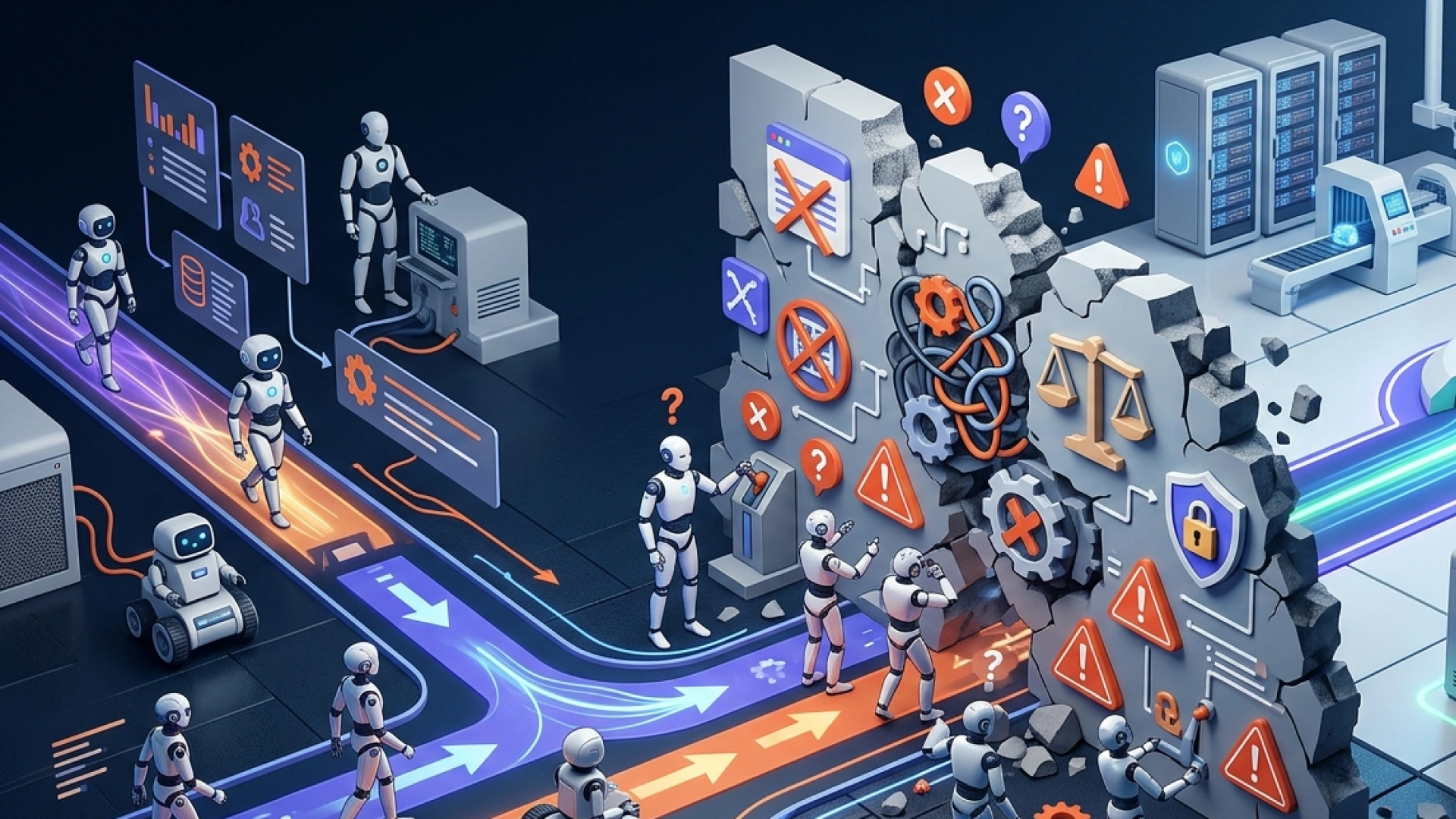
Agentic AI plans and executes multi-step tasks with limited human input, and it is no longer experimental. But most pilots never reach production. Deloitte's 2025 Emerging Technology Trends study found only 11% of organisations have agentic AI live in production, against 38% still piloting. The gap is delivery, not technology.
What Is Agentic AI, and Why Does It Stall?
Agentic AI refers to systems that take a sequence of actions to complete a goal, rather than simply answering a question. Research a prospect. Draft an outreach. Qualify a lead. Submit an application. No human in the loop for every step.
The gap between proof of concept and production is not a technology problem. It is a delivery problem, and it is the same gap that sinks every AI initiative that dies between the pilot and the boardroom.
Why Does Agentic AI Fail to Reach Production?
We have seen this pattern across CP/FMCG and logistics businesses. Real budgets, capable teams, genuine intent. Here is what goes wrong:
- No data engineering foundation. Agentic workflows depend on clean, accessible, structured data. Most companies don't have it. They discover this at week eight of a twelve-week pilot.
- No change management. The agent does the task. The human doesn't trust it. Adoption stalls. The system gathers dust.
- No production architecture. A demo that runs in a notebook is not a production system. Most pilots disappear in the gap between those two things.
- Strategy disconnected from P&L. The pilot was approved because it sounded compelling. Nobody mapped it to a margin line or a cost reduction. When the board asks for ROI, there is no answer.
This is not a criticism of the teams involved. It is a structural failure in how AI initiatives are scoped, resourced, and delivered.
AI Navi Insight: Our SCALE AI™ benchmark across UK CP/FMCG companies (2025) scores five readiness dimensions: Strategy 32%, Capability 28%, Applied AI 21%, Data Architecture 24%, and Leadership 18%. Data Architecture and Leadership are consistently the two lowest. Those are exactly the two gaps that stall agentic AI before production: without a governed data layer and a P&L-accountable sponsor, no agentic workflow survives contact with real operations.
What Does Production-Ready Agentic AI Actually Look Like?
SalesGenius, our own agentic prospecting product, replaced manual research with AI-driven outreach and cut prospecting time by 80%. It runs in production today, generating pipeline from day one, not sitting in a pilot environment.
The same delivery discipline applies inside client engagements. Abhishek compressed new product development iteration cycles from months to weeks for a pladis Global brand team: the same kind of multi-step, tool-using workflow that agentic AI now automates end to end.
The reason these hold up is not the technology. It is the delivery methodology underneath it.
How Does the Navigate, Execute, Land Framework Work?
Every AI Navi engagement follows the same three-pillar structure, because agentic AI rarely fails for one reason. It usually fails for three, at once.
Navigate — Strategy and Leadership. AI strategy connected to P&L, with C-suite alignment before a line of code is written. This is where the AI FlightCheck™ operates: a 15-page diagnostic that identifies the highest-margin agentic workflow candidate in two weeks.
Execute — Data and AI Engineering. The governed data foundation an agentic workflow needs to run reliably, then a working system in production, not a prototype. The AI FlightPath™ Sprint delivers this over ten weeks.
Land — Adoption, Change and ROI. Change management, team upskilling, and a number the board can see. The AI FlightScale™ Retainer keeps this pillar funded on a rolling three-month basis after go-live.
Most providers own one of these pillars. A strategy house gives you Navigate. A development shop gives you Execute. Nobody owns Land. We run all three, one team, no handoffs.
Is Agentic AI Ready for CPG and Logistics in 2026?
The technology is ready. The use cases are clear: prospecting, demand signal processing, supplier communication, document extraction.
What is not ready, in most organisations, is the delivery capability underneath it. Most vendors cannot take a business from concept to production. Most internal teams lack the data engineering foundation agentic workflows depend on. Most pilots produce a presentation, not a working system.
At AI Navi, we have led AI inside a $3B+ CPG and shipped agentic products into live production, not slideware. That is the difference between a compelling demo and a system that runs at 6am on a Monday morning without anyone watching.
How Do You Know If You Are Ready for Agentic AI?
Three questions worth answering before you commit budget:
- Do you have a data engineering layer? Not a data warehouse. A governed pipeline an agentic system can read and write to reliably.
- Is there a P&L owner for this initiative? Not a technology sponsor. A business leader whose numbers move if it works, or doesn't.
- Do you have a plan for the 30 days after go-live? Adoption doesn't happen automatically. Agentic systems need trust-building with the people who depend on them.
If the answer to any of these is no, the pilot will likely stall, regardless of which technology you choose.
The Bottom Line
Agentic AI is not hype, and the production gap is not a reason to wait. It is a reason to be deliberate about how you deliver it.
The companies that extract real value from agentic AI in 2026 will be the ones that treat delivery as seriously as they treat technology selection.
If you want to see how SalesGenius was built, and how the same Navigate, Execute, Land methodology applies to your highest-priority workflow, the AI FlightCheck™ diagnostic surfaces your top opportunities in two weeks.
Book it at ainavi.co.uk. No pitch. Just the gaps and the plan.
Frequently Asked Questions
What is agentic AI?
Agentic AI refers to systems that take a sequence of actions toward a goal, using tools and data with limited human input at each step, rather than simply answering a single question.
Why do most agentic AI pilots fail to reach production?
Deloitte's 2025 research found only 11% of organisations have agentic AI live in production. The barrier is usually delivery, not the underlying technology: missing data engineering, weak change management, or no P&L owner accountable for the outcome.
What is the Navigate, Execute, Land framework?
It is AI Navi's three-pillar delivery model. Navigate connects AI strategy to P&L and secures leadership alignment. Execute builds the data foundation and ships a working system into production. Land drives adoption, change management, and measurable ROI.
How long does it take to get a working agentic AI system into production?
The AI FlightCheck™ diagnostic takes two weeks and identifies the highest-value candidate workflow. The AI FlightPath™ Sprint then delivers a first working system in production over ten weeks.
What is the AI FlightCheck™ diagnostic?
A 15-page diagnostic plus a 90-day action plan, priced below typical procurement thresholds, that identifies where agentic AI can create the most margin or time impact before any development work begins.
Is agentic AI worth the investment for CPG and logistics businesses in 2026?
The use cases (prospecting, demand signal processing, supplier communication, document extraction) are proven. The risk is not the technology, it is choosing a delivery partner who can take a business from concept to production rather than concept to presentation.