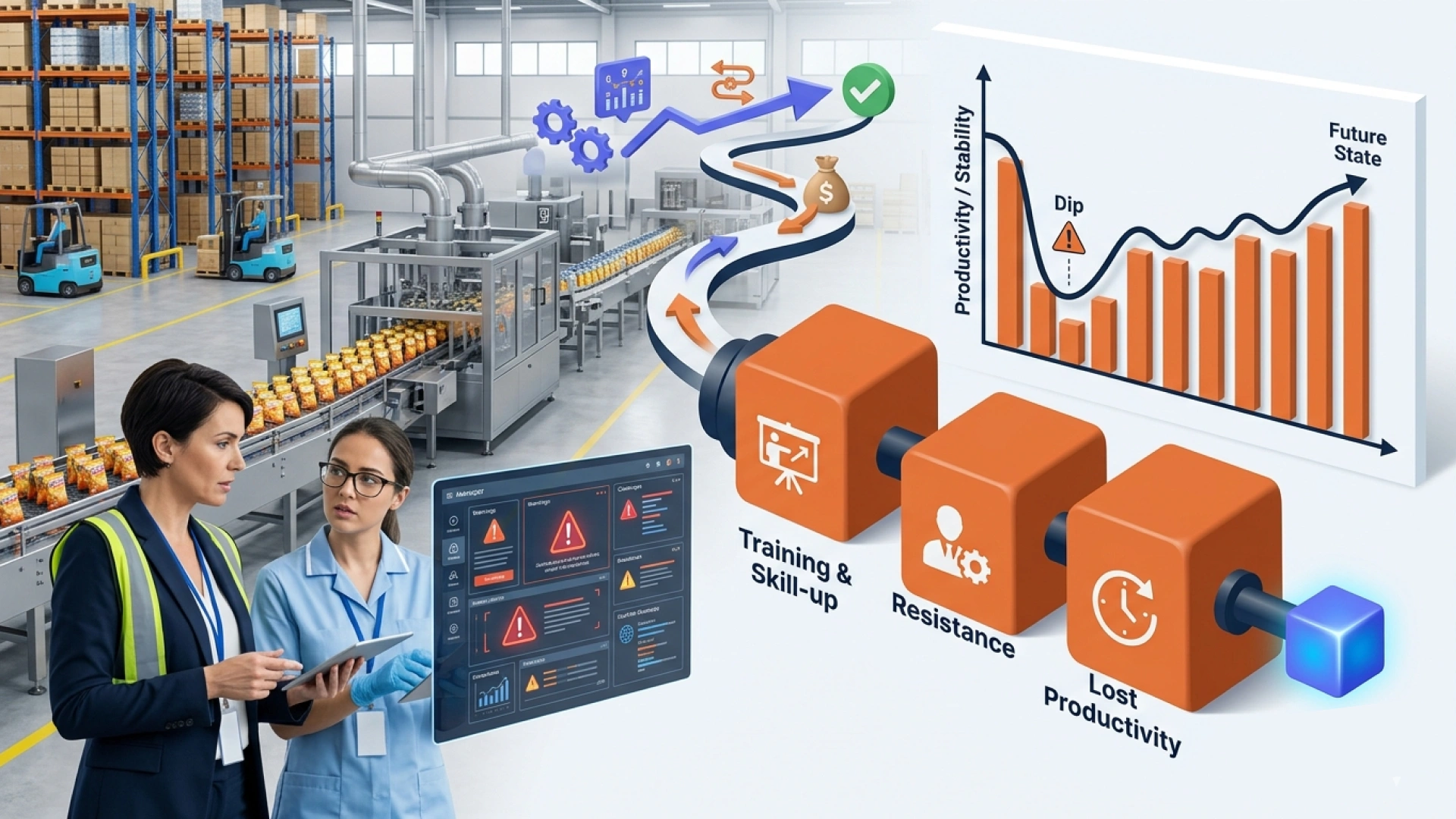
AI Change Management for FMCG: The Real Adoption Cost
| AI change management is the work of getting people to trust and use a system that already works, and it is where most FMCG projects stall. Budget for it as the majority of total project effort, not the technology. The model rarely fails in mid-market CPG. Adoption does. |
If your last AI pilot produced a strong demo, senior buy-in, and a working proof of concept, then died somewhere between handover and daily use, the gap was not technical. It was the cost of changing how people work, and almost nobody budgets for it. This page sets out where that cost lands in an FMCG business, how much to plan for, and what good adoption looks like in the first 90 days.
What is the change management tax in an AI project?
The change management tax is the senior time and organisational effort needed to move an AI system from “it works in a test” to “the team runs the business on it.” It covers process redesign, user trust, workflow documentation, and cross-functional alignment. The technology is the cheap part. Getting a Commercial Director to change their S&OP routine because a forecast model says so is the expensive part.
The clearest external benchmark for this comes from McKinsey. Its research finds that fundamental workflow redesign correlates more strongly with EBIT impact than any other organisational change, yet only around a fifth of companies have redesigned any workflows. The rest layer AI on top of how they already work, which is exactly why the system gets used for a fortnight and then quietly abandoned.
Where does the change management tax hit hardest in FMCG?
It lands in four places that never appear in the original AI proposal, and every one of them is operational rather than technical.
Process integration debt. Your new demand forecast updates weekly. Your S&OP meeting runs monthly. Someone has to redesign the decision rhythm so the model output actually changes a buying or production call, rather than sitting in a report no one acts on.
Data trust building. A finance team will not act on a recovery or deduction model until they understand how it ranks cases. Until then they shadow it manually, which doubles the work and stalls the business case. Trust is built by validating outputs in the open for a few weeks, not by a single training session.
Workflow redesign. The current manual process is inefficient, but the team knows every exception in it. The new process is faster and unfamiliar. Someone has to document it, train each user, and handle the edge cases that surface in the first 30 days of live running.
Stakeholder coordination. A forecasting or trade-spend model touches Commercial, Supply Chain, and Finance at once. Aligning three functions on new decision rights and escalation paths takes dedicated senior attention that line managers rarely have spare. This is the work that decides whether a pilot reaches production, and we cover the failure pattern in detail in why most AI pilots never reach production.
AI Navi Insight: what the FlightCheck™ files show about adoption
FROM THE FLIGHTCHECK™ FILES A £400M CPG client's Flight Risk Index™ fell from 7.2 to 4.1 in 60 days off a single data pipeline project. The score did not move because we deployed more AI. It moved because one trusted, usable data flow replaced a forecasting process run across three markets in spreadsheets, and the commercial team started making calls on it. Across the mid-market CPG businesses we assess, manual S&OP corrections cost roughly 12% of forecasting accuracy. That is margin lost to a process problem, not a model problem, and it is recovered through adoption rather than a better algorithm. In our SCALE AI™ benchmark, Leadership is the lowest-scoring dimension at 18%. That is the ownership gap. It is also the single best predictor of whether change management lands, because adoption needs someone senior who will not let the team revert to the old way. |
How much should you budget for AI change management?
Plan for the majority of total project effort to land on people and process, not the build. The widely used planning split puts roughly 10% of effort on the algorithm, 20% on technology and data, and 70% on people, process, and adoption. For a 90-day FMCG implementation, that effort is overwhelmingly senior time, and it is rarely costed in a vendor proposal.
The work is front-loaded but it does not disappear. It shifts shape across the first three phases:
| Phase | Where the effort goes | Who owns it | Signal it is working |
|---|---|---|---|
| Weeks 1–4 | Process and decision-rhythm redesign; naming decision rights | Senior operator + function heads | Meetings restructured around the model output |
| Weeks 5–8 | User training, live support, validating outputs in the open | Operator + power users | Team stops shadowing the system manually |
| Weeks 9–12 | Trust embedding, exception handling, success communication | Operator + Finance | Decisions made on the model without sign-off escalation |
If no one in your plan owns this column, you do not have a deployment plan. You have a pilot with an expiry date. The AI FlightCheck™ diagnostic maps exactly where this effort will fall before you commit budget.
Why is AI adoption harder than a normal system rollout?
AI carries three adoption challenges that a standard IT project does not.
Black-box trust. People are asked to act on recommendations they cannot fully audit. An Operations Director who cannot explain the logic to their CEO will not adjust inventory on it, and that is rational risk management, not resistance. Someone has to translate model outputs into business language a board will sign off.
Shifting success metrics. Models improve with use. A forecast that looks disappointing at 65% accuracy in week three can be strong at 85% by week twelve. Without someone managing that expectation, the programme gets cancelled before it matures.
Cross-functional dependencies. Adoption runs at different speeds in different functions. Commercial may take to trade-spend optimisation while Finance struggles with the reporting change. McKinsey's change research is blunt on why this matters: companies that invest in building trust around AI are nearly twice as likely to see revenue growth of 10% or higher. The trust work is the growth work.
What does good AI change management look like in practice?
The businesses that deploy successfully treat adoption as a senior leadership job, not a training afterthought. Three patterns repeat.
Embedded senior ownership. The most successful rollouts have a senior figure visibly present in the first weeks of live running. Their attendance signals that reverting to the old process is not an option. This is the case for a fractional Chief AI Officer who carries the seniority to make integration calls without learning AI on the job.
Gradual confidence building. Do not start with full autonomy. Week one, the model flags and the team investigates manually. Week three, the model prioritises and the team spot-checks the top items. Week six, the model handles routine cases and the team reviews only exceptions. Trust is built in stages while value is proven.
Clear success communication. The team needs to know what good looks like at each stage so early, partial accuracy is read as progress rather than failure. Setting that expectation is part of the AI implementation strategy, not a nice-to-have.
Why fractional AI leadership solves the adoption problem
The change management tax exists because most mid-market businesses do not have a senior leader who holds both AI experience and the authority to drive adoption. The technical team understands the model but lacks organisational weight. The senior team has the weight but lacks the AI experience to troubleshoot resistance.
Fractional AI leadership closes that gap with someone who has run adoption across several businesses and can make integration decisions. The economics work because the tax hits hardest in the first 90 days. After that, adoption stabilises and an internal team can manage ongoing optimisation. This is the same ownership gap we quantify in why 91% of FMCG companies have AI but only 13% see financial impact.
Get the next AI project right from day one Start with the AI FlightCheck™ diagnostic. In 2 to 4 weeks it maps your specific adoption risks and returns a 90-day action plan that budgets for change management, not just the build. Or take the AI Readiness Scorecard to see where you stand today. |
Frequently asked questions
What is AI change management?
AI change management is the organisational work of getting people to trust and use a working AI system. It covers process redesign, user training, building trust in model outputs, and aligning decision rights across functions. It is the part of an AI project that determines whether the technology actually changes how the business runs.
Why do most AI pilots fail in FMCG?
Most fail in adoption, not in build. The model works in a test but the team reverts to familiar manual processes, senior leadership loses confidence as usage plateaus, and funding for the next phase is cut. The cause is an unbudgeted change management effort, not a technology shortfall.
How much of an AI project budget should go to change management?
Plan for the majority of effort, not budget, to land on people and process. The common planning split is roughly 10% on the algorithm, 20% on technology and data, and 70% on adoption. In mid-market CPG this is overwhelmingly senior time across the first 90 days.
How long does AI adoption take?
Trust builds over weeks, not in a single training session. A workable pattern is staged handover over the first 90 days: the model flags and the team verifies, then the model prioritises and the team spot-checks, then the model runs routine cases and the team reviews exceptions only.
What is the Flight Risk Index™?
The Flight Risk Index™ is an AI Navi score of how likely an AI programme is to stall. A £400M CPG client's score fell from 7.2 to 4.1 in 60 days off a single data pipeline project, because one trusted, usable data flow replaced a spreadsheet forecasting process the commercial team could finally act on.
Who should own AI adoption inside the business?
A senior operator with the authority to change how people work and the AI experience to handle resistance. Where that person does not exist internally, a fractional Chief AI Officer provides it for the high-risk first 90 days, then hands ongoing optimisation to the internal team.
Is AI change management different from normal IT change?
Yes. AI adds three challenges: people must act on recommendations they cannot fully audit, success metrics shift as models improve with use, and adoption runs at different speeds across Commercial, Supply Chain, and Finance at the same time.