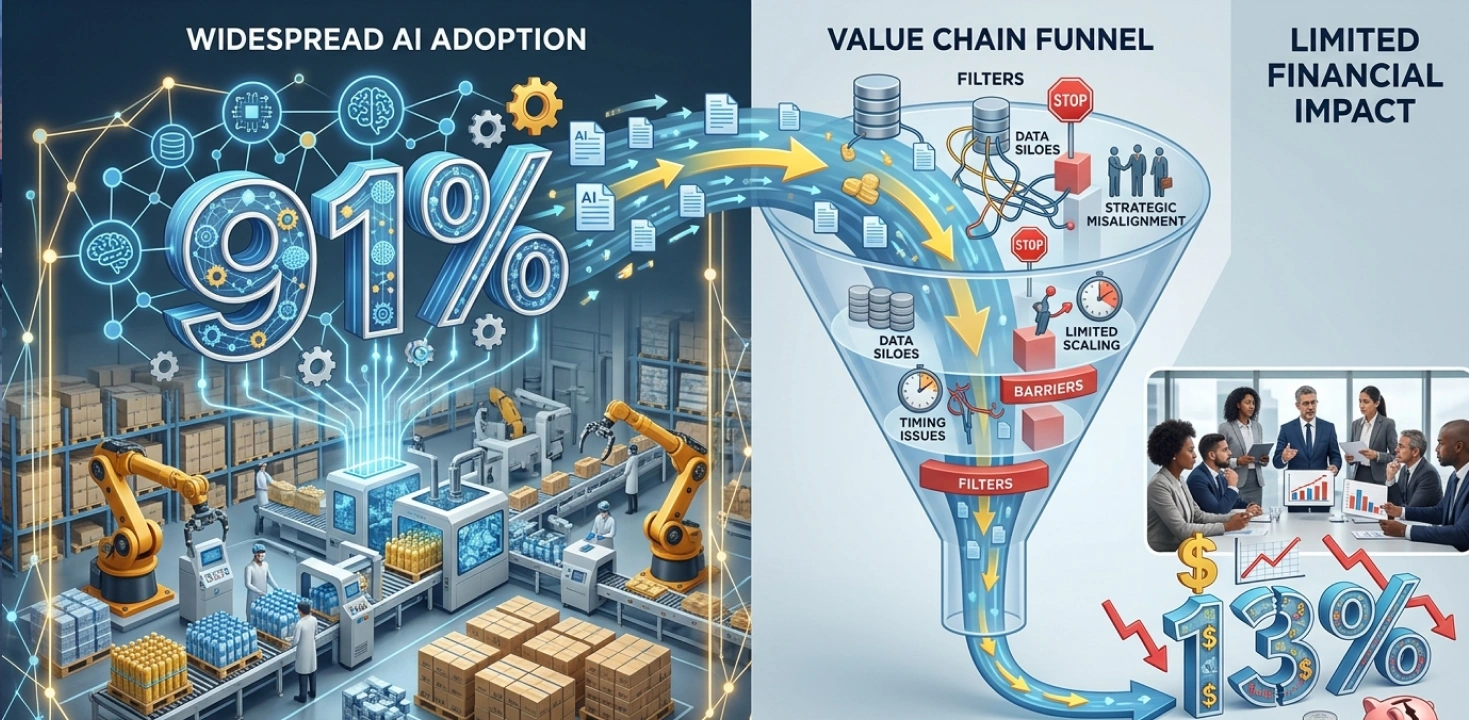
Your board approved the AI budget. You've deployed systems across demand planning and supply chain. Yet the P&L impact they expected? Still waiting.
We help CP/FMCG leaders bridge the gap between AI investment and production results specifically when you've backed pilots and hired vendors but have little to show for it.
What's Really Happening in FMCG AI?
The numbers tell a story of massive investment meeting execution reality. According to NVIDIA, 91% of enterprises have adopted AI in 2026, with 58% actively deploying systems. That's up 16% from 2024.
But here's the gap: only 13% of logistics service providers report scaled financial impact.
92% are planning budget increases above 10%. Yet 87% are struggling to scale beyond pilots.
This isn't a technology problem anymore. It's an execution problem.
Why 'Unclear ROI' Tops Executive Concerns
According to BCG research, 40% of companies cite 'unclear ROI' as their primary AI barrier in 2026.
We've seen this exact pattern across three £1B+ CPG businesses. The symptoms are always the same:
- Demand forecasting models that improve accuracy by 12% but don't reduce overstock costs
- Promotional optimization algorithms that surface insights no one acts on
- Supply chain visibility dashboards that gather dust while planners stick to Excel
- AI-powered assortment tools that don't connect to category P&L
The root cause: AI strategy disconnected from business outcomes.
Most implementations start with technology capabilities rather than margin leaks. They build models that work but don't drive decisions. They create insights that don't translate to EBITDA impact.
The Three-Part Execution Gap We Keep Finding
Gap 1: Strategy Without P&L Connection
Your AI roadmap lists 47 use cases across demand planning, pricing, and logistics. But which one delivers £2M in cost reduction by Q4? Which improves case fill rate by 8%? Which reduces promotional spend waste by 15%?
Most strategies can't answer these questions.
We built a promotional effectiveness model at a £3B CPG that identified £18M in annual waste across just three categories. The model was technically sound. But it took six months of change management to get category managers to actually use the recommendations.
The lesson: Technical success means nothing without commercial adoption.
Gap 2: Data Engineering That Doesn't Scale
Your pilot worked beautifully with clean data from two product lines. But scaling to 2,000 SKUs across 12 markets reveals the real challenge: data quality, system integration, and operational complexity.
We've seen £200K AI investments fail because:
- Master data inconsistency across ERP systems
- No automated pipeline for promotional data feeds
- Forecast outputs that don't integrate with S&OP workflows
- Models that break when new product launches change category dynamics
The pattern: Proof of concept assumes perfect data. Production demands operational resilience.
Gap 3: Change Management as an Afterthought
Your demand planner has used the same Excel template for eight years. Your category manager trusts their judgment over algorithmic recommendations. Your supply chain team measures success on service levels, not forecast accuracy.
AI adoption is fundamentally a people challenge disguised as a technology project.
The Navigate-Execute-Land Framework for FMCG AI
We've shipped 30+ AI products across consumer products and logistics. The successful deployments follow the same three-pillar pattern:
Navigate: Strategy Connected to Margin Impact
| Traditional Approach | P&L-Connected Approach |
|---|---|
| ✗ List 47 AI use cases | ✓ Identify top 3 margin leaks |
| ✗ Build what's technically possible | ✓ Build what drives EBITDA |
| ✗ Measure model accuracy | ✓ Measure business outcomes |
| ✗ Present to IT steering committee | ✓ Present ROI to CFO |
We start every engagement by identifying the highest-value margin leak that AI can address within 90 days. No generic roadmaps. No theoretical frameworks. Just specific business problems with measurable financial impact.
Execute: Production-Ready Systems from Day One
Most AI projects die in the "productionization" phase. They work in the lab but fail in the real world of dirty data, legacy systems, and operational constraints.
Our approach:
- Week 1-2: Data engineering assessment and pipeline design
- Week 3-4: Model development with production constraints
- Week 5-6: Integration testing with existing workflows
- Week 7-8: User acceptance and change management
Result: Working AI system in production within 30 days, not 6-month implementation cycles.
Land: Adoption Through Change Management
The fastest route to AI ROI is user adoption, not model sophistication.
We embed change management from the start:
- Train users on interpreting AI outputs, not using the technology
- Connect recommendations to existing KPIs and incentives
- Provide decision support, not decision replacement
- Measure usage rates alongside business outcomes
A demand forecasting model that improves accuracy by 15% but gets used by 40% of planners delivers less value than a 10% improvement model used by 90% of the team.
What This Means for Your AI Investment
If you're part of the 91% with AI deployed but struggling with financial impact, the solution isn't more technology. It's execution discipline.
Three diagnostic questions:
- Can you name the specific margin leak your AI investment will address in £ terms?
- Do you have a production-ready data pipeline that handles real-world complexity?
- Have you designed adoption incentives for the people who must use AI outputs?
If any answer is "no," you're likely heading toward the 87% who struggle to scale.
From AI Investment to P&L Impact
Successful FMCG AI requires:
- Strategy that starts with business outcomes, not technical capabilities
- Data engineering that works in production, not just proof of concept
- Change management that drives adoption, not just training
We've built this exact bridge for CP/FMCG leaders at £500M-£2B revenue companies. The ones who succeed share three traits: they focus on specific margin leaks, they insist on production-ready systems, and they measure adoption as rigorously as accuracy.
30 days from AI strategy to working system in production.
Book an AI FlightCheck we'll surface your highest-ROI AI opportunities and show you exactly how to close the execution gap.