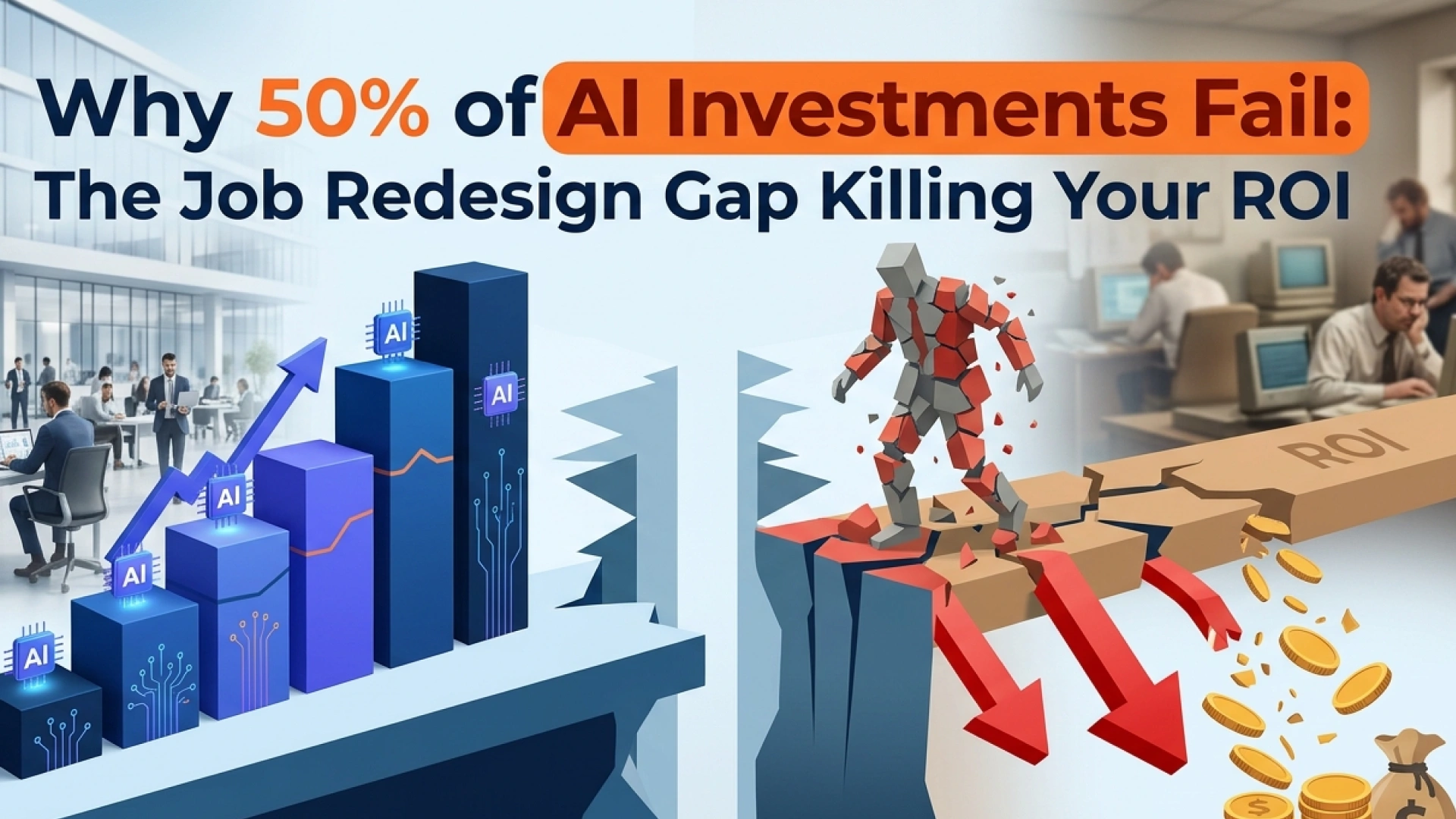
AI investments fail because organisations deploy tools without redesigning the jobs expected to use them. The result is sophisticated AI layered onto workflows built for a pre-AI operating model and adoption that plateaus at 8–15% regardless of the technology's capability. This is the job redesign gap, and it is the single most common cause of AI ROI failure across enterprise implementations.
What's Behind the 50% AI ROI Failure Rate?
Only half of companies implementing AI solutions achieve positive ROI within 12 months. The core issue isn't technical limitations or poor tool selection, it's the fundamental mismatch between how jobs are structured and how AI actually creates value.
Most organizations invest in AI faster than they redesign the roles expected to use it. You end up with sophisticated automation capabilities bolted onto workflows that were never designed to leverage them. It's like installing a Formula 1 engine in a delivery truck and wondering why it doesn't go faster.
The gap between AI investment and business impact reveals a design problem, not an execution problem. Companies are applying AI to roles built for yesterday's operating model, then expressing surprise when productivity gains don't materialize.
In 7 of the last 9 AI implementations we have assessed, the performance management framework had not been updated to reflect AI-assisted workflows
Why Traditional AI Implementation Approaches Fall Short
The technology-first approach that dominates AI implementation creates predictable blind spots.
Vendors and systems integrators naturally focus on what they know: deploying software, configuring APIs, and training users on new interfaces. They treat job redesign as someone else's problem—usually HR's or operations'—creating a coordination failure that kills ROI.
We've observed this pattern repeatedly in our client work. In a recent engagement with a £280M process manufacturer, the predictive maintenance AI was accurate to within 6 hours on equipment failure prediction. Twelve months after deployment, adoption was at 11%. The reason: maintenance technicians were still measured on mean time to repair, not failure prevention rate. The AI was predicting failures nobody was rewarded for preventing. We changed one KPI. Adoption reached 74% within 60 days.
Another client implemented AI-powered customer service tools but maintained the same case volume targets and escalation procedures. Agents used AI to handle cases faster but weren't empowered to resolve more complex issues that the AI surfaced. The result: marginally faster case closure but no improvement in customer satisfaction or operational cost.
The Four Dimensions of Effective Job Redesign for AI
Successful AI adoption requires systematic job redesign across four key dimensions.
Decision Authority and Scope
AI creates judgment capacity at lower levels of the organisation. If the AI can identify a churn-risk customer in real time but the agent needs manager approval for any retention offer, the AI's value is structurally blocked. Redesign means pushing authority down to where the AI-enhanced decision sits.
Performance Metrics and Incentives
The most common adoption killer. If a sales team is measured on call volume, they will use AI to make more calls faster — not to qualify better and close larger deals. Metric redesign must happen before or alongside tool deployment, never after.
Skill Requirements and Development
AI shifts which skills matter. In most enterprise roles, this means less time on data retrieval and more time on exception handling, stakeholder communication, and AI output interpretation. In one engagement, 40% of training hours were reallocated to AI literacy rather than AI tool operation.
Workflow Integration and Handoffs
AI that requires switching between three systems to act on a recommendation will be abandoned within 90 days regardless of its accuracy. Map the end-to-end workflow before deployment. Identify every click that sits between the AI insight and the human action.
The Real Cost of the Job Redesign Gap
Ignoring job redesign creates cascading costs that extend far beyond initial ROI disappointment.
| Cost Category | Impact | Timeline | Patterns Observed |
|---|---|---|---|
| Direct Technology Waste | Unused licenses, 20–40% of AI tool spend | 6-12 months | Tools purchased; adoption at 8%; licences renewed out of sunk-cost inertia |
| Opportunity Cost | Competitors gain advantage while you struggle with adoption | 12-18 months | Competitors who redesigned roles in year one are 18 months ahead by year two |
| Change Fatigue | Teams become resistant to future AI initiatives, | 18-24 months | Second AI rollout faces 3× more internal resistance than the first |
| Talent Retention | High performers leave for organizations that empower them with better tools | 12-36 months | Exit interviews cite "lack of modern tools" — but the tools exist; the workflows do not |
The most expensive cost is often invisible: the strategic opportunities you miss while wrestling with adoption challenges. Markets move fast, and competitors who nail job redesign gain compounding advantages.
How to Bridge the Job Redesign Gap
Closing this gap requires a systematic approach that addresses both technology deployment and organizational change.
| Phase | Timeframe | Action | Output |
|---|---|---|---|
| Role impact assessment | Weeks 1–2 | Map which decisions shift, which metrics change, which skills matter | Role redesign brief per function |
| Metric redesign | Weeks 2-4 | Rewrite performance frameworks to reflect AI-enabled outcomes | Updated KPIs signed off by leadership |
| Parallel piloting | Weeks 3-8 | technical pilot in one function | Real adoption data before full rollout |
| Measurement | Weeks 10 onward | Track adoption metrics (not just technical metrics) weekly | Leading indicators of ROI realisation |
Start with Role Impact Assessment
Before selecting AI tools, map how different roles will actually change. Which decisions will shift? What new capabilities will emerge? Which skills become more or less important?
This assessment should drive both technology selection and change management planning. If a role won't materially change, question whether AI investment is justified.
Design New Operating Rhythms
AI often changes when and how work gets done. Predictive models provide insights days or weeks ahead of traditional reactive approaches. Customer service AI can resolve issues in minutes that previously took hours.
Job redesign captures these timing changes and builds new operating rhythms around them. This might mean shifting from weekly planning cycles to daily optimization cycles, or from reactive problem-solving to proactive prevention.
Build Change Management into Technology Rollout
Most AI implementations in the UK treat change management as a follow-up activity. Job redesign should happen in parallel with technology deployment, not after it.
We've found success with integrated rollout approaches where job redesign pilots run alongside technical pilots. This allows real-time iteration on both technology configuration and role changes based on actual usage patterns.
Measure Adoption, Not Just Technology Metrics
Traditional implementation metrics focus on technical milestones: systems deployed, users trained, uptime achieved. Job redesign success requires different metrics: decision quality, workflow efficiency, role satisfaction, business outcome improvements.
Track these adoption metrics with the same rigor as technical metrics. They're leading indicators of ROI realization.
Why This Matters More Than Ever in 2026
The AI landscape has matured rapidly over the past two years. Technology capabilities are increasingly commoditized—most enterprise AI tools can deliver similar technical functionality. Competitive advantage now comes from how effectively you deploy and adopt those capabilities.
Organizations that master job redesign will capture disproportionate value from AI investments. Those that don't will find themselves trapped in endless technology refresh cycles, chasing the latest tools while missing fundamental adoption challenges.
The companies pulling ahead aren't necessarily using the most advanced AI—they're using AI most effectively by redesigning how work gets done around it.
What This Means for Your Next AI Initiative
If your AI tools are deployed but adoption is below 30%, the job redesign gap is the likely cause. Our two-week AI adoption audit identifies exactly where the workflow, metric, and authority gaps are and delivers a prioritised fix plan before your next board review. Fixed fee. No ongoing commitment required.
Start your next AI project with role impact assessment, not technology evaluation. Identify which jobs will change and how, then select technologies that support those changes rather than driving them.
Build change management capabilities as seriously as you build technical capabilities. The organizations winning with AI treat adoption as a core competency, not an afterthought.
Most importantly, measure success by business outcomes, not technology deployment metrics. ROI comes from changed behavior, not installed software.
The 50% failure rate isn't inevitable—it's the predictable result of treating AI as a technology problem instead of a change management challenge. Organizations that bridge the job redesign gap will find themselves in the successful 50%, capturing real ROI from their AI investments.
Ready to bridge the job redesign gap in your organization? Our Navigate-Execute-Land methodology at AI Navi addresses this structural challenge by integrating change management with technology deployment from day one.