Back to blog
AI in supply chain·11 May 2026

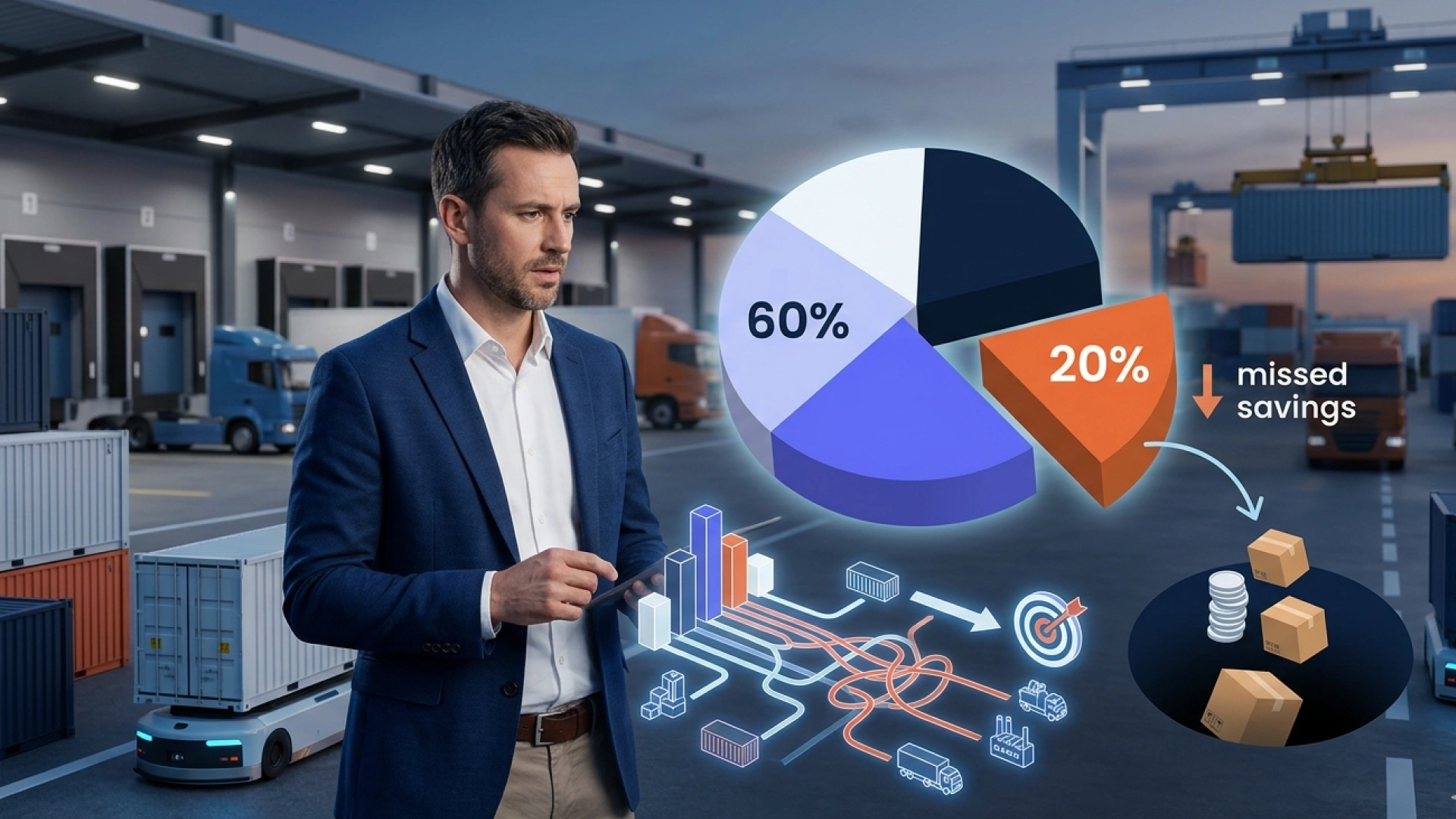
Why 60% of Supply Chain Leaders Are Missing 20% Cost Reductions in 2026

Despite proven results like 5–20% cost reductions, only 40% of supply chain leaders actively use AI in 2026. The real barrier is no longer technology — it’s leadership execution, organizational resistance, and failure to connect AI initiatives to operational and financial outcomes. Through real-world examples across CPG and food businesses, the article shows how AI improves forecasting, routing, inventory, and procurement while outlining the practical strategies successful companies use to bridge the gap between AI pilots and measurable transformation.

Why 60% of Supply Chain Leaders Are Missing 20% Cost Reductions in 2026

at AI Navi, we've led AI implementations across £3B+ CPG operations and the latest supply chain AI adoption data should terrify every COO reading this. We're sitting on proven 5-20% cost reductions, yet only 40% of supply chain leaders report active AI use in 2026.

I've watched companies lose millions while their competitors automate the same processes they're handling manually. The gap between AI's proven logistics benefits and actual implementation isn't about technology anymore — it's about leadership.

What's Really Behind Low Supply Chain AI Adoption?

Supply chain AI adoption sits at just 40% despite proven ROI because most implementations fail at the strategy-execution bridge. Companies pilot AI tools but never connect them to P&L impact or operational workflows.

From my experience implementing AI across five different food businesses, the real barriers aren't technical. They're organizational. Most supply chain leaders inherit systems built for manual processes, then try to bolt AI onto workflows that weren't designed for automation.

Consider this: A £60M beverage company spent 18 months testing three different AI forecasting tools. Each pilot showed 25% accuracy improvement over their Excel models. But they never deployed any of them because "the timing wasn't right" and "we needed more data validation." Meanwhile, their competitor implemented similar AI in 12 weeks and reduced inventory by £800K.

The 24% increase in adoption from 2024 to 2026 sounds impressive until you realize it took two years to move from "almost nobody" to "less than half." Meanwhile, early adopters are capturing 20-30% inventory reductions while laggards struggle with spreadsheets.

Where Supply Chain AI Delivers Measurable Results

Demand Forecasting Accuracy

AI-enabled demand forecasting reduces forecast error by 30-50% compared to traditional statistical methods. This translates directly to inventory reduction and service level improvements.

At one £40M food brand, we replaced their Excel-based forecasting with AI models trained on two years of sales data, weather patterns, and promotional calendars. Forecast accuracy improved from 65% to 89% within eight weeks, reducing safety stock requirements by £180K.

Another example: A £120M frozen food distributor was manually forecasting 2,400 SKUs using historical averages. Their planning team spent three days each week updating spreadsheets. We implemented AI models that processed the same data in six hours and delivered 40% better accuracy. The planning team shifted focus from data entry to exception management and strategic analysis.

A third case involved a £80M pet food manufacturer whose seasonal products created massive inventory swings. Their buyers relied on "gut feel" for Christmas and Easter demand. AI models incorporating weather data, economic indicators, and social media sentiment reduced forecast error from 45% to 18%, eliminating £300K in obsolete seasonal inventory.

Distribution Route Optimization

Route optimization AI typically delivers 5-15% reduction in logistics costs through improved vehicle utilization and reduced fuel consumption. The technology works by analyzing delivery patterns, traffic data, and customer requirements simultaneously.

A £200M food service distributor was routing 40 trucks manually using driver knowledge and basic mapping. Drivers spent 15 minutes each morning adjusting routes based on last-minute customer changes. We deployed AI route optimization that processed delivery requirements, traffic patterns, and vehicle constraints in real-time. Results: 12% reduction in miles driven, 8% improvement in on-time delivery, and drivers gained 90 minutes per day for customer interaction.

Another distributor example: A £150M bakery supply company served 800 delivery points across three regions. Manual routing created inefficiencies where drivers crossed territories and made unnecessary stops. AI optimization reduced total delivery time by 18% and cut fuel costs by £180K annually while improving customer service scores.

Traditional route planning relies on driver experience and basic mapping tools. AI considers variables humans can't process: traffic patterns, weather impacts, vehicle capacity constraints, and customer time windows. The result is measurably better routes that reduce both costs and delivery times.

Inventory Management

AI-driven inventory management systems achieve 20-30% inventory reduction while maintaining or improving service levels. This happens through more accurate demand sensing and dynamic safety stock optimization.

Traditional ApproachAI-Enabled ApproachTypical Improvement
Fixed reorder pointsDynamic reorder points25% inventory reduction
Manual safety stockAI-calculated safety stock30% working capital improvement
Weekly planning cyclesDaily demand sensing40% forecast accuracy improvement
Reactive supplier managementPredictive supplier alerts15% procurement cost reduction

Real example: A £90M confectionery manufacturer carried 14 weeks of safety stock across 300 SKUs because their planner "preferred to be safe." AI analysis revealed that 60% of SKUs needed only 4 weeks safety stock based on actual demand variability. Implementing dynamic safety stock rules freed up £450K in working capital without affecting service levels.

Another inventory case: A £160M household products company experienced frequent stockouts on promotional items while holding excess slow-moving inventory. Their buyers used gut instinct for promotional planning. AI models analyzing promotional lift patterns, competitive activity, and seasonality reduced promotional stockouts by 70% while cutting total promotional inventory by 25%.

Procurement Optimization

AI procurement systems deliver 5-15% spend reduction through better supplier selection, contract optimization, and demand aggregation.

A £180M food manufacturer was managing 400 suppliers across 50 categories using spreadsheets and email. Purchase decisions relied on historical relationships and manual price comparisons. We implemented AI procurement analytics that evaluated supplier performance, price trends, and risk factors automatically. Results: 11% procurement cost reduction, 30% faster supplier onboarding, and elimination of maverick spending worth £120K annually.

Another procurement example: A £250M beverage company struggled with ingredient price volatility. Their buyers made purchasing decisions based on monthly supplier calls and basic trend analysis. AI models incorporating commodity futures, weather data, and geopolitical risk factors improved buying timing and reduced ingredient costs by 8% while maintaining quality standards.

The Real Implementation Barriers

Data Quality Reality Check

Most supply chain leaders assume their data isn't ready for AI. This is usually wrong. AI works with imperfect data better than manual processes work with perfect data.

I've implemented AI systems using data with 15% missing values and inconsistent formatting. At one client, their inventory system had three different product code formats across warehouses. Rather than spend months cleaning data, we built AI models that recognized these variations and normalized them automatically. The system delivered value within weeks rather than waiting for perfect data quality.

Another data quality example: A logistics company had customer addresses in free-text fields with inconsistent formatting. Manual processes required staff to interpret and correct addresses daily. AI geocoding models processed these variations automatically, reducing address correction time from 2 hours daily to 10 minutes weekly.

Technology Integration Fears

Many operations directors worry about integrating AI with existing WMS, ERP, and TMS systems. In practice, modern AI tools connect through APIs without requiring system replacement.

A £140M food distributor feared that AI implementation would disrupt their established SAP workflows. We connected AI forecasting models through standard APIs, allowing planners to access improved forecasts within their existing interface. No system replacement required, no workflow disruption, immediate benefit.

Another integration case: A manufacturing company used three different systems for production planning, inventory management, and customer orders. Instead of requiring system consolidation, AI models pulled data from all three systems and delivered unified insights through a simple dashboard interface.

The biggest integration challenge isn't technical — it's cultural. Teams resist changing processes that worked for years, even when AI demonstrably improves results.

ROI Measurement Confusion

Supply chain AI benefits are measurable but require proper baseline establishment. Many companies pilot AI without documenting current performance, making ROI calculation impossible.

One client spent £80K on an AI vendor pilot but couldn't prove ROI because they never measured baseline forecast accuracy. When we re-implemented with proper measurement frameworks, the same AI technology delivered documented £200K annual savings within six months.

Successful implementations establish clear metrics before deployment: current forecast accuracy, inventory turns, delivery performance, and cost per shipment. This creates objective measurement frameworks for AI impact.

How Leading Companies Bridge the Strategy-Execution Gap

Start with Bounded Problems

Successful supply chain AI implementations focus on specific, measurable problems rather than enterprise-wide transformation. This might mean automating one distribution center before scaling across the network.

At pladis, we started AI implementation with demand forecasting for our top 50 SKUs rather than the entire product portfolio. This allowed us to prove ROI quickly and build internal capability before scaling. The focused approach delivered measurable results within eight weeks and created advocates for broader implementation.

A similar bounded approach worked at a £110M dairy company. Rather than attempting full supply chain transformation, we focused on optimizing milk collection routes from 200 farms. This specific problem had clear metrics (fuel costs, collection time) and limited variables. Success here built confidence for expanding AI across other operations.

Build Internal Champions

AI adoption requires operational teams who understand both the technology and business impact. This means training existing staff rather than hiring AI specialists who don't understand supply chain operations.

A £190M logistics company created an internal "AI task force" combining their best supply chain analysts with external AI support. This hybrid team understood both operational requirements and AI capabilities, ensuring implementations addressed real business problems rather than theoretical opportunities.

Another champion-building example: A food manufacturer paired their most experienced demand planner with AI specialists for three months. The planner learned to interpret AI model outputs while the AI team learned business context. This partnership approach created internal expertise that sustained AI adoption long after external support ended.

The most successful implementations pair data scientists with supply chain veterans. The veterans provide business context while data scientists handle model development and optimization.

Measure Everything

AI implementations generate measurable improvements when properly tracked. This requires establishing KPI dashboards that show AI impact on operational metrics: forecast accuracy, inventory levels, delivery performance, and cost reductions.

A comprehensive measurement example: A £170M beverage distributor created weekly AI performance dashboards tracking forecast accuracy, inventory turns, delivery performance, and cost per case. These metrics provided objective proof of AI value and guided continuous improvement efforts.

The 60% Still Waiting: What They're Missing

Competitive Disadvantage Compounds

While 60% of supply chain operations remain manual, AI-enabled competitors gain cumulative advantages. Better demand forecasting leads to higher service levels, which drives customer loyalty and revenue growth.

A stark example: Two competing £100M food distributors served the same market. Company A implemented AI demand forecasting and route optimization, achieving 95% service levels and 12% lower logistics costs. Company B maintained manual processes and struggled with 88% service levels and rising costs. After 18 months, Company A captured three major customers from Company B specifically citing superior service reliability.

This creates a compounding effect where early AI adopters capture market share through superior operational performance. Late adopters don't just miss cost savings — they lose customers to better-performing competitors.

Labor Cost Pressure

Supply chain labor costs continue rising while AI costs decrease. Companies still relying on manual processes face increasing cost pressure that AI adoption could eliminate.

A warehouse operations example: Distribution centers using AI for workforce management reduce labor costs by 10-15% through better shift scheduling and task assignment. One £200M retailer reduced warehouse labor costs by £300K annually through AI-optimized staff scheduling while improving productivity metrics. Meanwhile, manual operations struggle with staffing challenges and productivity decline.

Your Next 90 Days

The supply chain AI adoption gap represents immediate opportunity for operations directors ready to act. Focus on one bounded problem where you can measure improvement within 90 days.

Start with demand forecasting if you're managing excess inventory. Focus on route optimization if logistics costs concern you most. Choose inventory management if working capital is your priority. Select procurement optimization if supplier costs are rising fastest.

A practical 90-day example: A £130M food company chose demand forecasting as their starting point. Week 1-2: Baseline measurement and data preparation. Week 3-8: AI model development and testing. Week 9-12: Pilot deployment with top 20 SKUs. Results: 35% forecast accuracy improvement and £80K inventory reduction by day 90.

The 40% already using AI aren't waiting for perfect conditions — they're building competitive advantages while others analyze the decision. The question isn't whether to implement supply chain AI. It's whether you'll be in the 60% still catching up next year.

Ready to join the 40% capturing proven supply chain AI benefits? Contact AI Navi to discuss your specific logistics challenges and 90-day transformation timeline.

More articles

AI in Logistics

87% of Logistics AI Projects Fail to Deliver ROI — Here’s the Brutal Reason Why (and How the Top 13% Win)

Most logistics companies aren’t failing at AI—they’re failing to connect it to financial outcomes. While 40% have moved beyond pilots, only 10–13% achieve measurable ROI. The gap isn’t technical; it’s methodological. This piece breaks down the three common failure patterns (accuracy trap, dashboard illusion, pilot bubble) and introduces a practical framework to link AI directly to P&L impact—turning experiments into measurable profit.

Enterprise AI

Adding AI to Enterprise Software: A 2026 Playbook for Product Leaders

Enterprise software companies are under pressure to integrate AI into their products, but most AI features fail to drive adoption, retention, or pricing power. This playbook breaks down the four real AI product strategies, the most common failure modes, and a practical framework for deciding when to build, buy, or partner. It also introduces a proven 30/60/90-day roadmap for shipping AI features that customers actually use — while protecting unit economics and creating long-term competitive advantage.

AI Strategy

The 10-Point AI Check Every CPG Operations Leader Should Run Before Spending a Penny

Most AI initiatives in Consumer Products fail not because the technology is ineffective, but because businesses invest before assessing operational readiness. This article introduces a practical 10-point AI readiness check for CPG leaders, covering strategy, data quality, governance, executive sponsorship, adoption planning, and commercial alignment. Drawing on real-world experience from global CPG transformations, it explains why AI success depends more on foundations than software — and how businesses can avoid costly failed pilots by identifying structural gaps before investing.

AI Company

AI Companies vs Fractional AI Leadership: When You Need Each (UK 2026)

This guide explains how UK mid-market CPG, FMCG, and logistics companies should decide between hiring an AI company, a fractional Chief AI Officer, or a Big 4 consultancy. It breaks down the cost, speed, risks, and ideal use cases for each option, while highlighting why most AI projects fail before deployment. The article also includes a practical buyer’s checklist, red flags to avoid, pricing benchmarks, and the critical questions leaders should ask before signing an AI engagement.

AI strategy

5 Questions That Save London Mid-Market CEOs from £200K AI Consulting Mistakes

A practical 2026 guide for London mid-market leaders evaluating AI consultants. The article compares Big 4 firms, boutique AI consultancies, and Fractional CAIO models, explaining where each works best, where projects fail, and the five critical questions buyers should ask before committing six-figure AI budgets. The core insight: successful AI transformation depends less on technology and more on operational accountability, sector understanding, and measurable commercial outcomes.

AI In supply chains

AI in Supply Chain Is No Longer Optional: Why 94% Are Making the Move

AI decision support is rapidly becoming the operational standard in supply chains, with 94% of firms planning adoption. But success isn’t about adopting AI—it’s about implementing it correctly. This blog explains how agentic AI moves beyond insights to autonomous execution, handling high-volume, time-sensitive decisions faster and more consistently than humans. It outlines the four pillars of effective deployment—trust architecture, exception management, continuous learning, and system integration—while highlighting common pitfalls like poor data quality and overly broad implementations. The piece also provides a practical, phased framework for moving from pilot to production and demonstrates real-world results, including significant reductions in stockouts and improvements in working capital.

AI Investment

Why 50% of AI Investments Fail to Deliver ROI — And How to Fix It (UK 2026)

Your AI investment may not be failing because of the technology — it may be failing because your organization still operates with pre-AI job structures, workflows, incentives, and decision-making models. This article explores why 50% of AI initiatives fail to generate ROI, the hidden “job redesign gap” blocking adoption, and the four critical dimensions organizations must redesign to unlock measurable business impact from AI.

AI Revenue Growth Management FMCG UK

How Can AI Improve Revenue Growth Management in FMCG? A UK Guide for Commercial Directors (2026)

AI improves Revenue Growth Management in FMCG by attributing promotional uplift at SKU × retailer × mechanic level, raising demand forecast accuracy by 12–20 percentage points, optimising price pack architecture against real elasticity, and surfacing margin-leaking SKUs before the next joint business plan. In UK mid-market FMCG, a working AI RGM use case can be in beta inside 30 days and validated against P&L inside 90. The constraint is rarely the AI. It is the data foundation, the commercial sponsor, and the adoption plan — in that order.

AI software

The £150K AI Software Trap: Why CPG Tech Leaders Keep Buying Platforms They Never Use

Most mid-market CPG and FMCG companies are overspending on AI platforms before fixing the operational foundations needed to make AI successful. The real barriers are poor data readiness, underestimated implementation timelines, weak adoption planning, and a lack of commercial AI strategy. Successful AI adoption starts with solving measurable business problems first — not buying software first.

AI Insights

Are Most Enterprise AI Projects Destined to Fail at Scale?

Most enterprise AI projects don’t fail because of bad technology they fail because of poor structure. Between 2018–2022, only 26% of Fortune 500 companies successfully scaled AI, meaning the majority got stuck in pilot mode despite strong resources. The difference between success and failure comes down to three critical gaps: Strategy Gap: AI projects often optimize technical metrics, not business outcomes tied to revenue or EBITDA. Data Gap: Pilots use clean, historical data, but real-world systems require messy, real-time integration. Adoption Gap: AI tools aren’t designed around how teams actually work, so they go unused. Successful companies overcome these gaps by: Starting with business impact (P&L), not technology Investing heavily in data infrastructure before modeling Designing AI to augment humans, not replace them The core takeaway: AI scaling is an organizational challenge, not a technical one.

Consumer Products AI Integration

Consumer Products AI Integration: Why 59% Fail & How to Succeed

Consumer products and FMCG companies struggle with AI not because of the technology itself, but due to integration complexity across multi-channel data, cross-functional dependencies, and regulatory requirements. Most organizations fall into the trap of deploying isolated AI tools or running pilots that never scale. The solution lies in a structured integration approach built on three pillars: business-aligned AI strategy, unified data orchestration, and cross-functional change management. Companies that successfully integrate AI across functions unlock coordinated decision-making, real-time responsiveness, and predictive planning—transforming AI from fragmented tools into a true competitive advantage.

data engineering

Data Engineering Foundations: The AI Scaling Bottleneck in 2026

Enterprise AI scaling in 2026 is still failing for one core reason: weak data engineering foundations. While many organisations rush toward AI deployment, the real bottleneck remains fragmented data infrastructure, poor data quality, weak governance, and disconnected systems. Based on 1,500+ enterprise conversations, AI Navi argues that successful AI transformation follows a strict maturity progression: Data Foundations → Analytics Effectiveness → Operating Maturity → Governed AI Scaling. Companies that skip foundational work often face failed deployments, low trust in AI outputs, scaling bottlenecks, and expensive rework cycles later.

AI governance

Does the EU AI Act Apply to Your UK Business? What Mid-Market Leaders Need to Know in 2026

The EU AI Act introduces binding obligations that apply to UK businesses serving EU markets regardless of Brexit. This guide explains the four-tier risk framework, maps common FMCG and logistics AI systems to their compliance tier, breaks down what high-risk obligations require in practice, and provides a six-step governance framework that mid-market leadership teams can act on now.

ai leadership

10 Signs Your FMCG Company Needs a Fractional Chief AI Officer (UK 2026)

Discover the 10 warning signs that your FMCG business needs fractional AI leadership instead of expensive full-time hires. UK-specific 2026 guidance.

AI Insights

From Stalled Pilot to Working AI in 30 Days: Real Case Studies

Many AI initiatives never progress beyond pilot stage because organisations focus on technology before outcomes. This article showcases four real AI Navi projects that reached production, including an AI talent-matching platform delivered in 5 days, a healthcare diagnostics application rebuilt in 4 weeks, SalesGenius.ai reducing outbound research by 80%, and ApplyGenius.ai launched in under 30 days. Across all four examples, the success factor was not the AI model itself but a repeatable delivery framework that combines strategy, data engineering, implementation, and user adoption into a single execution model.

Chief AI Officer

How much does a fractional Chief AI Officer cost in the UK?

This guide breaks down the real-world costs of AI leadership and implementation models available to UK mid-market companies in 2026. It compares AI audits, implementation sprints, fractional CAIO retainers, Big 4 advisory engagements, and full-time AI hires — including pricing benchmarks, deliverables, timelines, and risks. The article helps CPG and logistics leaders understand which AI model delivers the fastest operational impact, strongest ROI, and lowest execution risk.

Fractional CAIO

How to Hire a Fractional CAIO in the UK (2026 Guide)

A step-by-step guide to hiring a Fractional Chief AI Officer in the UK: where to find one, what to look for, red flags to avoid, costs, and a 30-day onboarding plan.

AI Strategy

How to Turn Board Pressure for AI ROI Into Your Strategic Advantage

Boards have shifted from curiosity about AI to demanding measurable financial outcomes—specifically revenue growth, margin improvement, and working capital optimization. This blog explains why most AI initiatives fail to meet board expectations and introduces a practical three-pillar framework—Navigate, Execute, Land—to connect AI directly to P&L impact. Using real-world experience, it shows how organizations can move from disconnected AI pilots to production-ready systems that deliver measurable EBITDA results, faster decision-making, and sustained competitive advantage.

AI Data

What Does an AI Data Consultant Actually Do? An Honest Guide from an Ex-Deloitte Insider (UK 2026)

An ex-Deloitte AI lead breaks down what UK AI data consultants actually do, what they cost (£50K–£500K+), and why the engagement model fails most UK mid-market CPG and logistics companies. Includes a side-by-side comparison of consultant vs fractional CAIO vs in-house hire, and an honest decision framework for boards being told to "go and hire an AI consultant.

AI Audit

What Is an AI Check? (And Why Every UK Mid-Market Company Needs One in 2026)

An AI check is a structured diagnostic that helps organisations understand why their AI initiatives are stalled and what actions are needed to move toward measurable business outcomes. For UK mid-market companies in Consumer Products, FMCG, and Logistics, AI checks have become essential in 2026 as boards and investors increasingly demand ROI from AI investments. The article explains what an AI check covers — including strategy alignment, data readiness, organisational capability, governance, and initiative auditing — and why many AI programmes fail due to fragmented data, unclear ownership, and lack of operational alignment. It also outlines how AI Navi’s AI FlightCheck™ diagnostic helps businesses identify blockers, prioritise next steps, and create a board-ready 90-day AI action plan.

ai in supply chain managenent

What ROI Can You Actually Expect from Supply Chain AI?

AI in supply chains delivers measurable ROI through improved forecasting accuracy, reduced stockouts, and lower inventory levels. Companies that adopt AI effectively see up to 23% higher profitability and significant operational efficiencies within months. However, success depends less on technology and more on focusing on high-impact use cases, building strong data foundations, and ensuring team adoption.

AI in FMCG

Why 2030 is the Make-or-Break Year for CPG Industrial AI

New research confirms what CPG insiders already know: only 39% of AI programmes are delivering enterprise earnings impact, and the 2030 competitiveness deadline is closer than most production timelines allow. This article breaks down the three patterns separating the companies that succeed from the 61% that don't — starting with the wrong thing (technology instead of margin leaks), skipping the data engineering foundation, and failing to bring production teams along. Written from the perspective of AI leaders who ran data and AI at a £3B+ CPG operation, it offers a practical three-question diagnostic and a clear implementation reality check: if you need working AI by 2030, you need to start now.

AI Strategy

How FMCG Brands Turn AI Into Real Financial Impact

Most FMCG companies have adopted AI, but very few achieve meaningful financial impact due to poor execution. While 91% have deployed AI, only 13% see scaled ROI because initiatives are disconnected from P&L, lack production-ready data infrastructure, and overlook change management. The real challenge is not technology but execution—aligning AI to margin improvement, building systems that work in real-world conditions, and ensuring adoption. A structured approach focused on business outcomes, operational readiness, and user uptake is key to turning AI investment into measurable results.

ai implementation

Why 78% of AI Agent Pilots Never Reach Production (And How to Fix It)

Most AI pilots fail to reach production—not because the technology doesn’t work, but because companies approach AI backwards. Instead of focusing on clear business outcomes, many teams start with experimentation, leading to “pilot hell,” where promising prototypes never scale. Three core issues drive failure: data drift (models break in real-world conditions), unexpected infrastructure costs (pilot budgets don’t match production reality), and misaligned expectations between executives and engineers. Successful AI deployments avoid these pitfalls by tying projects directly to financial impact, designing for production from day one, and aligning stakeholders on what success actually means. The key is a production-first mindset—building robust data pipelines, planning for scale early, and integrating AI into real workflows. Companies that follow this approach can move from pilot to working AI systems in weeks, not months, unlocking measurable ROI and avoiding the costly trap of stalled innovation.

ai implementation

Why Does It Take Organizations 3-6 Months to Deploy AI?

Move AI from pilot to production faster with the blend strategy. Learn how combining internal IP with proven platforms reduces risk, speeds deployment, and delivers results in 30 days.

fractional caio

Fractional CAIO UK: Cost, ROI & When to Hire (2026 Guide)

Mid-market companies are shifting away from expensive full-time Chief AI Officers (CAIOs) toward fractional models that deliver faster results at significantly lower cost. With annual costs of £48K–£90K versus £270K–£500K+, fractional CAIOs offer a 5x cost advantage, immediate sector expertise, and faster time to value. This model is particularly attractive to PE-backed and £100M–£2B companies needing rapid, ROI-driven AI execution without long hiring cycles or high risk. While full-time CAIOs suit large enterprises, most mid-market firms benefit more from flexible, accountable, and cost-efficient fractional leadership.

AI in logistics

Why Logistics Leaders Need AI Strategy Before Labor Automation — Not After

Rising labor costs are pushing logistics companies toward automation, but most initiatives fail to deliver expected ROI due to poor workforce integration. The real challenge isn’t deploying AI or robotics—it’s preparing people to work alongside them. Successful automation requires a hybrid labor model, combining technology deployment with reskilling, change management, and adoption tracking. Companies that prioritize workforce readiness achieve significantly higher efficiency gains and sustainable ROI, while those that focus only on technology often see stalled projects and underperformance.

Never miss an insight

Join mid-market leaders getting weekly AI strategy and implementation updates.

Subscribe to the newsletter