We've sat in your seat. You've invested in AI pilots, hired vendors, deployed systems. Your board is asking: where are the results?
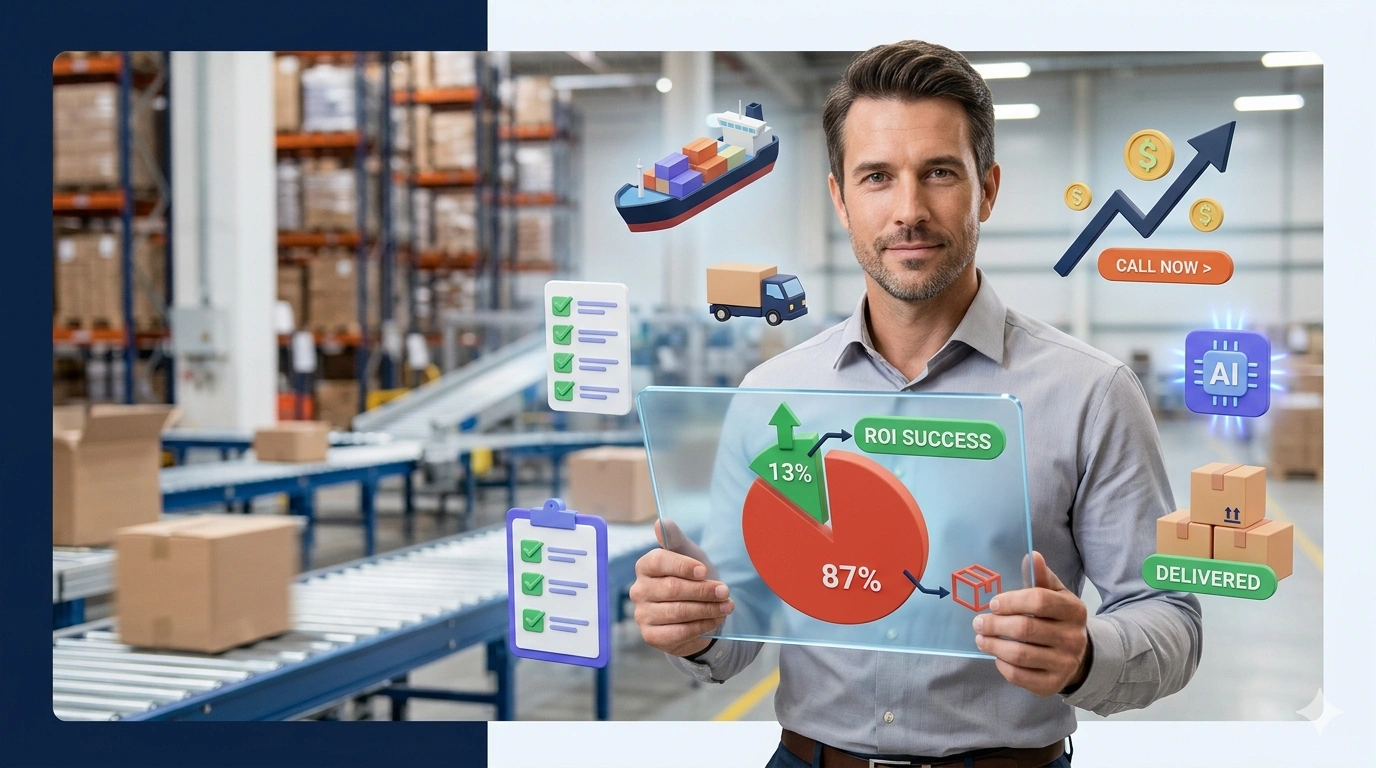
You're not alone. Recent research from BCG surveyed over 180 logistics providers and found a stark reality: despite 40% moving beyond pilots, only 10-13% have achieved measurable financial impact from AI.
Your transport planning system might be live. Your visibility dashboards might be deployed. But if you can't quantify the EBITDA impact, you're part of the 87% still waiting for ROI.
What's causing the AI ROI crisis in logistics?
The gap between deployment and impact isn't technical. It's methodological.
Most logistics AI projects focus on the wrong metrics from day one. They measure system uptime, prediction accuracy, or user adoption. But none of those translate to bottom-line impact.
The real issue? No one connected the AI system to your P&L before you built it.
The three deployment patterns that kill ROI
We've seen this pattern across logistics operations at £100M–£1B revenue companies:
Pattern 1: The Accuracy Trap Your vendor delivered a route optimization model with 95% accuracy. Impressive, right? But 95% accuracy on inefficient routes still burns fuel. Your last-mile costs stayed flat.
Pattern 2: The Dashboard Delusion You deployed real-time visibility across your network. Beautiful dashboards. Live tracking. But your dwell time didn't drop. Your carrier volatility didn't improve. You just have prettier reports of the same problems.
Pattern 3: The Pilot Paradise Your AI pilot showed promising results in a controlled environment. Then you scaled to production. Performance dropped 40%. Why? The pilot used clean data and motivated users. Production has messy data and skeptical operators.
Sound familiar?
Why transport planning AI fails to deliver ROI
According to BCG's research, transport planning and execution shows 64% adoption among logistics service providers. The highest of any AI use case.
Yet only 10-13% see measurable financial impact.
Here's what we've learned building AI systems inside logistics operations:
The missing layer: Commercial connection
Most transport planning AI optimizes for distance or time. But your P&L cares about cost per delivery, margin per route, or EBITDA per mile.
We built a route optimization system for a £500M logistics provider. The technical team focused on reducing total travel time. Impressive algorithm. Zero impact on profitability.
Then we rebuilt it. Same routes. Same data. But we optimized for margin per delivery, factoring in fuel cost, driver overtime, and customer contract terms.
Result: 18% reduction in cost per delivery. Six-figure annual saving. Identical technology. Different commercial focus.
The data engineering reality check
Your AI vendor assumed your data was production-ready. It wasn't.
Transport planning AI needs clean, connected data across:
- Customer delivery requirements
- Driver availability and constraints
- Vehicle capacity and routing restrictions
- Real-time traffic and weather conditions
- Dynamic fuel and toll pricing
Most logistics companies have this data. In seven different systems. None of them talking to each other.
The AI works in the demo. It breaks in production.
How visibility and tracking AI becomes an expensive reporting tool
BCG found 50% of logistics providers have deployed visibility and tracking AI. Second highest adoption rate.
Yet the ROI gap persists.
The pattern is predictable. You deploy AI-powered visibility to track shipments in real-time. Customers love the transparency. Operations teams get better dashboards.
But your key metrics don't move:
- On-time delivery rates stay flat
- Exception handling time unchanged
- Customer complaint volume unaffected
- Carrier performance unchanged
Why? Because visibility without action is just expensive reporting.
The action layer most companies miss
Real-time visibility is table stakes. The ROI comes from real-time intervention.
We worked with a £300M logistics provider whose AI tracked 99.7% of shipments in real-time. Impressive visibility. No impact on delivery performance.
The missing piece: automated exception handling. When the AI detected a potential delay, it did nothing. A human still had to spot the alert, assess options, and take action.
We added the action layer. AI detects exception. AI evaluates alternatives. AI triggers intervention automatically.
Result: 34% reduction in delivery exceptions. 22% improvement in on-time delivery. Same visibility data. Different response capability.
The ROI measurement framework that works
According to BCG, unclear ROI measurement is the primary barrier for 40% of logistics providers.
The solution isn't better metrics. It's connecting the right metrics to your commercial model from day one.
Framework: AI impact on logistics P&L
| AI Use Case | Technical Metric | Commercial Impact | P&L Connection |
|---|---|---|---|
| Route Optimization | 95% accuracy | 18% cost per delivery reduction | £280K annual saving |
| Demand Forecasting | 12% MAPE | 23% inventory holding cost reduction | £420K working capital improvement |
| Carrier Selection | 89% on-time prediction | 15% carrier cost reduction | £180K annual procurement saving |
| Exception Management | 2-minute response time | 34% exception resolution improvement | £150K operational cost avoidance |
Notice the pattern: we measure technical performance, commercial improvement, and P&L impact. All three. Connected.
Most companies measure one. Usually the technical metric. Then wonder why the board isn't impressed.
The three-pillar approach to logistics AI ROI
Pillar 1: Navigate - Connect AI to your margin structure
Before you build anything, map your AI use case to specific margin levers:
- Last-mile cost per delivery
- Warehouse labour cost per pick
- Carrier rate optimization opportunity
- Inventory holding cost reduction
- Customer service cost avoidance
No commercial connection, no project approval.
Pillar 2: Execute - Build for production from day one
Most logistics AI fails because it's designed for demos, not operations:
- Clean training data vs. messy production data
- Technical accuracy vs. commercial outcomes
- Prototype performance vs. scale reliability
- Algorithm optimization vs. change management
We design for production reality. Messy data. Skeptical users. Commercial pressure.
Pillar 3: Land - Measure what moves your P&L
Your AI success metrics should mirror your commercial KPIs:
- EBITDA improvement per AI system deployed
- Working capital optimization from demand forecasting
- Cost avoidance from predictive maintenance
- Revenue protection from exception management
Technical metrics matter for engineering teams. Commercial metrics matter for boards.
Why 87% of logistics companies get stuck
The failure pattern is consistent across the sector:
- Strategy without commercial grounding: AI roadmap disconnected from P&L priorities
- Pilots without production thinking: Demo success doesn't predict operational impact
- Deployment without adoption support: System works, people don't use it
- Measurement without business relevance: Track accuracy, ignore profitability
We've seen this exact pattern at three £500M+ logistics companies. Same challenges. Same stalled results.
Until they fixed the methodology.
The competitive reality: AI ROI separates winners from followers
The 10-13% achieving measurable AI ROI aren't just performing better. They're building structural advantages:
- Cost structure: 15-25% lower operational costs through AI-driven efficiency
- Service delivery: Better on-time performance and customer satisfaction
- Margin expansion: AI-optimized pricing and route planning
- Capital efficiency: Predictive systems reducing working capital needs
The gap between AI winners and AI pretenders is widening. Fast.
Your competitors in the 10-13% club aren't sharing their playbook. But the methodology is learnable.
Getting from pilot purgatory to production profit
If you're part of the 40% with AI pilots but no measurable ROI, the solution isn't more pilots.
It's better methodology.
Step 1: Commercial audit of current AI initiatives
- Map each AI project to specific P&L impact
- Identify which systems can't prove commercial value
- Calculate opportunity cost of stalled initiatives
We call this an AI FlightCheck. Five days. Complete audit. Board-ready assessment.
Step 2: Rebuild for production and ROI
- Connect AI systems to margin drivers
- Design for operational reality, not demo perfection
- Build measurement into the system architecture
This is our AI FlightPath Sprint. 30 days. Working system. Measurable impact.
Step 3: Scale what works, kill what doesn't
- Expand ROI-proven systems across operations
- Shut down zombie projects consuming resources
- Build internal capability for continuous improvement
Our AI FlightScale retainer provides embedded AI leadership for this transformation.
The 90-day path to measurable AI ROI
You don't need another AI strategy deck. You need production systems that move your P&L.
Here's how logistics leaders join the 10-13% with proven ROI:
Days 1-30: AI FlightCheck and immediate wins
- Complete commercial audit of existing AI initiatives
- Identify highest-ROI opportunity in your operations
- Deploy first working system with built-in measurement
Days 31-60: Scale and optimize
- Expand successful system across relevant operations
- Train internal teams on new processes
- Validate P&L impact through actual performance data
Days 61-90: Blueprint for continuous AI ROI
- Document methodology for future AI initiatives
- Build internal capability for ongoing optimization
- Present board-ready ROI report with expansion roadmap
90 days. Measurable impact. No more pilot purgatory.
Stop wasting AI investment, start generating AI returns
The research is clear: 87% of logistics companies are stuck between AI deployment and AI returns.
You don't have to be one of them.
The methodology exists. The proof points exist. The capability exists.
What doesn't exist is time to waste on more AI experiments that never reach production.
Your board wants results. Your operations need efficiency. Your margins need protection.
The question isn't whether AI can deliver ROI in logistics. The question is whether you'll join the 10-13% who've proven it, or remain part of the 87% still waiting.
Ready to move from AI expense to AI returns?
Book an AI FlightCheck. Five working days. Complete audit of your current AI initiatives. Board-ready assessment of highest-ROI opportunities.
No strategy presentations. No vendor pitches. Just clear analysis of how to get your AI investment generating measurable returns.
Book your AI FlightCheck here or reach out directly: hello@ai-navi.co.uk
Because your AI investment deserves better than being part of the 87% with nothing to show for it.