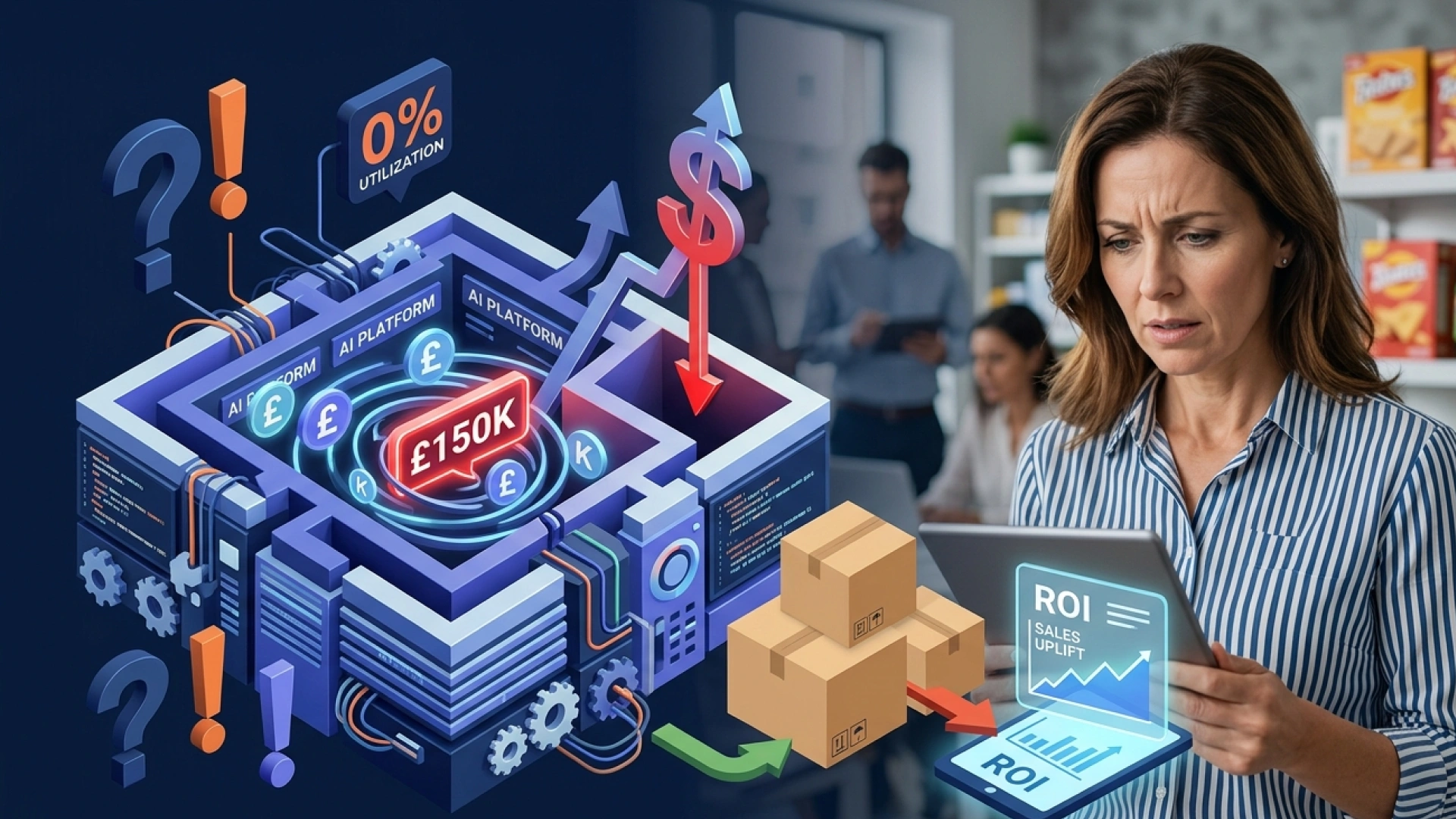
Why mid-market CPG tech leaders keep buying AI platforms they never use and what to do instead.
A Commercial Director at a £400M UK food business said their company had bought three AI tools in eighteen months. Not one was being used in a decision that mattered.
The licences cost £147,000. The implementation cost more than that again. The board had been told the platforms would “transform demand forecasting.” Instead, the S&OP team had quietly gone back to the spreadsheet — the same one they were running before the first contract was signed.
This is not an unusual story. It is, in mid-market CPG and FMCG, the default story.
Buying AI software is the most expensive form of AI inaction in the market today. It feels like progress. It rarely is.
Only 3% of UK FMCG companies have AI in full production
84% of UK FMCG leaders say their organisation needs to move faster on AI (CheckoutSmart (2025). Only 3% have reached full deployment. The other 81% are not standing still — they are buying. Platforms, modules, add-ons, copilots.
The buying is the problem.
Mid-market CPG tech leaders are under board pressure to act. The vendors know it. A £50K–£150K platform commitment feels decisive, defensible, and — critically — below the threshold where it needs a real business case. It can be approved in a steering committee on a Thursday.
Nine months later, adoption is at 8% and nobody owns the failure.
Why CPG companies keep buying AI platforms that never get used
Across the engagements at AI Navi, we run — and the much longer career both founders spent inside CPG businesses at pladis, Saint-Gobain, and others — we see the same four failure patterns. They are predictable. They are also avoidable.
1. The data foundation cannot support the software you just bought
Five years of sales data sits inside a legacy ERP that nobody can extract reliably at scale. Demand forecasting is run in Excel, with manual overrides applied by three different planners using three different judgement calls. Trade spend data lives in a finance system that does not talk to the commercial system.
The AI platform you bought assumed clean, centralised, labelled data. It got none of those things. The vendor will not say so out loud, but the implementation timeline quietly stretches from “six weeks to value” to “nine months to a pilot.”
Implementation does not fix data. Data fixes data. And data work is the part vendors deliberately quote out of scope.
2. Eighteen months is the real timeline. Nobody priced the eighteen months.
SAP AI, Salesforce Einstein, Microsoft Copilot, IBM watsonx, and every category-specific CPG AI platform on the market shares one thing: a marketing timeline that bears no relation to the implementation timeline.
Realistic CPG implementation horizons are 9–18 months for any platform deployed against more than one source system. By month nine, three things have usually happened. The internal sponsor has moved roles. The original use case has been redefined twice. And the original procurement business case is no longer accurate enough to defend at the board.
The platform does not fail at month eighteen. It fails at month four, when the data work is harder than scoped, the team is smaller than promised, and the next budget cycle has moved on to a different priority.
3. Adoption was nobody's job
A platform is not a transformation. It is a tool that requires a transformation to land.
The vendor delivered training. The IT team configured user access. A change management plan, if it existed at all, sat in a deck somewhere. Frontline planners were never asked what they actually needed. Middle managers were never trained on how the new tool changed their weekly workflow.
Six months in: 8% adoption. The S&OP team is running the old process in parallel because the new one cannot be trusted yet. Both processes are now more expensive than the one process you started with.
4. There was no AI strategy. There was a shortlist of vendors.
This is the failure that sits underneath the other three. The board asked for an AI strategy. The team responded by asking three vendors to pitch. The strategy became the shortlist.
A real AI strategy starts with the EBITDA question, not the software question. Where is the margin leak? Which decision, made every week, costs the business most when it is wrong? What data already exists to inform that decision — and what is missing? Only then does the tool conversation begin, and at that point the shortlist is shorter, the criteria are sharper, and the integration scope is realistic.
Most platforms are not bought against a strategy. They are bought against a board deadline. The two produce very different outcomes.
The real cost of a £150K AI platform
CFOs see the licence number. They do not see the rest of the bill. The honest total cost of ownership for a mid-market CPG AI platform deployment, before any value is delivered, looks closer to this:
| Cost Area | Typical Cost |
|---|---|
| Software licence | £50K–£150K annually |
| Implementation partner fees | £80K–£300K |
| Internal resource allocation | £120K–£250K |
| Data engineering | £60K–£200K |
| Change management | Usually underestimated |
- Implementation partner fees: usually a Big 4 or vendor SI, billed against an optimistic scope
- Internal team time: 1–2 FTE across IT, data, and commercial for 9–18 months
- Data engineering: make the source systems usable, almost always scoped out of the original quote
- Change management: rarely budgeted, usually delivered by a stretched HR or comms team, and the single biggest determinant of whether the platform ever gets used
A £150K platform is almost never a £150K decision. It is a £500K–£900K decision wearing a £150K invoice. And the return on it depends entirely on whether four things — strategy, data, build, and adoption — were addressed before the procurement signature.
The companies that succeed with AI do not start bigger. They start cleaner.
What to do before you sign the next platform contract
This is not an argument against AI platforms. It is an argument against buying one before you have done the work that makes one usable. Here is the sequence that consistently produces results in mid-market CPG businesses:
Step 1. Identify the EBITDA question before the software question
Pick the one decision, made every week, that costs your business most when it is wrong. For most CPG businesses this is one of three: demand forecasting accuracy, promotional ROI, or trade spend allocation. Anchor the AI conversation to that decision. Everything else is a distraction until this is named.
Step 2. Audit the data that decision depends on
Can you extract two years of clean, labelled data for that decision today? If not, you have a data engineering problem, not an AI problem. Buying an AI platform will not fix it; it will only make the problem more expensive and more visible.
Step 3. Build a working prototype before you buy the platform
A real AI prototype against your real data, delivering a real output for the team that has to use it, can be built in 4–6 weeks. It tells you three things a vendor demo cannot: whether the data is good enough, whether the team will adopt it, and whether the business case stands up when the numbers are yours, not the vendor's.
If the prototype works, the platform decision becomes obvious. If it does not, you have saved yourself £500K and eighteen months.
Step 4. Land the change before you scale the tool
Adoption is built into the build. The planners who will use the AI output need to be in the room when the prototype is designed, not handed the platform six months later and asked to embrace it. This is the part vendors cannot deliver and most internal teams underestimate.
How AI Navi approaches this
We are fractional Chief AI Officers and data engineering leaders. Both founders ran AI and data inside pladis Global, a $3B+ CPG business. We have sat in the seat the buyer is sitting in. We have been pitched the platforms. We have implemented some and quietly retired others.
Our entry product, the AI FlightCheck™, is a two-week diagnostic at that tells a CPG tech leader where their AI ROI actually sits, what their data foundation can support today, and which platform decisions are worth taking to the board. It is designed to be smaller than the procurement decision it informs below most committee thresholds, with a clear written deliverable.
Most companies we run a FlightCheck for do not need a new platform. They need a clearer view of what the platform they already own could deliver, if the data and the adoption work were done properly. Three of the last four FlightCheck engagements ended with the client cancelling or renegotiating an AI software contract — not signing a new one.
Before you sign the next AI software contract Take the 3-minute AI Readiness Scorecard. It will tell you, honestly, whether your data foundation can support the platform you are evaluating — and where the highest-ROI AI opportunity in your business actually sits. No pitch. No sales call unless you ask for one. |