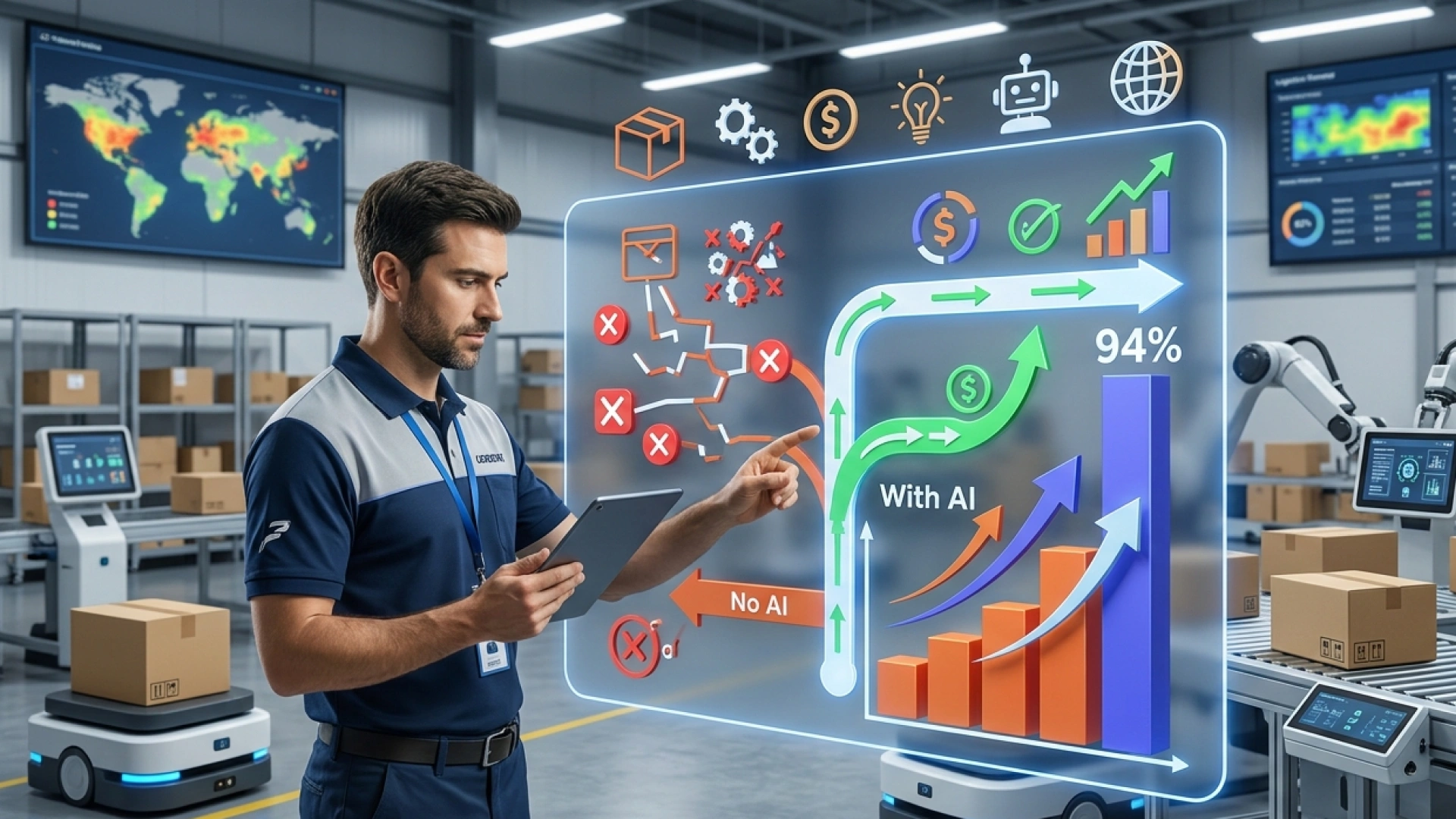
The numbers are striking on OpenSky Group, 94% of supply chain firms plan AI for decision support. DataForest reports that by 2026, 40% of enterprise apps will be powered by task-specific AI agents.
LatentView expects agentic AI systems to drive 29% of AI value by 2028.
What Is AI Decision Support Actually Delivering?
AI decision support moves beyond reporting to autonomous action. The system doesn't just flag a stockout risk — it triggers replenishment orders.
We've deployed this at scale. At our demand forecasting models didn't just predict demand. They automatically adjusted production schedules and procurement orders.
The difference: human oversight on strategy, AI execution on operations.
Traditional approach:
- Alert: "SKU X showing stockout risk"
- Human reviews data
- Human makes decision
- Human executes action
- Result: 2-3 day delay, inconsistent decisions
Agentic AI approach:
- System detects stockout risk
- System evaluates supplier capacity
- System places replenishment order
- System notifies human for oversight
- Result: Same-day response, consistent logic
Why Supply Chain Operations Need Autonomous AI
Three operational realities drive this shift:
Volume overwhelms human capacity. Modern supply chains process thousands of SKUs across dozens of locations. Manual decision-making creates bottlenecks.
Speed determines competitive advantage. Stockouts cost revenue. Overstock costs cash flow. The window for optimal decisions measured in hours, not days.
Consistency improves outcomes. Human decisions vary by experience, workload, and judgment. AI applies the same logic across all scenarios.
We've seen this pattern across logistics operations: the companies winning on efficiency run autonomous replenishment, dynamic pricing, and predictive maintenance.
The Four Pillars of Effective AI Decision Support
1. Trust Layer Architecture
AI makes decisions within defined parameters. Humans set the boundaries.
Example from our work:
- AI can adjust inventory levels between 10-30 days of stock
- AI can change pricing within ±15% of baseline
- AI cannot alter supplier contracts or payment terms
- Any decision outside parameters triggers human review
2. Exception Management Protocol
Normal operations: AI handles 80% of decisions autonomously Edge cases: System escalates to human judgment Crisis scenarios: Human override takes control
The key: designing clear escalation triggers before deployment.
3. Continuous Learning Framework
AI decisions improve through feedback loops:
- Outcome tracking: Did the decision improve KPIs?
- Human feedback: When humans override, capture the reasoning
- Model updates: Refine decision parameters based on results
We track three metrics: decision accuracy, business impact, and human intervention rate.
4. Integration with Existing Systems
Agentic AI must connect to your current tech stack:
✓ ERP systems for real-time inventory data ✓ CRM platforms for demand signals ✓ Financial systems for cost constraints ✓ Supplier portals for capacity updates
No integration = isolated decisions = suboptimal outcomes.
Common Implementation Mistakes We've Observed
Starting too broad. Most firms try to automate everything simultaneously. Start with one high-volume, low-risk decision type.
Insufficient data quality. AI decisions are only as good as input data. Clean your data foundation first.
No human training. Teams need to learn how to work with AI agents, not just monitor them.
Weak feedback mechanisms. Without learning loops, AI performance stagnates.
A Production-Ready Implementation Framework
Phase 1: Decision Mapping (Week 1-2)
- Audit current decisions: What gets decided daily? By whom? Based on what data?
- Identify automation candidates: High frequency, clear parameters, measurable outcomes
- Set success metrics: Accuracy targets, speed improvements, cost reductions
Phase 2: Pilot Development (Week 3-4)
- Build decision logic: Translate human decision trees into algorithms
- Create override mechanisms: Human controls for edge cases
- Design feedback systems: Capture outcomes for learning
Phase 3: Production Deployment (Week 5-6)
- Shadow mode: AI makes recommendations, humans decide
- Gradual handoff: AI handles increasing percentage of decisions
- Full autonomy: AI operates independently within parameters
Phase 4: Optimization (Ongoing)
- Performance monitoring: Track KPIs against baseline
- Parameter tuning: Adjust decision boundaries based on results
- Scope expansion: Apply to additional decision types
The Business Case: Why This Matters Now
Cost pressure intensifies. Labor costs rise 8-12% annually. AI handles routine decisions at fixed cost.
Competition accelerates. Customers expect same-day response. Manual processes can't match AI speed.
Complexity increases. Multi-channel, global supply chains overwhelm human capacity.
Companies implementing AI decision support report:
- 25-40% reduction in stockouts
- 15-30% improvement in cash conversion
- 60-80% faster response to disruptions
These aren't theoretical benefits. We've delivered them in production.
What Success Looks Like in Practice
At one £500M+ logistics operation, we implemented autonomous replenishment:
Before: Planners reviewed 2,000+ SKUs manually. Decision cycle: 3-5 days. Stockout rate: 12%.
After: AI handles 85% of replenishment decisions. Human review for exceptions only. Decision cycle: Same day. Stockout rate: 4%.
Result: £2.8M annual improvement in working capital efficiency.
Moving Beyond Pilot Purgatory
The 94% planning to implement AI decision support face a choice:
Build theoretical strategies that gather dust.
Or deploy working systems that deliver measurable results.
We've seen both approaches. The companies that succeed start small, move fast, and measure everything.
Your Next Step
Agentic AI isn't a future trend. It's operational reality at leading supply chain companies.
The question: Will you implement AI decision support before your competitors gain the advantage?
Book an AI FlightCheck — we'll identify your highest-ROI opportunities for AI decision support in five working days. No strategy decks. Just specific, actionable recommendations based on your current operations.
Schedule your AI FlightCheck here.