Is Industrial AI Really Critical for CPG Competitiveness by 2030?
Yes. And the timeline is shorter than you think.
According to Schneider Electric's latest study, CPG manufacturers anticipate mounting production losses without industrial AI and view it as essential for competitiveness by 2030. The study reveals deployment hurdles like unreliable data infrastructure are exacerbating risks.
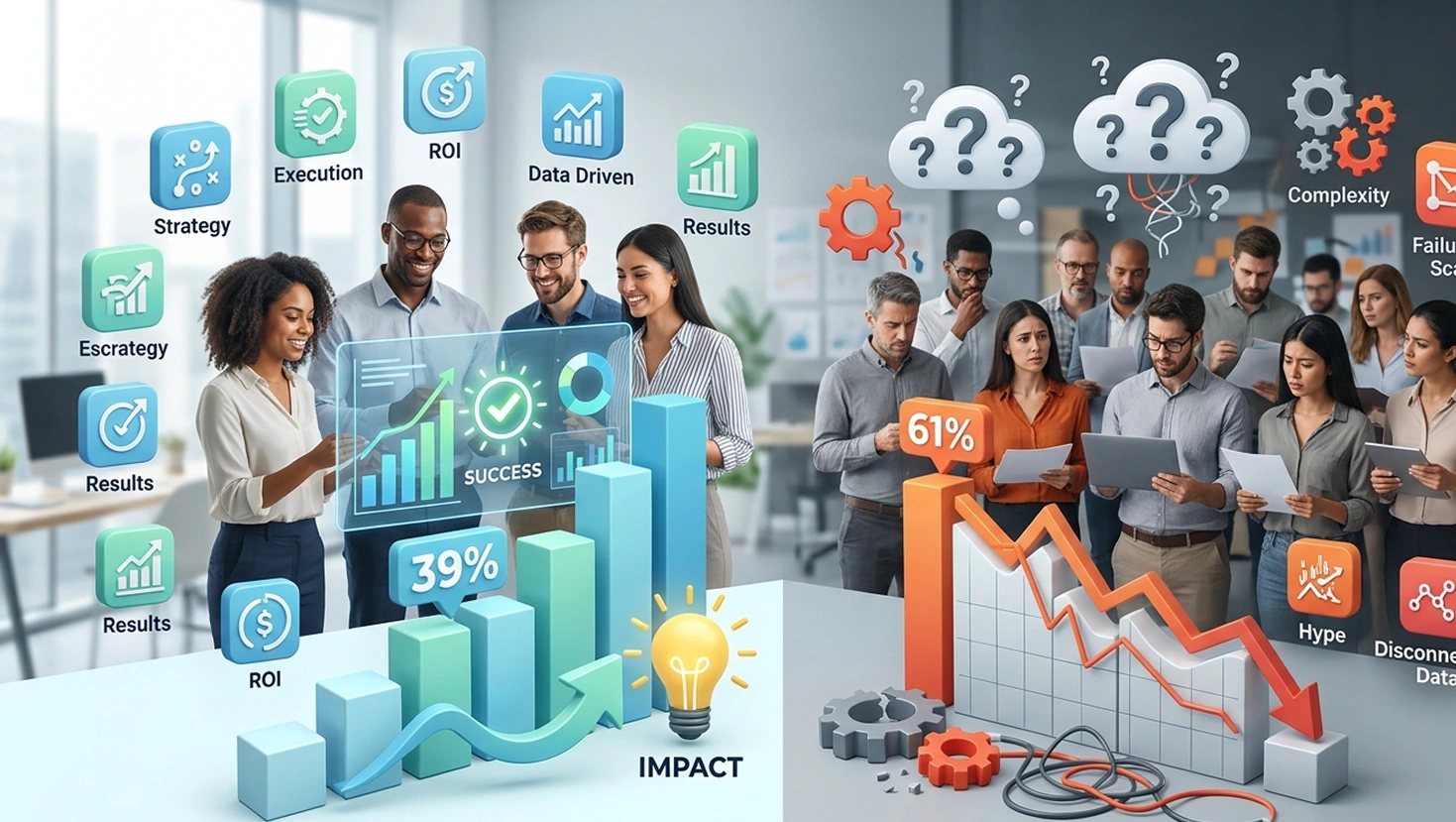
Meanwhile, according to CIO.com research, only 39% of AI programs are delivering enterprise earnings impact. CPG tech leaders face mounting pressure as boards demand rapid AI deployment.
We led AI transformation at pladis Global — £3B+ CPG revenue. The manufacturing floor tells you everything about whether AI will work or fail. Most companies are failing.
What Makes Industrial AI Different from Other AI Deployments?
Industrial AI isn't chatbots or customer service automation. It's production-line intelligence that directly impacts EBITDA.
The manufacturing environment creates unique challenges:
- Real-time decisions with physical consequences: A wrong prediction doesn't just waste compute. It wastes materials, labour, and machine time.
- Legacy system integration: Your ERP talks to your MES differently than your quality systems. AI needs to understand all three.
- Data infrastructure gaps: Sensors generate data. But is it clean? Is it contextualised? Can your models trust it?
At pladis, we tackled demand forecasting across 2,000+ SKUs in 14 markets. The complexity isn't the algorithm. It's making the algorithm work with your S&OP process, your production constraints, and your commercial reality.
Your promotional spend affects demand. Your production capacity affects what you can promise. Your carrier costs affect what you should make. Industrial AI needs to understand all of it.
Why Are 61% of CPG AI Programs Failing to Deliver Impact?
Three patterns emerge from our work with CP/FMCG companies:
Pattern 1: They Start with Technology, Not Margin Leaks
"We need AI for our factory" isn't a strategy. "We're losing 3% margin to demand forecast errors" is.
The 61% that fail start with technology selection. The 39% that succeed start with P&L impact. We always ask: where is your biggest controllable cost that AI could influence?
Pattern 2: No Data Engineering Foundation
Your data exists in silos. Production data lives in the MES. Quality data lives in LIMS. Commercial data lives in the ERP. AI needs all three to make intelligent decisions.
Most companies assume their data is "ready for AI." It isn't. We spend 60% of our first 30 days building data pipelines, not training models.
Pattern 3: No Change Management for Production Teams
Production managers have run plants for 20+ years. They trust their experience. They don't trust black-box recommendations.
Successful industrial AI explains its decisions. "Increase Line 3 speed by 8% because quality variance is low and demand forecast shows 15% uplift next week." Production teams need context, not just instructions.
How to Be in the 39% That Delivers Enterprise Impact
Based on our experience deploying AI systems in £3B+ CPG operations:
Step 1: Identify Your Highest-ROI Production Decision
| Decision Type | Typical Impact | AI Deployment Complexity |
|---|---|---|
| Demand forecasting | 2-5% margin improvement | Medium |
| Production scheduling | 8-12% efficiency gain | High |
| Quality prediction | 15-25% waste reduction | Medium |
| Maintenance planning | 10-20% downtime reduction | High |
Start with medium complexity, high impact. Quality prediction typically wins.
Step 2: Build the Data Foundation First
Don't hire data scientists until your data engineering is solid.
Your production data needs:
- Real-time ingestion: Decisions happen in minutes, not hours
- Contextual enrichment: Machine temperature means nothing without product context
- Quality validation: Bad data creates expensive mistakes on production lines
We built a real-time data pipeline at pladis that ingested sensor data from 12 production lines across 3 plants. The engineering took 8 weeks. The AI model took 2 weeks.
Step 3: Deploy with Production Team Buy-In
Production managers need to understand why the AI made its recommendation.
We use a three-layer approach:
- Decision layer: "Reduce batch temperature by 2°C"
- Reasoning layer: "Quality variance is trending up, and we're 15 minutes from the tolerance limit"
- Override layer: "Production manager can override with one click and provide feedback"
The override data improves the model. Production teams feel in control, not controlled.
What Industrial AI Success Looks Like by 2030
Successful CPG manufacturers will have AI systems that:
- Connect production decisions to commercial outcomes: Not just efficiency, but margin per SKU
- Predict quality issues 2-3 batches ahead: Instead of reacting to failures
- Optimize across constraints: Production capacity, raw material costs, demand volatility
- Learn from production team expertise: Augmenting human judgment, not replacing it
We're already seeing this in our client work. One logistics client reduced last-mile costs by 18% using AI routing that learned from driver preferences and customer patterns.
Another CPG client improved case fill rates by 12% with demand sensing that combined sales data, promotional calendars, and weather patterns.
The 2030 Deadline Is Really a 2026 Implementation Deadline
Industrial AI deployment takes 18-24 months from strategy to full production impact.
If competitive advantage requires industrial AI by 2030, you need working systems by 2028. Which means you need to start AI implementation by 2026.
The companies that wait until 2027 will be buying catch-up technology from competitors who started early.
Your Next Step: Industrial AI Readiness Assessment
Most CPG companies don't know if their data infrastructure can support industrial AI. Or which production decisions offer the highest ROI.
We've developed the AI FlightCheck specifically for CP/FMCG manufacturers. In five working days, we:
- Audit your production data readiness across all systems
- Identify your three highest-ROI AI opportunities with P&L impact projections
- Map the 18-month deployment roadmap with specific milestones
- Help you be in the 39% that actually delivers enterprise impact.
Board-ready briefing. No theoretical strategy deck. Specific recommendations based on your production environment and commercial constraints.
The 2030 competitiveness deadline isn't optional. But whether you're in the 39% that succeeds or the 61% that struggles — that choice is happening now.
Book your AI FlightCheck consultation. We'll show you exactly where industrial AI can impact your P&L, and what it takes to get there by 2030.
AI Navi provides fractional AI leadership for CP/FMCG and logistics companies, helping transform promising pilots into production systems. Your board wants AI results. Your production teams are running on legacy systems. The clock is ticking toward 2030.