Why Consumer Products Leaders are Failing at AI Integration (And How to Fix It)
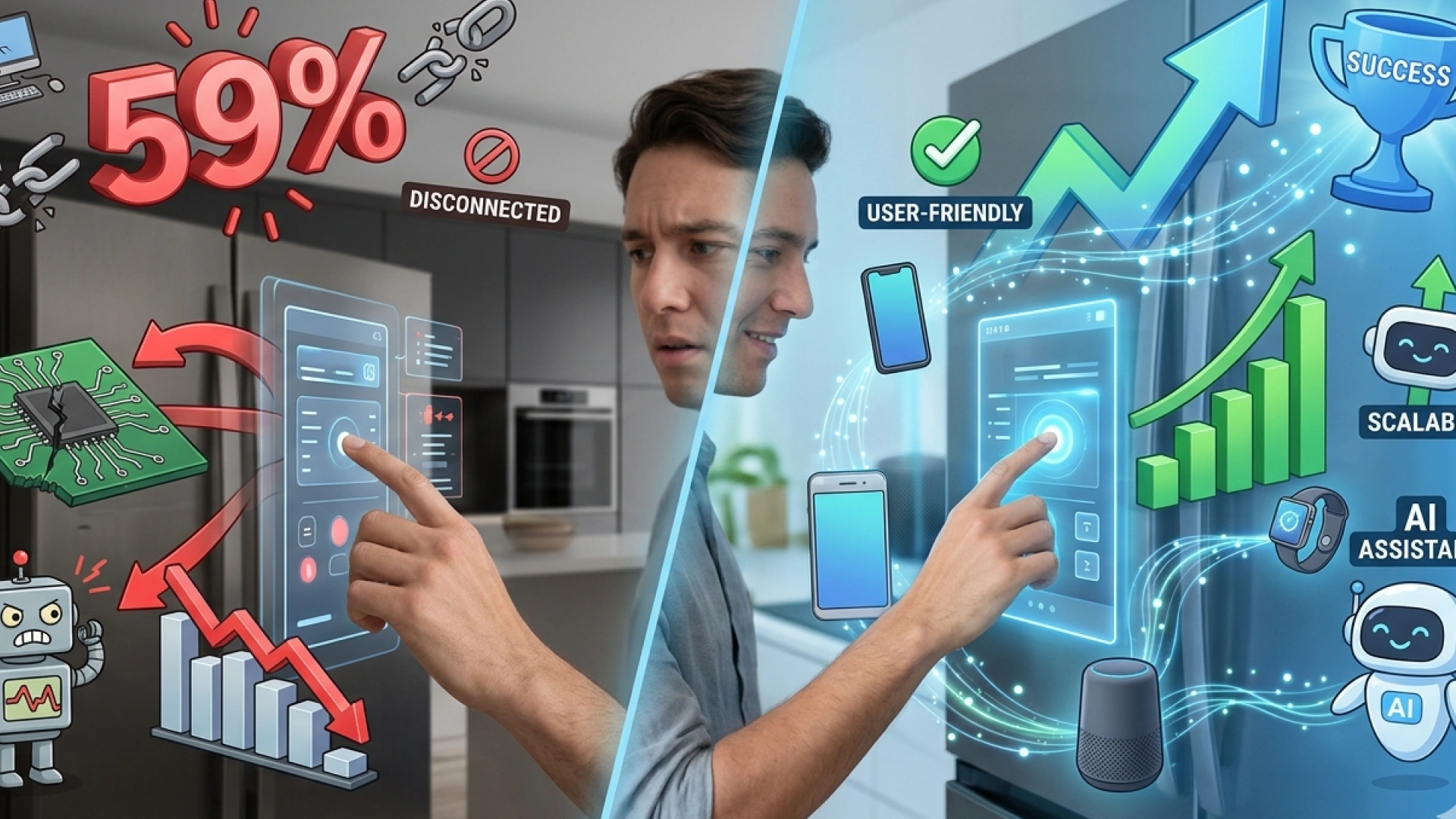
As AI strategy experts specializing in consumer products and FMCG, we at AI Navi, help leadership teams move beyond pilot projects to full-scale AI transformation. If you're a consumer products leader, you're facing a reality that our recent sector analysis confirms: 59% of your peers cite integration complexity as their number one barrier to AI success.
This isn't a technology problem. It's an execution problem. And it's costing your business competitive advantage every quarter you delay.
What's Really Behind Consumer Products' Integration Challenge?
Integration complexity tops the list because consumer products companies operate across more touch points than any other sector. You're managing supply chains, retail partnerships, direct-to-consumer channels, manufacturing operations, and regulatory compliance simultaneously. When AI initiatives can't speak to each other across these functions, they create data silos instead of business value.
The numbers tell the story: only 27% of consumer products companies have fully embedded an AI strategy across business units, and just 37% are comfortable letting AI agents execute complete processes. Compare this to financial services, where integration challenges rank fifth, and you see why consumer products needs a fundamentally different approach.
Why Traditional AI Implementation Approaches Fall Short in Consumer Products
Most AI consultancies treat every industry the same. They focus on technology deployment without understanding how consumer products businesses actually operate.
Here's what we've observed across dozens of FMCG implementations: companies get sold on point solutions that work beautifully in isolation but fail spectacularly when they need to coordinate across the business.
The Procurement Trap
Your procurement team buys an AI tool for demand forecasting. Marketing implements a separate AI platform for campaign optimization. Supply chain deploys predictive analytics for inventory management. Finance uses AI for pricing optimization.
Six months later, you have four AI systems that can't share data, contradictory recommendations, and frustrated teams who've lost confidence in AI altogether.
The Pilot Project Purgatory
We see consumer products companies running endless pilot projects that never scale. Why? Because they're testing AI in controlled environments that don't reflect the messy reality of how consumer products businesses operate.
A demand forecasting pilot might show 15% accuracy improvement using clean historical data. But when you try to scale it across multiple SKUs, seasonal variations, promotional periods, and new product launches, the model breaks down because it wasn't designed for integration complexity.
The Three Integration Challenges Specific to Consumer Products
Challenge 1: Multi-Channel Data Orchestration
Consumer products companies collect data from retail partners, e-commerce platforms, social media, manufacturing systems, and customer service channels. Each source has different formats, update frequencies, and quality standards.
| Data Source | Update Frequency | Format | Integration Complexity |
|---|---|---|---|
| Retail POS | Daily/Weekly | EDI/CSV | High - multiple partners |
| E-commerce | Real-time | API/JSON | Medium - standardized formats |
| Manufacturing | Hourly | ERP/Database | High - legacy systems |
| Social Media | Real-time | API/JSON | Low - standardized APIs |
| Customer Service | Real-time | CRM/Database | Medium - structured data |
Without proper orchestration, your AI initiatives become isolated experiments rather than integrated capabilities.
Challenge 2: Cross-Functional Process Dependencies
In consumer products, AI decisions in one department immediately impact others. A promotional pricing algorithm affects demand forecasting, which impacts production planning, which affects supply chain optimization, which impacts customer satisfaction scores.
We worked with a major beverage company where their AI-driven promotional strategy increased sales 12% but created stockouts that damaged retailer relationships. The AI was optimizing for the wrong objective because it wasn't integrated with supply chain constraints.
Challenge 3: Regulatory and Compliance Integration
Consumer products companies face complex regulatory requirements across markets. Your AI systems need to incorporate food safety regulations, labeling requirements, environmental standards, and data privacy laws simultaneously.
This isn't just about compliance reporting—it's about embedding regulatory intelligence into AI decision-making from day one.
How Leading Consumer Products Companies Approach AI Integration
The Three-Pillar Integration Framework
Successful consumer products AI implementations follow a three-pillar approach: Strategy alignment, Data orchestration, and Change management.
Strategy Pillar: Business-First AI Planning
Start with business outcomes, not technology capabilities. We help consumer products leaders define AI success metrics that align with their specific market dynamics:
- Brand Portfolio Management: How does AI support your brand architecture decisions?
- Channel Optimization: How does AI improve performance across retail, e-commerce, and direct channels?
- Innovation Pipeline: How does AI accelerate new product development cycles?
Data Pillar: Unified Consumer Intelligence
Create a single source of truth that connects customer behavior, market performance, operational efficiency, and financial outcomes. This means:
- Real-time data synchronization across all touchpoints
- Standardized metrics that work across categories and markets
- Privacy-compliant customer data integration
- Predictive models that account for seasonality, promotions, and market events
Change Pillar: Cross-Functional AI Adoption
Consumer products success requires coordinated change across marketing, sales, supply chain, finance, and operations. This means:
- Shared AI literacy training across functions
- Integration protocols that prevent AI systems from working at cross-purposes
- Performance metrics that reward collaboration over individual optimization
What Full AI Integration Actually Looks Like in Practice
When consumer products companies get integration right, the results are transformative. Here's what we see:
Coordinated Decision Making
Marketing's promotional AI talks to supply chain's inventory AI talks to pricing's optimization AI. Instead of three separate point solutions, you have one integrated intelligence system that maximizes overall business performance.
Real-Time Market Response
When a competitor launches a new product, your integrated AI system immediately assesses impact across all relevant metrics: market share risk, inventory implications, promotional response options, and financial projections. You can respond strategically within hours, not weeks.
Predictive Business Planning
Your AI doesn't just forecast demand—it predicts the downstream impacts of demand changes on manufacturing capacity, supplier relationships, logistics costs, and cash flow. You can model "what-if" scenarios across your entire value chain.
The Navigate-Execute-Land Methodology for Consumer Products AI
Navigate Phase: AI Strategy That Fits Your Business Model
We start by mapping your specific consumer products complexity:
- Category dynamics and seasonal patterns
- Retail partnership requirements
- Regulatory landscape across markets
- Brand portfolio interdependencies
This isn't a generic AI strategy—it's designed specifically for how consumer products businesses create value.
Execute Phase: Integrated Implementation
Instead of isolated pilots, we implement AI capabilities that work together from day one:
- Connected data architecture across all business functions
- AI models that share common assumptions and objectives
- Integration protocols that prevent system conflicts
- Change management that coordinates across departments
Land Phase: Sustainable AI Operations
We ensure your AI capabilities evolve with your business:
- Continuous learning systems that improve over time
- Integration maintenance that prevents system drift
- Team capabilities that support ongoing optimization
Making AI Integration Work: Your Next Steps
If you're a consumer products leader frustrated with AI initiatives that never deliver on their promise, the solution isn't better technology—it's better integration.
Start by auditing your current AI investments. Ask these questions:
- Can your AI systems share data and coordinate decisions?
- Do your AI initiatives support your overall business strategy?
- Are your teams equipped to work with integrated AI capabilities?
If the answer to any of these is "no," you're experiencing the integration complexity that's blocking 59% of your peers.
The good news? This challenge is solvable with the right approach. Consumer products companies that get integration right don't just improve efficiency—they gain sustainable competitive advantage.
Ready to move beyond pilot projects to integrated AI transformation?
Let's discuss how the Navigate-Execute-Land methodology can address your specific integration challenges.