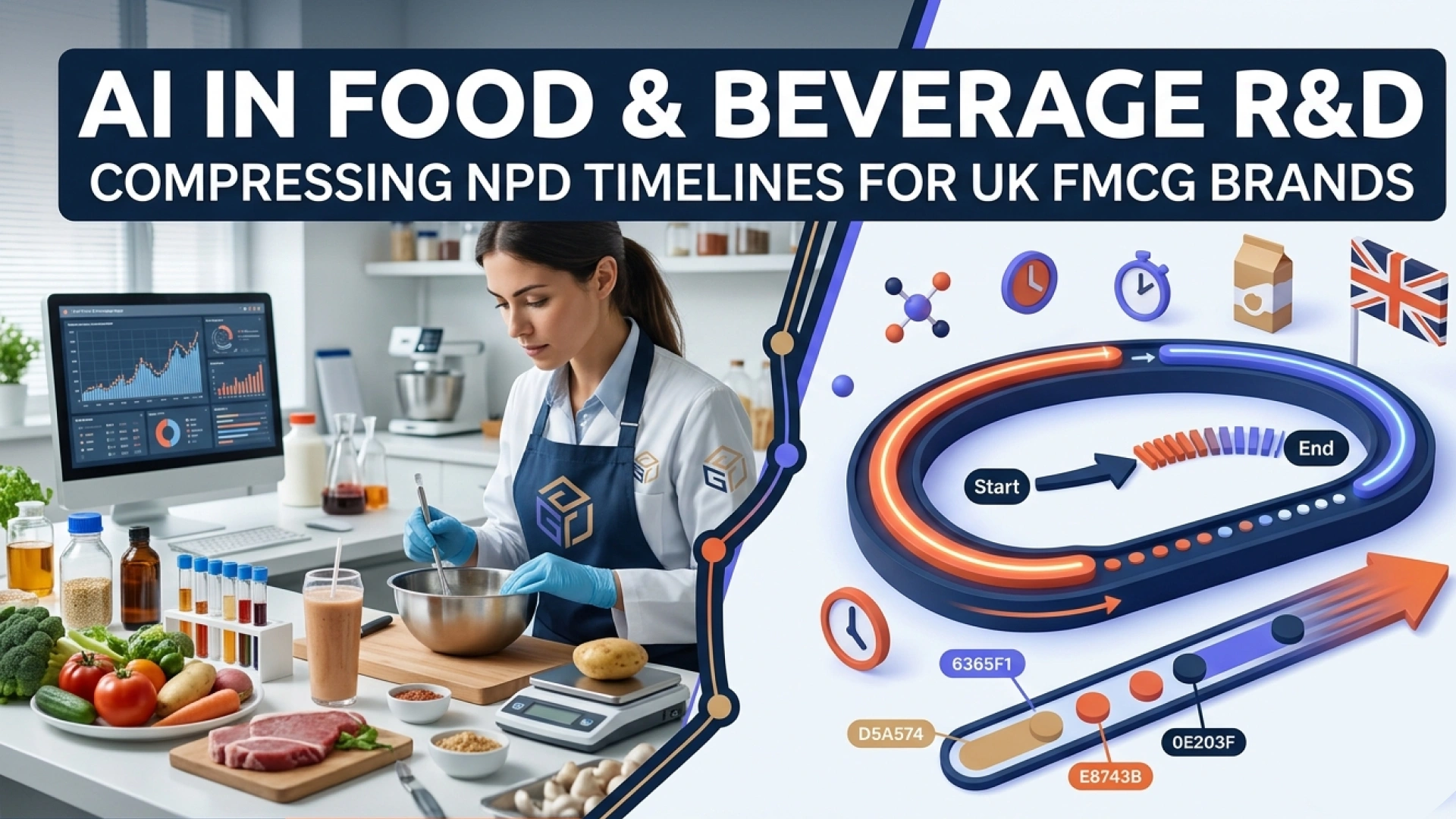
UK food and beverage brands are under sustained pressure from three directions simultaneously: ingredient cost inflation is squeezing reformulation budgets, retailer range reviews are demanding faster innovation pipelines, and allergen and regulatory requirements are adding compliance friction at every stage of development.
The traditional response (longer R&D cycles, more testing rounds, additional headcount) is no longer commercially viable at the margin pressure levels most mid-market brands are carrying. A product that takes 18 months from brief to shelf has already missed one or two retailer review windows and absorbed significant resource cost before it generates a single point of margin.
AI is beginning to change the sequence of how food and beverage businesses move from concept to production. The evidence from large CPG businesses is clear at AI Navi. The question for Multi-million pound UK food brands is how to access the same capability without the data infrastructure budgets of a Unilever or a Nestle.
This article sets out what generative formulation AI, predictive shelf-life modelling, and compliance automation actually do in practice; where the real bottlenecks sit; and what a realistic 90-day starting point looks like for a mid-market UK food and beverage business.
What is generative formulation AI and how is it being used in food and beverage R&D?
Generative formulation AI refers to machine learning systems trained on ingredient databases, flavour interaction data, nutritional profiles, allergen flags, and historical product performance data to model and propose new formulations automatically. Rather than an R&D team running sequential bench trials across weeks, the system generates and ranks candidate formulations against defined parameters (cost, nutritional target, flavour profile, shelf life) in hours.
The practical applications currently in commercial use across the sector include:
- Formulation proposal and optimisation: generating ingredient combinations that meet a defined cost, nutrition, and sensory brief, reducing the number of physical trials required before bench confirmation.
- Predictive shelf-life modelling: estimating product deterioration under different storage and distribution conditions based on historical product and ingredient data, reducing the time and cost of accelerated shelf-life testing.
- Regulatory compliance and claim validation: automatically checking proposed formulations against allergen labelling requirements, clean label standards, and market-specific regulatory rules before any physical prototype is produced.
- Reformulation scoping: identifying which ingredient substitutions are most likely to achieve a cost or sustainability target while preserving the sensory profile of an existing product.
Industry reporting from Just-Food, which covers AI in food NPD specifically, describes the sector as moving past early AI experimentation and into formulation-specific applications, with allergen detection and regulatory claim validation among the most commercially mature use cases currently in deployment. The majority of implementations remain point solutions -- AI that handles one step and then hands off to a human for the next. That does not reduce the commercial opportunity for mid-market brands; it defines the entry point precisely.
How is AI compressing NPD timelines in food and beverage manufacturing?
The standard NPD cycle in mid-market food and beverage runs 12 to 18 months from concept brief to retail launch. The compression AI creates is not distributed evenly across that cycle. It concentrates in three specific phases.
Ideation to brief
Consumer trend analysis, competitor benchmarking, and whitespace identification that previously required weeks of manual research can be completed in days using AI trained on retail range data, menu datasets, social signals, and sales history. The brief that reaches the R&D team arrives with more evidence behind it and fewer wasted degrees of freedom.
Bench trial iteration
This is where AI delivers the largest single time saving. Physical bench trials are expensive and slow; each iteration requires ingredient procurement, laboratory time, sensory panel resource, and analytical testing. AI can model iteration cycles computationally before any physical trial is run, reducing the number of bench rounds required from ten or fifteen to three or four. That single compression (fewer rounds, not shorter rounds) is where the majority of the time and cost saving sits.
Compliance clearance
Allergen labelling requirements, HFSS regulations, clean label commitments, and retailer-specific nutritional standards create a compliance matrix that a mid-market brand's R&D team typically checks manually against each formulation draft. AI systems trained on the relevant regulatory frameworks can perform these checks automatically, flagging issues at the proposal stage rather than after a prototype has already been produced.
What are the biggest data barriers blocking AI adoption in food and beverage R&D?
The tooling now exists. The barrier for most mid-market UK food and beverage businesses is not access to AI platforms. It is the state of the data that would need to feed those platforms.
Three specific constraints appear consistently across businesses assessed:
Formulation data fragmentation
Recipes and formulation records exist in disconnected systems: ERP, spreadsheets, laboratory information management systems, and individual scientists' files. No single queryable source of truth for historical formulation data means no AI system can be trained on the business's own product history. It can only work with generic ingredient databases, which reduces predictive accuracy and commercial relevance significantly.
Unstructured trial data
Decades of bench trials exist as paper records, PDFs, and email threads rather than machine-readable formats. The institutional knowledge is real; the AI-readiness of that knowledge is close to zero. Without structured historical trial data, a generative formulation AI cannot learn from what has and has not worked in the specific context of the brand's sensory standards, cost parameters, and consumer base.
Supplier data in non-usable formats
Ingredient supplier technical data sheets, allergen declarations, and nutritional specifications are typically provided as PDFs. For an AI compliance system to check a proposed formulation against allergen requirements automatically, that data needs to exist in a structured, queryable format. Most mid-market businesses receive it in formats that require manual extraction before any automation is possible.
This is the data architecture problem that precedes any R&D AI investment. Addressing it does not require a multi-year transformation programme. It requires a scoped, sequenced 60-to-90-day effort that structures the highest-priority data assets and connects them to a pilot AI use case. Without that foundation, AI tooling delivers a sophisticated front end sitting on top of a fragmented data estate, and the projected time saving does not materialise.\
AI Navi InsightIn food and beverage R&D specifically, the constraint is almost always formulation data structure rather than AI tooling availability. The businesses making the fastest progress on NPD cycle compression are those that addressed their data estate in the first 60 days before commissioning any AI platform. |
How does AI support allergen detection and regulatory compliance in food reformulation?
Allergen management is a significant and growing compliance burden for UK food and beverage manufacturers. Fourteen major allergens must be declared under UK food labelling law, and the consequences of a labelling error (product recall, regulatory action, reputational damage) are commercially severe at any business size.
For mid-market brands managing frequent reformulation driven by ingredient cost inflation or sustainability commitments, the compliance check on each reformulation iteration represents a meaningful slice of total R&D resource. When ingredient substitutions are being considered at speed, the risk of a manual compliance process missing a cross-contamination risk or labelling implication increases.
AI-assisted compliance works by maintaining a live, structured map of ingredient allergen profiles, supplier declarations, and regulatory requirements by market, then automatically checking any proposed formulation change against that map. A formulation change that introduces a new allergen risk surfaces the flag before the change progresses to physical testing. A regulatory claim (high in protein, no added sugar, clean label) can be validated against the formulation data in seconds.
Analysis of AI in food safety and product development identifies allergen detection and regulatory claim validation as areas where AI deployment is most commercially advanced, precisely because the structured, rules-based nature of regulatory compliance maps well to current AI capabilities.
For UK mid-market brands, the practical entry point is an ingredient master data project: structuring supplier allergen declarations and nutritional data into a queryable format. This serves as the foundation for automated compliance checking across all future reformulation work, compounding in value across every project that follows.
What does a 90-day AI R&D pilot look like for a mid-market UK food brand?
The most common mistake mid-market food businesses make when approaching AI in R&D is attempting to address the full NPD workflow at once. This leads to large, slow-moving projects that run out of board patience before any measurable output is visible.
A structured 90-day pilot scopes to a single high-value use case with clear input and output conditions and measures results against a specific commercial metric. The three most productive starting points for food and beverage brands of £40M-£150M in revenue are:
Reformulation cost modelling
Objective:
reduce the cost of a specified product line's formulation by a defined percentage through ingredient substitution, without materially affecting the sensory profile.
AI input:
structured formulation data and historical trial outcomes.
AI output:
ranked list of candidate substitutions with predicted sensory and cost impact. Human role: bench confirmation of top-ranked candidates. This is achievable in 90 days where the formulation data is sufficiently structured, and the ROI is directly measurable against the current formulation cost.
Shelf-life prediction for a new format
Objective:
generate reliable shelf-life predictions for a new product format or packaging configuration before investing in a full accelerated shelf-life testing programme. AI input: historical shelf-life data for comparable products.
AI output:
shelf-life probability distribution under specified storage conditions.
Human role:
targeted physical testing of predicted boundary conditions rather than a full accelerated programme. The saving in testing time and cost is visible within the 90-day window.
Allergen compliance automation
Objective:
remove manual compliance checking from the reformulation sign-off process.
AI input:
structured ingredient master data with allergen declarations.
AI output:
automated allergen flag on every proposed reformulation change before it progresses to physical testing.
Human role:
exception management. This is as much a data infrastructure project as an AI project, and the efficiency gains compound across every future reformulation.
An AI FlightCheck diagnostic typically identifies which of these use cases is most accessible given the business's current data estate and produces a 90-day action plan scoped to the highest-priority entry point. The FlightCheck is completed in two to four weeks and produces a 15-page diagnostic report with a Flight Risk Index score and a sequenced delivery plan.
What ROI can UK food brands realistically expect from AI in product development?
The ROI case for AI in food and beverage R&D is most robust when anchored to four specific metrics rather than generalised efficiency claims.
Reduction in bench iterations
If a typical reformulation currently requires twelve physical bench trials and AI computational modelling reduces that to four, the saving in laboratory time, ingredient procurement, sensory panel resource, and analyst time is significant and directly measurable. A single reformulation project at a mid-market brand can absorb £80,000-£150,000 in direct R&D resource. Reducing the iteration count substantially has a clear margin impact.
Reduction in time-to-market
A product that reaches retail shelf three months earlier than the traditional timeline captures an additional quarter of revenue, avoids missing one retailer review window, and reduces the working capital tied up in development. For a product generating £2M per year in revenue, three months' acceleration is a £500,000 revenue question.
Reduction in compliance cost
Manual allergen and regulatory compliance checking adds time and cost to every reformulation. Automating that check reduces the per-project compliance burden and reduces the risk of a product recall that would dwarf the entire AI investment.
Improved SKU success rate
The most commercially significant metric and the most difficult to quantify in advance. If a brand's historical new product failure rate runs at 60-70 percent within three years of launch, a 10-point improvement across an innovation pipeline of 20 products per year represents a material EBITDA shift.
These metrics reflect the outputs observed where structured data foundations were in place before AI tooling was introduced. The critical qualifier is exactly that: without the data architecture, the ROI does not materialise.
Businesses seeking to understand where they sit before committing to an R&D AI investment can complete AI Navi's AI Readiness Scorecard at in under ten minutes. The output identifies the specific data and organisational readiness gaps most likely to affect delivery in R&D and adjacent functions.
Frequently Asked Questions
What types of AI are most useful in food and beverage R&D?
The most commercially mature applications are generative formulation tools that model ingredient combinations against defined parameters, predictive shelf-life systems trained on historical product data, and rules-based regulatory compliance checkers. Consumer trend analysis AI is widely adopted but sits earlier in the pipeline, informing the brief rather than the formulation.
How long does it take to see results from AI in food NPD?
A focused 90-day pilot scoped to a single use case (typically reformulation cost modelling, shelf-life prediction, or allergen compliance automation) can produce measurable results within the pilot window. A full NPD cycle compression from 18 months to under six months requires structured data foundations and integrated tooling, which takes 6-12 months to build at a mid-market business.
Do we need to replace our current ERP or formulation software to use AI in R&D?
No. The first priority is structuring the data that already exists in current systems, not replacing those systems. AI tools can be connected to existing ERP, LIMS, and formulation software via API once the underlying data is structured. A data architecture project typically precedes any platform integration and is significantly lower cost.
How much does AI implementation cost in food and beverage R&D?
The cost depends on scope. A diagnostic to assess readiness and identify the highest-ROI starting point is comparable to a market audit (£5,000-£10,000). A 90-day pilot scoped to a single use case with structured data as a prerequisite typically runs in the range of a small consultancy engagement. Full NPD workflow AI integration is a multi-month programme best approached via phased delivery.
What is the risk if we invest in AI tools before our data is ready?
The primary risk is a failed pilot that consumes budget and board confidence without producing measurable output. The second risk is vendor lock-in to a platform built on unstructured data that requires a subsequent data migration before it can be properly used. The diagnostic step exists to avoid both.
Who should own the AI R&D programme inside a food business?
The programme should be owned by someone with authority to make decisions across both the R&D function and the data infrastructure. In practice, this means either a fractional Chief AI Officer, a sufficiently empowered Innovation Director, or a fractional AI lead embedded with cross-functional authority. Projects that sit exclusively within R&D without data engineering support consistently stall at the data structuring phase.
Next Step
The commercial case for AI in food and beverage R&D is not speculative. The tooling exists, the first-party evidence from large CPG businesses is clear, and the entry point for mid-market brands is well-defined.
The work that precedes tooling (structuring formulation data, cleaning ingredient master data, mapping historical trial records) is not complex. But it requires a sequenced plan and someone who has done it before.
AI Navi's AI FlightCheck diagnostic identifies exactly where your data estate sits today and which R&D AI use case is most accessible in a 90-day window.
Find out where your R&D data estate sits before you invest in tooling. Take the AI Readiness Scorecard.