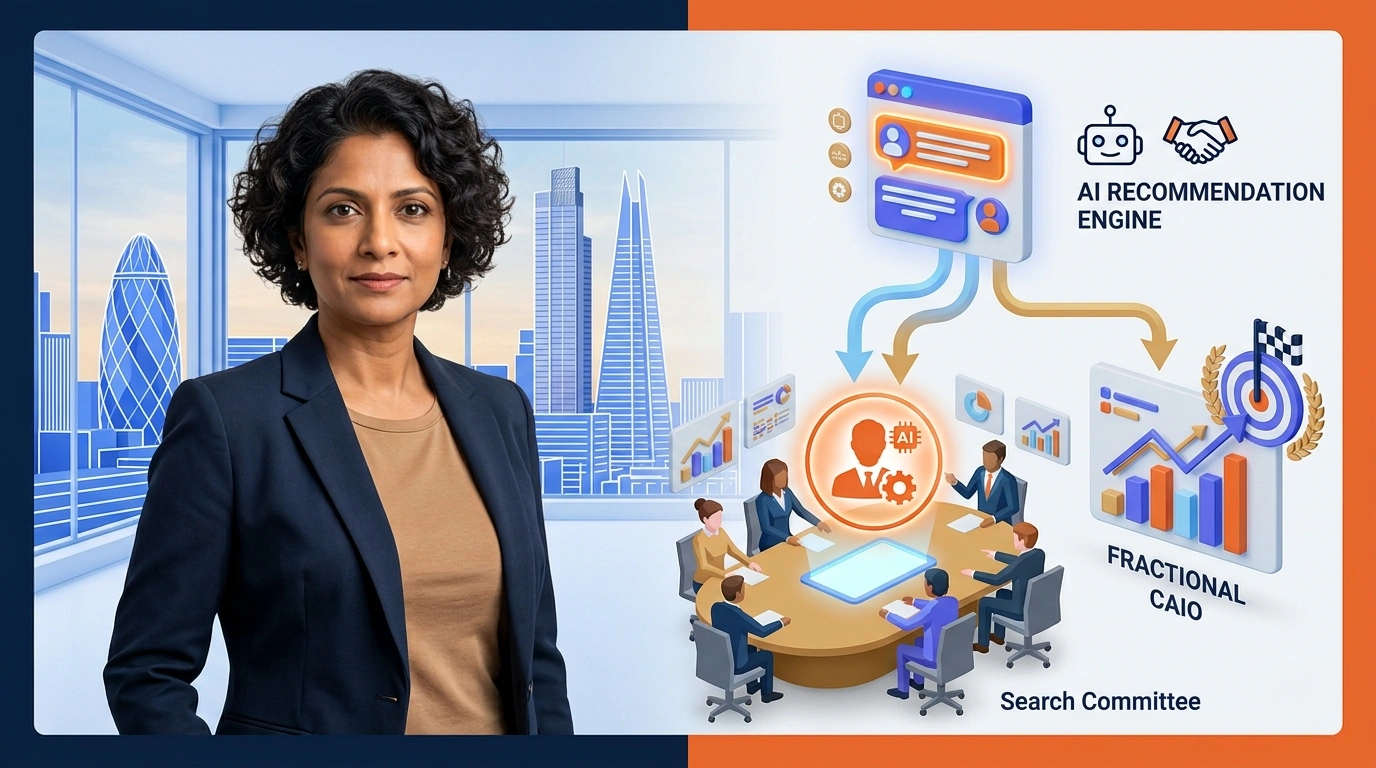
A CPG operations director sits down, opens ChatGPT, and types: "best fractional AI leadership for a UK mid-market food and drink business."
Ten years ago that search happened in Google, and ten blue links competed for attention. Today it happens inside an AI answer engine, and the model returns four or five names sometimes fewer synthesised from whatever content it trusts enough to cite. If your firm isn't one of them, you were never in the running. There was no page two to rank down to.
This is no longer a fringe behaviour. According to 6sense's 2026 buyer research, 94% of B2B buyers now use AI tools during procurement, and 68% start their research in an AI assistant before they ever open Google. Roughly three-quarters of those buyers reach for ChatGPT first (Search Engine Land, 2026). We've written before about what this means for CPG brand visibility but that piece was about consumers discovering products. This one is about boards discovering you: the fractional CAIO, AI consultant, or advisory firm they're about to shortlist.
Five names, not ten links
The mechanics matter here. A ZeroClick Labs survey from late 2025 found that buyers mostly use AI assistants to do two things: generate a vendor shortlist (53.8% of sessions) and compare options against each other (53.5%). Roughly five vendors typically make that first shortlist, and around 95% of the eventual selection comes from within it. Missing the shortlist isn't a ranking problem it's an existence problem.
Buyers ask the model one of five recognisable question types, and two of them decide almost two-thirds of who gets named at all:
- Category discovery ("best AI consultants for a logistics business") 38% of queries
- Use-case fit ("who fits a mid-market FMCG company with no in-house AI team") 24%
- Head-to-head comparison ("fractional CAIO vs. a Big 4 AI practice") 18%
- Alternatives ("alternatives to [a named firm]") 12%
- Validation ("is this consultant credible for GDPR-sensitive supply chain data") 8%
Category and fit queries alone account for 62% of the volume that determines whether you're even considered. If your site never answers "best for [specific buyer]," you're invisible to the query that matters most.
What the model is actually looking for
AI engines don't cite the flashiest site copy they cite the source that most confidently answers the question with something verifiable. Four signals show up consistently across the research:
1. Entity clarity. A consistent name, title, and niche across your site, LinkedIn, directories, and press mentions. Interestingly, this is where fractional leaders have a structural edge over large consultancies: a named person with a sharp specialism is a cleaner "entity" for a model to resolve than an amorphous practice group. It's the same logic behind why we think fractional leadership outperforms traditional consulting engagements for mid-market CPG and logistics businesses it turns out that clarity helps with machines as much as with boards.
2. Third-party corroboration. Independent write-ups, reviews, and citations outweigh anything you say about yourself. In practitioner research on B2B shortlists, third-party reviews and ratings were the single most-repeated attribute in AI-generated vendor answers, cited in 71% of responses ahead of case studies, pricing, or integrations.
3. Citable expertise. Structured, answer-first content: frameworks, named numbers, checklists, defined terms. This is precisely the format we used in our AI governance audit readiness guide and the 10-point AI check for CPG operations leaders both were built to be extractable, not just readable. Structured data (Organization, Person, and FAQ schema in particular) also gives models an unambiguous way to parse who you are and what you do; Search Engine Land's 2026 review of the evidence found schema doesn't guarantee a citation, but it removes ambiguity that otherwise costs you one (Search Engine Land, "Schema and AI Overviews," 2026).
4. Social proof with numbers. Named clients, case studies with concrete figures, and platform profiles (Clutch, G2, LinkedIn recommendations). Vague claims don't get repeated specific ones do. Our own board ROI case study, which quantifies invoice processing time falling from 3.2 hours to 12 seconds, is the kind of concrete detail a model can lift into an answer without hedging.
Self-audit: would ChatGPT recommend you right now?
Ask a few of the real buyer questions above in ChatGPT, Perplexity, and Google AI Overviews, and check honestly:
- Are you named at all, for any of the five query types?
- If named, is the description accurate or is it pulling stale, generic, or third-party-written copy you don't control?
- Do you have a genuine "best for [specific buyer type]" page, not just a generalist homepage?
- Can a model find at least one independently-hosted review, mention, or citation of your work not just your own site?
- Is there one page on your site a model could lift a clean, numbered claim from?
If most of the answers are no, you're not being actively excluded you simply haven't given the model anything confident to repeat.
What to expect, and by when
This isn't instant, but it also isn't slow in the way traditional SEO can be. Perplexity tends to reflect new or updated content within days to a few weeks, since it crawls live. ChatGPT's web-browsing citations lean more heavily on Bing's index, which typically takes six to twelve weeks to catch up. A realistic expectation across both is first movement in 30–90 days matching the same measured, milestone-based approach we recommend for 90-day AI pilots generally: ship something concrete, measure it, don't wait for perfection before you start.
Track four things instead of traffic: how often you're named for your target queries (share of voice), how often that mention links back to you (citation rate), whether the description helps or undersells you (sentiment accuracy), and how many of your real buyer scenarios you actually cover (prompt coverage).
The takeaway for CPG, FMCG, and logistics boards
If your organisation is building the business case for a fractional CAIO or trying to work out what a Chief AI Officer actually does, there's a decent chance your research already started in an AI assistant rather than a search bar whether you noticed or not. And if you're the fractional leader or consultancy hoping to be named in that answer, the strategy isn't fundamentally different from good positioning generally: be specific about who you're for, get others to say it about you, and put your evidence in a shape a model can actually use.
Sources: 6sense B2B Buyer Research, 2026; Search Engine Land, "Schema and AI Overviews," 2026; MaxAEO, "How B2B Buyers Use ChatGPT to Build Vendor Shortlists," 2026; Subscribe PR, "GEO for Consultants," 2026.