Why does AI integration stall in mid-market logistics?
Integration stalls because most programmes are scoped to the estate rather than the problem. The vendor proposal maps every system, every depot and every data source, then sequences a multi-quarter integration programme before any model runs. Somewhere around month four, operations stops attending the steering meetings.
The wider market data reflects this. In the Sage 2026 State of Supply Chain Report, only 10% of 200 retail and wholesale supply chain operators surveyed had AI live in their workflows, a figure reported in First Analysis research from July 2026. McKinsey has made a similar observation about the sector: most digital investments in supply chains fail to deliver value, which leaves operations leaders understandably hesitant about the next technology commitment.
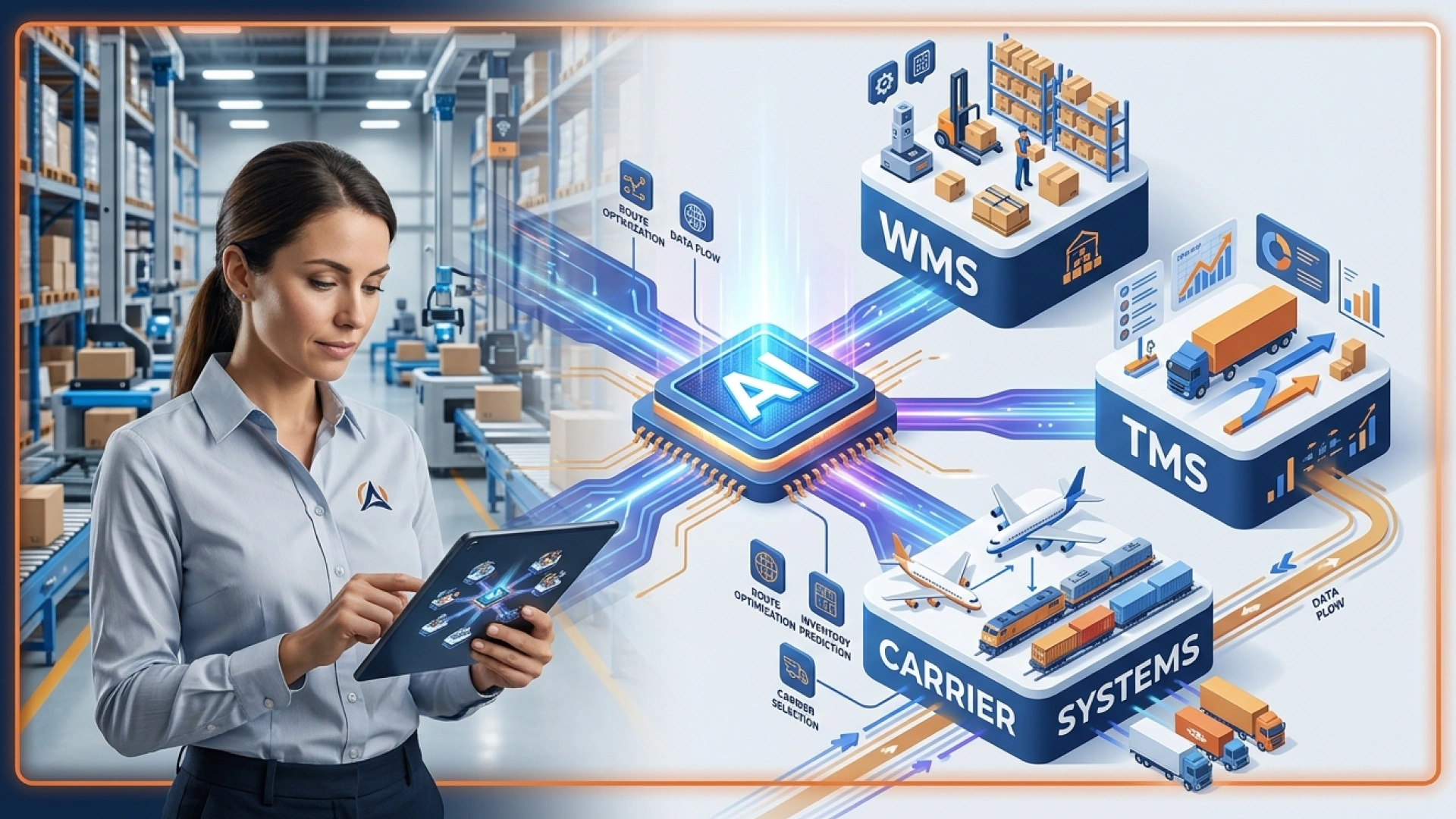
The gap is not model quality. In a mid-market logistics business running a WMS, a TMS and three to eight carrier relationships, the constraint is how AI reaches the data those systems already hold. That is an integration scoping question, and it has a specific, bounded answer.
Do you need to replace your WMS or TMS to use AI?
No. This is the single most expensive misunderstanding in logistics AI buying. A working AI system needs to read operational data on a reliable schedule. It does not need to live inside the WMS, write back to the TMS, or wait for a system upgrade.
Read-only access changes the entire risk profile of the project. IT approval is faster because nothing can corrupt a live system. Warehouse operations continue untouched because the AI consumes exports, not transactions. And the exit cost is near zero, because switching off a read-only feed breaks nothing.
AI Navi applies the same scoping method in logistics that it documents for CPG data work in How to Scope Data Engineering to One AI Use Case: identify the minimum data flows one use case requires, close those specific gaps, and ship. A £40M UK food brand recovered 60% of previously unchallenged deductions in eight weeks on exactly this basis, using data already sitting in existing systems, with no platform purchase and no restructure. The systems differ in logistics. The sequencing logic does not.
What data do WMS, TMS and carrier systems need to expose?
Less than most vendor discovery documents suggest. For the three highest-return logistics use cases, labour scheduling, route and load optimisation, and carrier selection, the required data maps as follows.
| System | Data AI actually needs | Typical access route | Watch for |
| WMS | Pick rates, labour hours by shift, order lines, inventory positions | Scheduled flat-file export or read-only API | Proprietary field names that need a one-off mapping exercise |
| TMS | Planned versus actual routes, cost per drop, load fill, delivery windows | Read-only API or nightly export | Inconsistent conventions across depots set up at different times |
| Carrier systems | POD timestamps, OTIF performance, surcharges, invoice lines | EDI feeds, portal exports, invoice files | Data arriving as PDFs and spreadsheets rather than structured feeds |
| ERP | Order-to-invoice records, customer and product masters | Existing BI or finance extract | Duplication with WMS data; pick one source of truth per field |
Two practical notes. First, carrier data trapped in PDFs and portal downloads is an extraction task, not a blocker; modern document extraction handles invoice and POD formats reliably and this is routine scope inside a delivery sprint. Second, none of this requires a data warehouse. It requires a pipeline per use case, which is a materially smaller commitment.
AI Navi Insight: what FlightCheck™ data shows about integration readiness
From the FlightCheck™ Files 24% is the average score on the Data Architecture dimension of the SCALE AI™ framework across UK mid-market businesses assessed, and Leadership averages 18%, the lowest of the five dimensions. That pairing is the finding. Businesses assume their integration problem is technical. The diagnostics consistently show two gaps moving together: data access that has never been mapped against a specific use case, and no named owner for what the AI output changes on the ground. The cost of leaving this unmeasured shows up in planning accuracy. Manual S&OP corrections cost approximately 12% forecasting accuracy across the mid-market businesses assessed. The corrections exist because planners do not trust system data; the distrust exists because nobody owns the pipeline. Integration readiness is an ownership question wearing a technical costume. |
How long does AI integration take for a UK logistics business?
For a bounded, single-use-case integration, the working standard is 90 days from scoping to production, with a working system visible well before that. The AI FlightPath™ Sprint runs this sequence and ships production AI inside ten weeks. The sequence matters more than the speed:
- Weeks 1 to 2, problem and data scoping. Pick one cost leak with a P&L line attached: cost per drop, agency labour hours, carrier surcharge recovery. Map only the data flows that use case requires, and name the operational owner of the output before any build starts.
- Weeks 3 to 4, read-only access. Stand up exports or API reads from the WMS, TMS and relevant carrier feeds. Validate a sample against what operations believes to be true; this step surfaces the depot-to-depot inconsistencies early, while they are cheap.
- Weeks 5 to 8, build against live data. Develop the model on real extracts, review outputs weekly with the named owner, and adjust to how the operation actually runs rather than how the process map says it runs.
- Weeks 9 to 12, production and handover. Move to scheduled runs, measure against the baseline set in week one, and hand the operating routine to the internal team. The team runs it after the engagement ends; the dependency stays with the business, not the provider.
This is the delivery pattern behind AI Navi’s work: the team’s delivery credits span DPD, Cargill and Swinkels Family Brewers, and the firm’s leadership carries senior operational backgrounds at Toyota and pladis Global, a $3B+ CPG business. The method is built for environments where the operation cannot stop while the technology arrives.
What are the most common AI integration mistakes in logistics?
Five patterns account for most stalled programmes AI Navi encounters in diagnostics:
- Building the data lake first. Estate-wide data programmes delay the first working output by two to three quarters and burn credibility with the board before anything ships. Scope the pipeline to one use case; sequence the architecture afterwards, informed by production.
- Requesting write access when read-only is enough. Write access triggers a heavier IT security review, extends sign-off by weeks and adds operational risk with no benefit to a first deployment.
- Integrating every depot at once. One site proves the mapping, the model and the operating routine. Rolling out a proven pattern across depots is fast; debugging eight depots simultaneously is not.
- Treating messy carrier data as a reason to wait. PDFs, portal exports and inconsistent EDI are the normal state of carrier data. Extraction is scoped work with a known cost, not a prerequisite for starting.
- No named owner for the output. If nobody owns what changes when the model flags a route, a shift plan or a surcharge, the output becomes a report. Reports do not move cost per drop. This is the Leadership gap the SCALE AI™ data keeps finding.
FAQ
Can AI work with a legacy WMS that has no API?
Yes. Scheduled flat-file exports are sufficient for most logistics use cases. If the WMS can produce a nightly CSV, it can feed an AI system. API access improves freshness but is not a precondition.
Does AI integration disrupt live warehouse or transport operations?
No, when scoped read-only. The AI consumes exports or read-only API calls, so nothing writes to the live system and daily operations continue unchanged throughout the build.
What if carrier data only arrives as PDFs and spreadsheets?
This is routine scope, not a blocker. Document extraction converts invoices, PODs and portal downloads into structured data as part of the pipeline build, and this is standard work inside a delivery sprint.
Do you need a data warehouse before integrating AI?
No. A bounded use case needs a pipeline for its own data flows only. Broader architecture is better sequenced after the first system is in production, informed by what production has revealed.
How much does AI integration cost for a mid-market logistics business?
Cost follows scope. The sensible first step is a fixed-scope diagnostic before any build commitment; AI Navi’s AI FlightCheck™ is comparable to market AI audits typically priced at $5,000 to $10,000 and completes in two to four weeks, sitting below most committee thresholds.
Who maintains the integration after deployment?
The internal team, by design. Handover of the operating routine is part of the delivery sequence. Where ongoing senior ownership is wanted, the AI FlightScale™ retainer provides embedded AI leadership on a rolling basis.
Next step
The AI FlightCheck™ answers the integration question for a specific business: a 15-page diagnostic across a business’s systems and data, a Flight Risk Index™ score, which is AI Navi’s measure of delivery risk across the dimensions that decide whether AI reaches production, and a 90-day action plan scoped to the data the business already generates. It completes in two to four weeks and is comparable to market audits typically priced at $5,000 to $10,000.
For a baseline reading in under ten minutes, the AI Readiness Scorecard at scores integration readiness before any conversation.