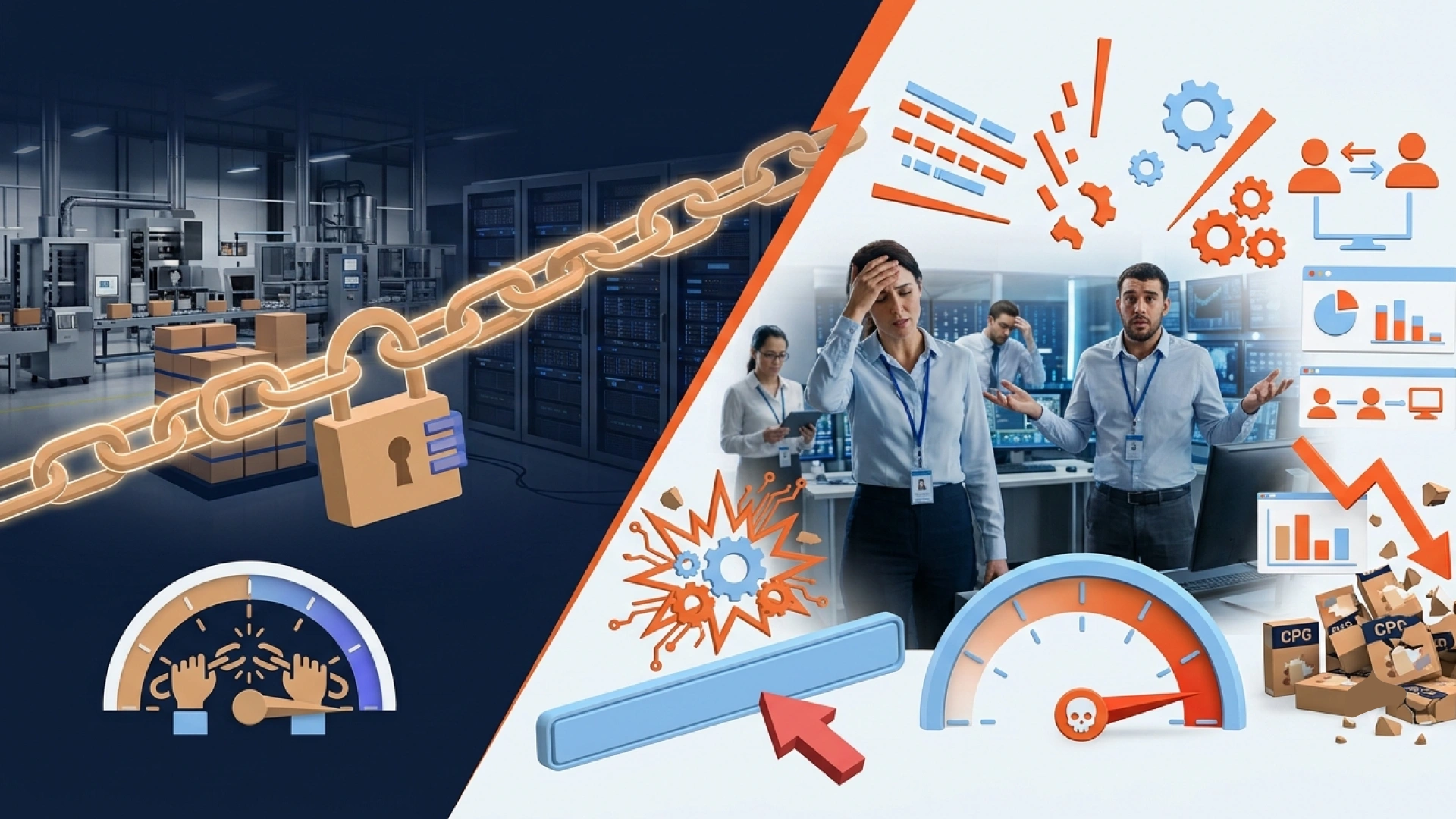
The Third Integration Failure in UK CPG AI Programmes
The third integration failure in UK CPG AI programmes is not technical. It is the moment operational teams are asked to run their S&OP, deduction, or forecasting workflow against an AI output they did not scope, do not trust, and cannot override. Human integration failure stalls more mid-market programmes than data silos and vendor lock-in combined.
Most stalled CPG AI programmes are diagnosed against the wrong list. When a pilot stops producing operational change, the instinct is to check the pipeline, check the vendor, and check the model. The technical integration failures are well documented across mid-market CPG and covered in detail elsewhere on this blog. What is less often examined is the third integration point every programme has to pass through: the connection between the AI output and the team of experienced operators who are supposed to act on it.
This article explains what human integration failure looks like inside a mid-market CPG business, why it stalls more programmes than the technical failures combined, and what the AI Navi team checks before any pilot is scoped.
What is human integration failure in a CPG AI programme?
Human integration failure is the point at which a technically working AI system stops producing operational change because the workflow it feeds into never adapted to consume the output.
The programme is running. The data flows. The model produces its recommendation. The dashboard populates. Adoption is measured by logins, and logins are on target.
Underneath that green status, a demand planner opens the tool, looks at the number, and submits the same figure into the S&OP cycle they would have submitted last year. A commercial finance analyst sees the AI-flagged deduction, notes that it does not match how she categorises claims, and closes it manually. A supply chain lead reads the routing recommendation, decides it does not account for a driver constraint the model was not given, and overrides it without logging the reason.
None of this is captured in the pilot review. The vendor is invoicing. The programme is not stalled on the RAG chart. And nothing is changing in the P&L.
This is human integration failure. It is quieter than a technical stall, it takes longer to surface, and by the time someone flags it, the pilot has been quietly reclassified as under review.
Why does CPG AI adoption collapse after go-live?
Three specific patterns account for most of the adoption collapses AI Navi has diagnosed inside mid-market CPG.
The operational team was not in the room during problem scoping. The commercial sponsor signed off. The vendor proposed. The data team validated. The people who have to live inside the output first saw it in a demo. When the model's recommendation contradicts their judgement in week three, they have no relationship with the problem it was built to solve. They fall back on the workflow they trust.
The recommendation was not placed inside a specific decision. "It lives on a dashboard" is not an integration. Which decision, at which point in the S&OP or trade spend or deduction cycle, does the output replace or inform? If nobody can answer at that level of specificity, the operational fit was not designed, and the recommendation floats above the workflow rather than inside it.
There is no escalation path when the output looks wrong. The first bad recommendation is inevitable. What determines adoption is what happens next. If the operator has a named model owner to escalate to, a documented feedback loop, and a way to override with the reason captured, trust is preserved. If the answer is "just do your best", every subsequent recommendation is inherited into a distrust bank that compounds silently.
These are not change management problems in the traditional sense of training and communications. They are integration problems. The AI output has to fit into the workflow the same way a new SKU fits into a range plan or a new promotion fits into a joint business plan. Someone has to design the fit before the go-live date.
How is human integration different from the technical two integration failures?
Data silos and vendor lock-in are covered in detail on the AI Navi blog. Both are solvable with a defined sequence of technical and contractual decisions.
Human integration behaves differently. It fails in three ways the technical failures do not.
It fails silently. A broken data pipeline surfaces in a matter of hours. An unfavourable vendor contract surfaces in the first exit conversation. A human integration failure does not surface until the operational team has quietly stopped using the output, which can take three to five months.
It compounds asymmetrically. A single bad AI recommendation, delivered without an escalation path, teaches an experienced operator a lesson that takes months to unlearn. A team that trusts the output will forgive one bad recommendation. A team that was handed the output on go-live day will not.
It is not recoverable with a technical fix. Once an operational team has decided the AI output does not survive contact with their reality, retraining the model does not rebuild trust. The rebuild is a relational and workflow-design problem, and it is significantly more expensive to do after the fact than to design in from week one.
This is why human integration deserves the same seat as the technical two in any pre-pilot diagnostic, not a workstream added later.
What questions should CPG operators ask before an AI pilot go-live?
Three questions the AI Navi team runs with every commercial sponsor before the technical build is scoped.
One. Who on the operational team has been in the room since the problem was defined? If the answer is nobody until after the model is trained, adoption will collapse. The team that has to live inside the output has to define what good looks like.
Two. Where does the AI recommendation live inside the existing workflow? Not on a dashboard or in a weekly email. Which decision, at which point in the cycle, does it replace or inform? The answer needs to be specific enough that the operator can describe it in one sentence.
Three. What happens when the output looks wrong? A named escalation path, a documented override mechanism, a feedback loop that reaches the model owner within a defined window. If any of these is vague, the adoption risk is already priced in.
If a commercial sponsor cannot answer all three cleanly, the human integration risk is materially higher than the technical risk, and the sequence needs to change.
AI Navi Insight: what the SCALE AI benchmarks show about human integration
Across the CPG programmes AI Navi has assessed using the SCALE AI methodology, the Leadership dimension scores lowest at an 18% benchmark. The Data Architecture dimension sits at 24%.
Data Architecture is the failure mode most commonly named. Leadership is the failure mode most commonly ignored. Both need attention. Only one is usually being addressed.
The Leadership dimension measures whether there is a named owner for the AI output inside the operational function, whether decision rights have been transferred alongside the technical build, and whether the escalation path from operator to model owner is documented and used. An 18% benchmark score means that in the majority of CPG programmes AI Navi has diagnosed, none of these conditions is fully in place at pilot go-live.
External research supports the pattern. ILX Group's 2026 study of 600 UK IT and project leaders found that 46% of businesses still treat change management as optional in AI programmes. Inside mid-market CPG that is rarely a recoverable position.
The technology is not the constraint. Ownership of the human integration is.
How does the Flight Risk Index measure human integration?
The Flight Risk Index is AI Navi's diagnostic scoring framework for AI programme delivery. It assesses a programme across the six dimensions that predict whether a project will reach production, rather than whether it will produce an impressive pilot.
For the human integration dimension specifically, the Flight Risk Index evaluates:
- Whether the operational team that will use the AI output has been involved in scoping the problem
- Whether there is a named internal owner authorised to make workflow decisions without escalation
- Whether decision rights have been formally transferred from the pilot team to the operational function by go-live
- Whether the team has prior experience with AI or data-driven decision tools and, if so, what the trust baseline is
- Whether there is a documented escalation path for when the output contradicts operator judgement
- Whether the operational team's KPIs have been re-scoped to reflect the new decision structure
Programmes that score highest on human integration risk consistently show the same pattern: strong technical delivery, weak commercial sponsorship of the workflow change, and no named owner inside the function that has to consume the output. The technology ships. The business does not change.
What does a de-risked CPG AI adoption sequence look like?
The fix is not more training. It is a sequenced rebuild of the integration between the output and the workflow, and it needs to happen in five specific steps.
Bound the problem to one operational decision. Not "improve demand forecasting". Which specific weekly decision, in which specific S&OP cycle, does the AI output need to change? Deduction recovery before demand forecasting. Single retailer before full customer base. One decision before five.
Involve the operational team in problem framing from week one. The team that has to use the output has to define what good looks like, what confidence they need to see, and what an unacceptable exception looks like. This is not a workshop bolted on at the end. It is week one of the build.
Design the workflow change and the technical build in parallel. The workflow change is not a change management workstream. It is a design deliverable, with named owners, decision rights, and an escalation path documented before go-live.
Ship confidence intervals, not point estimates. Experienced operators do not trust a single number from a system they did not build. They will trust a range with a stated confidence level, because it matches how they already think.
Measure adoption as decisions changed, not logins. The metric that matters is whether the operational team let the AI output change what they submitted into the process. If they did not, the programme is running but the business is not using it.
This is the sequence behind the AI FlightPath Sprint from AI Navi. Ten weeks, fixed scope, first working AI in production, with the human integration designed in from week one rather than retrofitted.
Where should CPG operators start if their AI programme has already stalled?
If the pilot is already live and adoption feels uncertain, the instinct to switch platform or bolt on another change management workstream is usually wrong. The starting point is a diagnostic, not another vendor conversation.
The AI FlightCheck from AI Navi is a two to four week assessment that produces a fifteen-page diagnostic, a Flight Risk Index score across all six dimensions, and a ninety-day action plan tied to the specific systems, workflows, and ownership gaps in the programme. It is a straight read of where the risk sits and what needs to happen next. No platform recommendation. No procurement upsell.
Most stalled CPG AI programmes have a technical layer that works and a human integration layer that does not. Diagnosing which layer is the constraint before spending another quarter on the wrong fix is where the assessment pays back.
Frequently asked questions
What is human integration failure in AI?
Human integration failure is when a technically functioning AI system stops producing operational change because the workflow it feeds into never adapted to consume the output. The programme runs, the data flows, and the model recommends, but the operational team continues to make decisions the way they always have. It is the most common cause of stalled AI adoption in UK mid-market CPG.
Why does CPG AI adoption collapse after launch?
Three patterns account for most collapses: the operational team was not in the room during problem scoping, the recommendation was not placed inside a specific decision in the existing workflow, and there is no named escalation path when the output looks wrong. Any one of these is enough to stall adoption inside six weeks of go-live.
How is change management measured in the Flight Risk Index?
The Flight Risk Index evaluates human integration across six specific signals: operational team involvement in scoping, named internal ownership of the output, formal decision rights transfer at go-live, prior team experience with AI, a documented escalation path, and re-scoped KPIs that reflect the new decision structure. A programme that scores well on the technical dimensions but poorly on these six is at high stall risk.
What percentage of AI programmes fail because of adoption issues?
ILX Group research from 2026 indicates 46% of UK businesses treat change management as optional in AI programmes. Across the CPG programmes AI Navi has assessed using the SCALE AI methodology, the Leadership dimension scores lowest at an 18% benchmark. McKinsey's Consumer Goods Forum insight through 2026 has also confirmed that the businesses pulling ahead in CPG AI are redesigning workflows, not adding pilots. Adoption-related failure is the majority pattern, not the exception.
How long does it take to fix a human integration failure?
Fixing a stalled human integration typically takes sixty to ninety days when the workflow, decision rights, and escalation path can be redesigned around the existing technical build. Designing it in from week one is significantly cheaper than retrofitting, which is why the AI Navi delivery sequence treats human integration as a week-one design task, not a go-live workstream.
Is human integration a data problem or a change management problem?
Neither and both. It is an integration problem, in the same category as connecting an ERP to a demand planning tool. The connection is between the AI output and the operational workflow that has to consume it, and it needs to be designed with the same discipline as any other integration point.
What is the difference between an AI FlightCheck and a change management assessment?
A change management assessment usually focuses on communications, training, and stakeholder engagement. An AI FlightCheck diagnoses the specific integration points that predict whether an AI programme will reach production, including data, vendor, and human integration risk. The FlightCheck output is a Flight Risk Index score across six dimensions, a fifteen-page diagnostic, and a ninety-day action plan. It is designed to precede platform decisions, not follow them.
The three integration failures in UK CPG AI look, on the surface, like they belong in different categories. Data silos are a plumbing problem. Vendor lock-in is a contract problem. Human integration is a trust problem.
The plumbing and the contracts are covered exhaustively across the AI Navi blog and elsewhere in the market. The trust problem is the one most CPG programmes still ignore until the pilot review, and it is the one that decides whether the AI ever earns its place inside the business.
Design it in from week one and the programme ships. Retrofit it after the build, and the P&L stays flat while the dashboard turns green.
If your AI programme has stalled and you want a straight read of where the risk sits, an AI FlightCheck is where to start.