Why Demand Forecasting AI Stalls in Month Four for UK CPG Businesses (2026)
AI NAVI INSIGHT Demand forecasting AI programmes in UK mid-market CPG and food businesses stall at a predictable point: month four. The root cause is not the data, the model, or the vendor. It is an ownership gap: no named person with the authority to own the AI output, resolve conflicts with planner judgement, and keep the system embedded in the S&OP operating rhythm. The technology is rarely the constraint. The organisation almost always is. |
The pattern plays out consistently across UK food, drink, and CPG businesses. The model goes live. The dashboard shows green. By month four, the planning team has quietly returned to their own judgement, and the AI output has become a formality rather than a decision input. This piece sets out why that happens, how to diagnose it before it compounds, and the ownership transfer structure that prevents it.
Why Does Demand Forecasting AI Fail in Month Four and Not at Go-Live?
Most CPG and food businesses measure AI programme risk at the wrong moment. The real test is not the go-live demo. It is the point in month three when the model produces a number the planning team does not trust and there is no process, no decision right, and no named person to resolve that tension. That is when override rates begin to climb without anyone tracking them. That is when the AI output gets relabelled a "reference point" in the weekly S&OP pack. By month four, the model is running and the business is not using it.
Manual S&OP corrections cost UK mid-market CPG businesses an average of 12% in forecasting accuracy. That figure does not appear as a single line item on the P&L. It surfaces across case fill rate variances, excess inventory write-offs, expedited freight costs, and retailer deductions for short shipments. The AI programme was built to close that gap. The ownership gap reopens it.
What Is the Month-by-Month Collapse Pattern in Demand Forecasting AI?
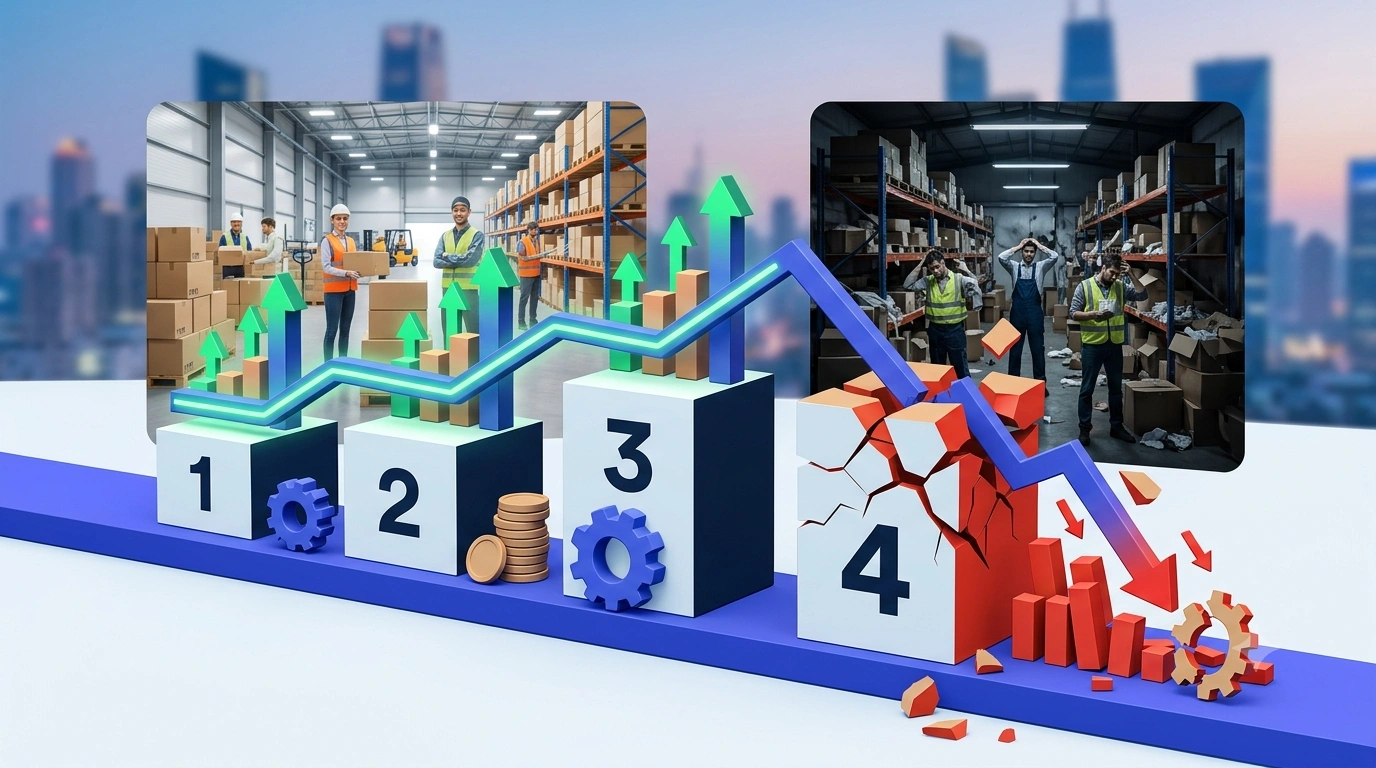
AI Navi has observed the same collapse sequence across CPG and food businesses ranging from £40M to £400M in annual revenue. Scale does not protect against it. The sequence unfolds in four stages.
Month one: The pilot launches. The vendor or internal team demonstrates the model output. Energy is high and a slide appears in the board pack. No one has yet asked who owns the output when the model gets it wrong.
Month two: The first discrepancies appear. A promotional uplift is missed. A new product launch creates a gap in the training data. The planning team flags the issue to the project lead, who logs it as a data problem and passes it to the data team.
Month three: Workarounds begin. A senior planner adjusts the output before it feeds into S&OP. Nobody formally decides this is the process. It becomes the process. The override rate climbs without anyone reviewing it.
Month four: The model is still running. The dashboard still shows green. But the decisions being made in the business are no longer shaped by the AI output. The programme has stalled, and no one has called it.
AI Navi has observed this play out in businesses ranging from £40M to £400M in revenue. Scale does not protect against it. The collapse is organisational, and it almost always begins in the first thirty days, not the fourth month.
AI NAVI INSIGHT From the SCALE AI Benchmarks Across SCALE AI assessments run in UK mid-market CPG and food businesses, the Leadership dimension scores an average of 18% — the lowest of the five framework dimensions. This dimension measures whether senior executives own AI outcomes operationally, not just on paper. A low Leadership score at programme start is one of the most reliable early indicators of a month-four stall in demand forecasting AI. The average AI confidence score across the UK mid-market CPG leaders AI Navi has assessed stands at 4.1 out of 10, reflecting how far ownership and accountability structures lag behind the technology being deployed. |
What Is the Real Root Cause of Demand Forecasting AI Failure?
The root cause is an ownership gap: no named person with the authority to make decisions about AI output in the operational rhythm of the business.
Most CPG AI programmes are built for a planning team rather than with one. The team is consulted, briefed, and trained. But the question that determines whether the system survives beyond month four is rarely answered before go-live: who owns the AI output, not the tool and not the model, but the actual number that goes into S&OP? And what happens when they disagree with it?
In one mid-market UK food business AI Navi assessed, the demand forecasting model was technically functioning. Outputs were visible in the planning system. No objections had been formally raised. But in the weekly S&OP meeting, the AI forecast was presented alongside a manually adjusted version described as a "commercial overlay." The overlay was consistently larger than the AI output. Within three months, the original model output had become a formality: generated, displayed, and replaced.
When asked who owned the decision to apply the overlay, the room went quiet. No one did. The overlay had evolved organically, driven by a legitimate discomfort with outputs the team could not explain under commercial pressure. Without the capability to interpret model outputs and the authority to act on them, the safest option for every individual in that meeting was to default to personal judgement and call it a commercial overlay.
This is not a data problem. This is not a model problem. This is an ownership problem. For the technical failure modes that precede it, see AI Navi's guide to the four demand forecasting failure patterns in UK food and drink brands.
How Do You Run Ownership Transfer During a 90-Day Demand Forecasting Pilot?
AI Navi applies a structured ownership transfer model inside every 90-day engagement. The distinction between consultant-style and operator-style change management determines whether the programme survives into production.
Consultant-style change management produces: communication plans, stakeholder matrices, training decks, and a readiness assessment in week eight. These are not without value. But they do not keep a planning team using a demand forecasting model when it produces an output they do not trust under commercial pressure.
Operator-style change management produces: named decision rights from day one, a person who owns the output rather than the tool, a defined process for resolving conflicts between AI recommendation and human judgement, and weekly friction reviews that surface resistance before it becomes disengagement. Good change management in this context is explored in depth in AI Navi's guide to what the adoption cost actually looks like in UK FMCG AI programmes.
The 30-60-90 Ownership Transfer Model
| Phase | Primary Goal | What This Means in Practice |
|---|---|---|
| Days 1–30 | Prove it works on a bounded problem | Run the AI alongside the existing process, not instead of it. Let the team see the output before it has consequences. The goal is familiarity, not dependency. |
| Days 31–60 | Transfer decision confidence | Introduce the first moments where the AI output shapes a real S&OP decision. Make the resolution process explicit: who decides when the model and the planner disagree? What gets logged when they do? |
| Days 61–90 | Institutionalise ownership | The team lead owns the output review. The delivery team steps back. Friction points are logged and resolved weekly. The AI is part of the operating rhythm, not a separate project with its own dashboard. |
The critical window is days 31 to 60. The initial energy has passed, the operational complexity has surfaced, and the project lead is typically focused on the technical deliverable rather than the organisational moment.
AI Navi schedules a named meeting in week five of every demand forecasting engagement: a decision rights session. Not a project update. The question on the agenda is: when the model produces a number the commercial team disagrees with, what happens? Who has the authority to override, and what gets logged when they do? If that question has no answer in week five, the conditions for a month-four stall are already in place. Research from Deloitte on supply chain transformation underscores the same finding: operational adoption, not model accuracy, is the rate-limiting factor in AI-driven planning programmes.
How Do You Diagnose an Ownership Gap Before Month Four?
AI Navi uses the following six questions in the first two weeks of any demand forecasting engagement. Fewer than four confident answers indicates an ownership gap. The technology may be sound. The deployment is fragile.
- Can you name the person who owns the AI output: not the project, not the tool, the output?
- Is there a documented process for resolving conflicts between AI recommendation and human judgement?
- Does the senior sponsor attend operational reviews, or only steering committee meetings?
- Do the people using the system daily understand, at a headline level, why it produces the outputs it does?
- Has anyone been held accountable for a decision that was informed by the AI output?
- Is the override rate being tracked, and does anyone review it?
AI Navi measures ownership structure formally through the Flight Risk Index, a proprietary six-dimension assessment of AI delivery risk. A £400M CPG client scored 7.2 out of 10 on that index when the engagement began, indicating high delivery risk. The primary drivers were undefined decision rights and a data architecture that had not been validated for AI use. Sixty days after a focused data pipeline project combined with structured ownership transfer work, the index stood at 4.1. The technical work and the organisational work ran in parallel. Neither would have moved the index alone. McKinsey's State of AI research corroborates the pattern: organisations that appoint a named owner for AI outputs are measurably more likely to sustain deployment beyond the pilot phase.
For a full assessment of where your programme currently stands, the AI Readiness Scorecard provides a baseline across the six SCALE AI dimensions in under fifteen minutes.
What Should You Do If Your Demand Forecasting AI Is Heading Into Month Three?
Do not commission another review. Do not bring in another vendor. Do one thing: get a senior operator into the room who has seen this pattern before and can name what is actually happening.
The businesses that recover stalled demand forecasting AI programmes fastest are those that identify the organisational problem for what it is, an ownership gap rather than a data gap, and address it directly. That means naming the person who owns the output, building the decision rights process, and running the friction reviews that surface resistance before it compounds into a full stall.
For businesses at any stage of a demand forecasting AI programme, the AI FlightCheck is a fixed-scope two-to-four week diagnostic that delivers a 15-page assessment, a Flight Risk Index score, and a 90-day action plan. It is comparable to AI readiness audits priced at $5,000 to $10,000 in the market, and it positions a business for a structured second phase rather than a restart.
The food businesses that got demand forecasting AI into production and kept it there treated the organisational work as the primary challenge, not the secondary one. The technology followed. If the override rate is climbing as you enter month three, that is the signal. It will not resolve itself in month four.
Get an honest read on your AI programme The AI FlightCheck delivers a 15-page diagnostic, your Flight Risk Index score, and a 90-day action plan. Fixed scope. Fixed timeline. ainavi.co.uk/ai-diagnostic-check |
Frequently Asked Questions: Demand Forecasting AI Failure in UK CPG
What is the most common reason demand forecasting AI fails in UK food and drink businesses?
The most common cause is an ownership gap: no named person with authority to own the AI output operationally. The model is built for the planning team rather than with them, so when the AI produces a number that conflicts with commercial judgement, there is no process to resolve it and no accountability for the outcome. The programme stalls through accumulating overrides rather than a single point of failure.
When does demand forecasting AI typically fail: at go-live or after?
Demand forecasting AI rarely fails at go-live. The risk window is months two to four, when initial programme energy has passed and the first operational conflicts between AI output and human judgement begin. If decision rights are not defined in this window, override rates climb and the AI output is gradually displaced by manual adjustments described as commercial overlays.
What is the Flight Risk Index in the context of demand forecasting AI?
The Flight Risk Index is AI Navi's proprietary measure of AI delivery risk across six dimensions, including data readiness, ownership structure, and leadership engagement. For demand forecasting programmes, a score above 6 out of 10 indicates high stall risk. A £400M CPG client moved from 7.2 to 4.1 in 60 days through combined data pipeline and ownership transfer work.
How long does it take to recover a stalled demand forecasting AI programme?
AI Navi's experience across UK mid-market CPG businesses is that structured ownership transfer work takes six to eight weeks when it runs alongside technical delivery from the outset. Recovery from a month-four stall typically takes eight to twelve weeks, as override habits are harder to reverse than prevent. A defined decision rights process installed before week five of a pilot prevents the stall from forming.
What does an AI FlightCheck diagnose in a demand forecasting programme?
The AI FlightCheck assesses a demand forecasting AI programme across technical, data, and organisational dimensions. It produces a 15-page diagnostic, a Flight Risk Index score, and a 90-day action plan. For programmes heading into month three, it identifies ownership and process gaps before they produce a month-four stall and provides a clear next phase rather than a restart.
Is the failure of demand forecasting AI a data problem or a people problem?
In most UK mid-market CPG businesses, it is an organisational problem first. Data quality matters, and the four technical failure modes in demand forecasting are well documented. But the specific pattern of programmes that function technically and still stall in the business is almost always driven by undefined decision rights and absent senior ownership, not data quality alone.